

414
A. P. Ingle et al.
some grown pathogens or gases released by the food in conditions of spoiling, in
order to warn the consumer of its environments (Kuswandi 2016). The smart food
packaging system comprises monitoring, being remarkable in industry food due to
possibility to overhaul itself and/or inform the final user of contaminations and some
undesirable microorganisms presence, being able to reveal microbial pathogens in
food products in 2–7 days as well as for detection of toxin, pesticide, and spoilage
(Pal 2017). While active package protects the foods, the aim of smart food packaging system is the communication among manufacturer, retailer, and final consumer,
showing the feasibility to track and inform the inside and outside conditions of the
package, by indicators, e.g., time-temperature, microorganism spoilage sensor, physical shock, leakage sensor, allergen sensor, oxygen, humidity, and others (Kuswandi
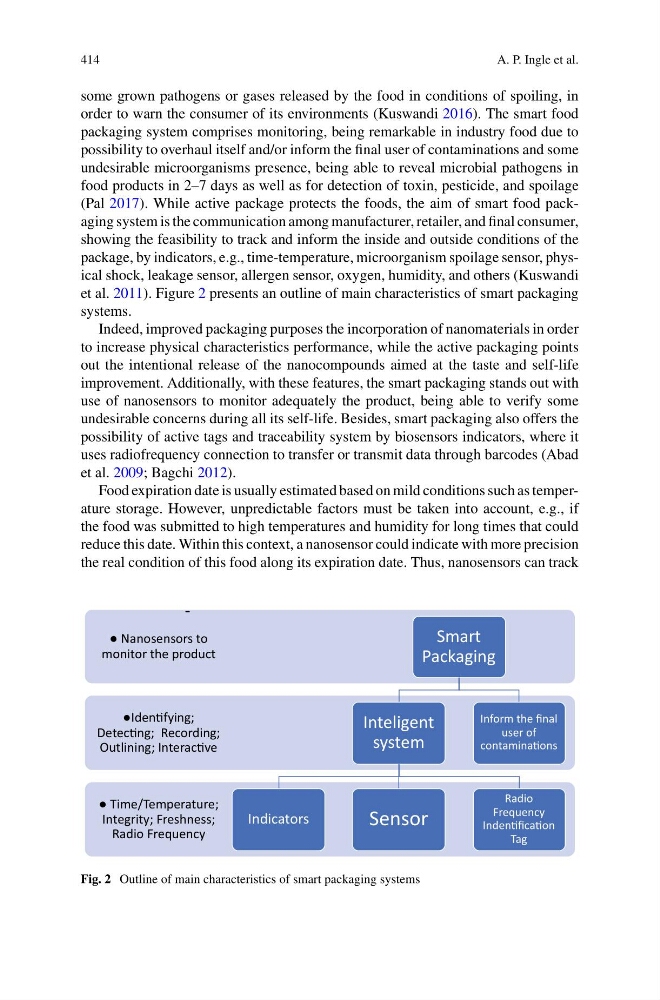
et al. 2011). Figure 2 presents an outline of main characteristics of smart packaging
systems.
Indeed, improved packaging purposes the incorporation of nanomaterials in order
to increase physical characteristics performance, while the active packaging points
out the intentional release of the nanocompounds aimed at the taste and self-life
improvement. Additionally, with these features, the smart packaging stands out with
use of nanosensors to monitor adequately the product, being able to verify some
undesirable concerns during all its self-life. Besides, smart packaging also offers the
possibility of active tags and traceability system by biosensors indicators, where it
uses radiofrequency connection to transfer or transmit data through barcodes (Abad
et al. 2009; Bagchi 2012).
Food expiration date is usually estimated based on mild conditions such as temperature storage. However, unpredictable factors must be taken into account, e.g., if
the food was submitted to high temperatures and humidity for long times that could
reduce this date. Within this context, a nanosensor could indicate with more precision
the real condition of this food along its expiration date. Thus, nanosensors can track
● Time/Temperature;
Integrity; Freshness;
Radio Frequency
●IdenƟfying;
DetecƟng; Recording;
Outlining; InteracƟve
● Nanosensors to
monitor the product
Smart
Packaging
Inteligent
system
Indicators
Sensor
Radio
Frequency
IndenƟficaƟon
Tag
Inform the final
user of
contaminaƟons
-
Fig. 2 Outline of main characteristics of smart packaging systems
A. P. Ingle et al.
some grown pathogens or gases released by the food in conditions of spoiling, in
order to warn the consumer of its environments (Kuswandi 2016). The smart food
packaging system comprises monitoring, being remarkable in industry food due to
possibility to overhaul itself and/or inform the final user of contaminations and some
undesirable microorganisms presence, being able to reveal microbial pathogens in
food products in 2–7 days as well as for detection of toxin, pesticide, and spoilage
(Pal 2017). While active package protects the foods, the aim of smart food packaging system is the communication among manufacturer, retailer, and final consumer,
showing the feasibility to track and inform the inside and outside conditions of the
package, by indicators, e.g., time-temperature, microorganism spoilage sensor, physical shock, leakage sensor, allergen sensor, oxygen, humidity, and others (Kuswandi
et al. 2011). Figure 2 presents an outline of main characteristics of smart packaging
systems.
Indeed, improved packaging purposes the incorporation of nanomaterials in order
to increase physical characteristics performance, while the active packaging points
out the intentional release of the nanocompounds aimed at the taste and self-life
improvement. Additionally, with these features, the smart packaging stands out with
use of nanosensors to monitor adequately the product, being able to verify some
undesirable concerns during all its self-life. Besides, smart packaging also offers the
possibility of active tags and traceability system by biosensors indicators, where it
uses radiofrequency connection to transfer or transmit data through barcodes (Abad
et al. 2009; Bagchi 2012).
Food expiration date is usually estimated based on mild conditions such as temperature storage. However, unpredictable factors must be taken into account, e.g., if
the food was submitted to high temperatures and humidity for long times that could
reduce this date. Within this context, a nanosensor could indicate with more precision
the real condition of this food along its expiration date. Thus, nanosensors can track
● Time/Temperature;
Integrity; Freshness;
Radio Frequency
●IdenƟfying;
DetecƟng; Recording;
Outlining; InteracƟve
● Nanosensors to
monitor the product
Smart
Packaging
Inteligent
system
Indicators
Sensor
Radio
Frequency
IndenƟficaƟon
Tag
Inform the final
user of
contaminaƟons
-
Fig. 2 Outline of main characteristics of smart packaging systems