

28
T. B. Asafa et al.
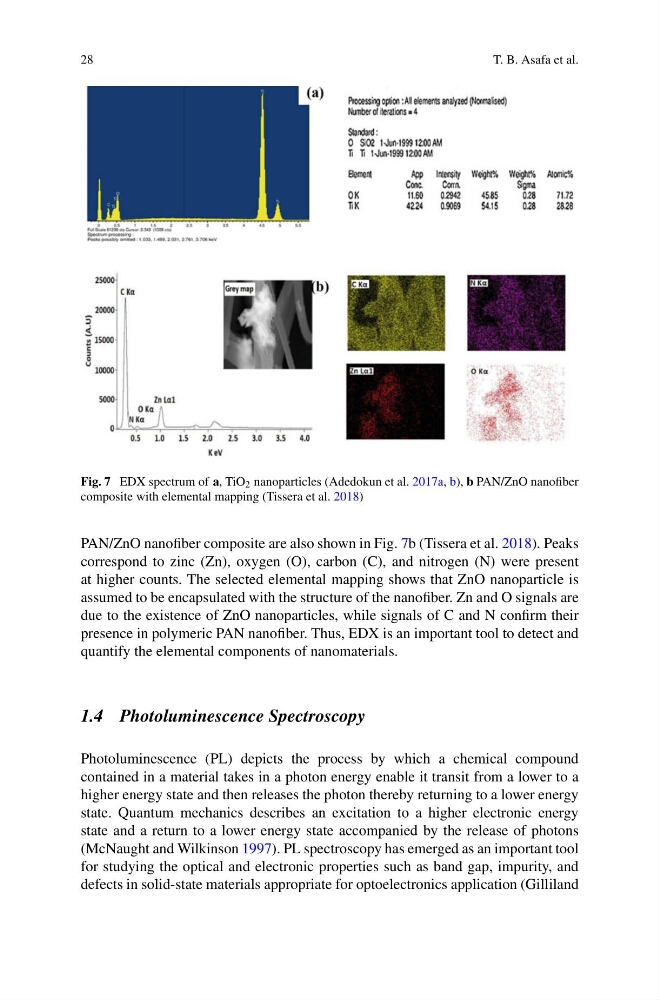
Fig. 7 EDX spectrum of a, TiO 2 nanoparticles (Adedokun et al. 2017a, b), b PAN/ZnO nanofiber
composite with elemental mapping (Tissera et al. 2018)
PAN/ZnO nanofiber composite are also shown in Fig. 7b (Tissera et al. 2018). Peaks
correspond to zinc (Zn), oxygen (O), carbon (C), and nitrogen (N) were present
at higher counts. The selected elemental mapping shows that ZnO nanoparticle is
assumed to be encapsulated with the structure of the nanofiber. Zn and O signals are
due to the existence of ZnO nanoparticles, while signals of C and N confirm their
presence in polymeric PAN nanofiber. Thus, EDX is an important tool to detect and
quantify the elemental components of nanomaterials.
1.4 Photoluminescence Spectroscopy
Photoluminescence (PL) depicts the process by which a chemical compound
contained in a material takes in a photon energy enable it transit from a lower to a
higher energy state and then releases the photon thereby returning to a lower energy
state. Quantum mechanics describes an excitation to a higher electronic energy
state and a return to a lower energy state accompanied by the release of photons
(McNaught and Wilkinson 1997). PL spectroscopy has emerged as an important tool
for studying the optical and electronic properties such as band gap, impurity, and
defects in solid-state materials appropriate for optoelectronics application (Gilliland
T. B. Asafa et al.
Fig. 7 EDX spectrum of a, TiO 2 nanoparticles (Adedokun et al. 2017a, b), b PAN/ZnO nanofiber
composite with elemental mapping (Tissera et al. 2018)
PAN/ZnO nanofiber composite are also shown in Fig. 7b (Tissera et al. 2018). Peaks
correspond to zinc (Zn), oxygen (O), carbon (C), and nitrogen (N) were present
at higher counts. The selected elemental mapping shows that ZnO nanoparticle is
assumed to be encapsulated with the structure of the nanofiber. Zn and O signals are
due to the existence of ZnO nanoparticles, while signals of C and N confirm their
presence in polymeric PAN nanofiber. Thus, EDX is an important tool to detect and
quantify the elemental components of nanomaterials.
1.4 Photoluminescence Spectroscopy
Photoluminescence (PL) depicts the process by which a chemical compound
contained in a material takes in a photon energy enable it transit from a lower to a
higher energy state and then releases the photon thereby returning to a lower energy
state. Quantum mechanics describes an excitation to a higher electronic energy
state and a return to a lower energy state accompanied by the release of photons
(McNaught and Wilkinson 1997). PL spectroscopy has emerged as an important tool
for studying the optical and electronic properties such as band gap, impurity, and
defects in solid-state materials appropriate for optoelectronics application (Gilliland