

Microbial-Mediated Nanoparticles for Sustainable Environment …
303
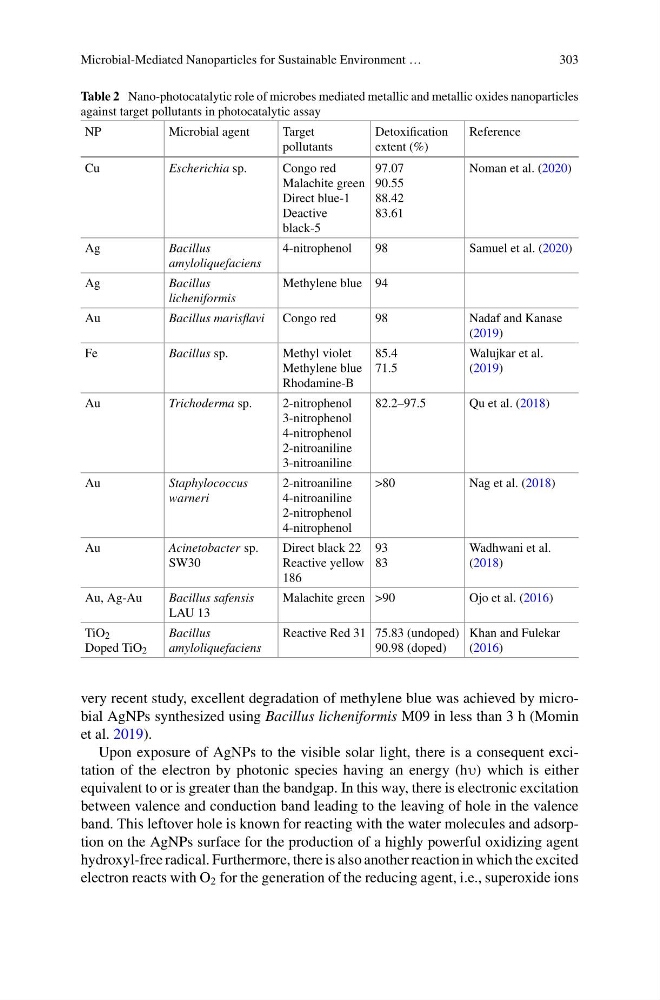
Table 2 Nano-photocatalytic role of microbes mediated metallic and metallic oxides nanoparticles
against target pollutants in photocatalytic assay
NP
Microbial agent
Target
pollutants
Detoxification
extent (%)
Reference
Cu
Escherichia sp.
Congo red
Malachite green
Direct blue-1
Deactive
black-5
97.07
90.55
88.42
83.61
Noman et al. (2020)
Ag
Bacillus
amyloliquefaciens
4-nitrophenol
98
Samuel et al. (2020)
Ag
Bacillus
licheniformis
Methylene blue 94
Au
Bacillus marisflavi Congo red
98
Nadaf and Kanase
(2019)
Fe
Bacillus sp.
Methyl violet
Methylene blue
Rhodamine-B
85.4
71.5
Walujkar et al.
(2019)
Au
Trichoderma sp.
2-nitrophenol
3-nitrophenol
4-nitrophenol
2-nitroaniline
3-nitroaniline
82.2–97.5
Qu et al. (2018)
Au
Staphylococcus
warneri
2-nitroaniline
4-nitroaniline
2-nitrophenol
4-nitrophenol
>80
Nag et al. (2018)
Au
Acinetobacter sp.
SW30
Direct black 22
Reactive yellow
186
93
83
Wadhwani et al.
(2018)
Au, Ag-Au
Bacillus safensis
LAU 13
Malachite green >90
Ojo et al. (2016)
TiO 2
Doped TiO 2
Bacillus
amyloliquefaciens
Reactive Red 31 75.83 (undoped)
90.98 (doped)
Khan and Fulekar
(2016)
very recent study, excellent degradation of methylene blue was achieved by microbial AgNPs synthesized using Bacillus licheniformis M09 in less than 3 h (Momin
et al. 2019).
Upon exposure of AgNPs to the visible solar light, there is a consequent excitation of the electron by photonic species having an energy (hυ) which is either
equivalent to or is greater than the bandgap. In this way, there is electronic excitation
between valence and conduction band leading to the leaving of hole in the valence
band. This leftover hole is known for reacting with the water molecules and adsorption on the AgNPs surface for the production of a highly powerful oxidizing agent
hydroxyl-free radical. Furthermore, there is also another reaction in which the excited
electron reacts with O 2 for the generation of the reducing agent, i.e., superoxide ions
303
Table 2 Nano-photocatalytic role of microbes mediated metallic and metallic oxides nanoparticles
against target pollutants in photocatalytic assay
NP
Microbial agent
Target
pollutants
Detoxification
extent (%)
Reference
Cu
Escherichia sp.
Congo red
Malachite green
Direct blue-1
Deactive
black-5
97.07
90.55
88.42
83.61
Noman et al. (2020)
Ag
Bacillus
amyloliquefaciens
4-nitrophenol
98
Samuel et al. (2020)
Ag
Bacillus
licheniformis
Methylene blue 94
Au
Bacillus marisflavi Congo red
98
Nadaf and Kanase
(2019)
Fe
Bacillus sp.
Methyl violet
Methylene blue
Rhodamine-B
85.4
71.5
Walujkar et al.
(2019)
Au
Trichoderma sp.
2-nitrophenol
3-nitrophenol
4-nitrophenol
2-nitroaniline
3-nitroaniline
82.2–97.5
Qu et al. (2018)
Au
Staphylococcus
warneri
2-nitroaniline
4-nitroaniline
2-nitrophenol
4-nitrophenol
>80
Nag et al. (2018)
Au
Acinetobacter sp.
SW30
Direct black 22
Reactive yellow
186
93
83
Wadhwani et al.
(2018)
Au, Ag-Au
Bacillus safensis
LAU 13
Malachite green >90
Ojo et al. (2016)
TiO 2
Doped TiO 2
Bacillus
amyloliquefaciens
Reactive Red 31 75.83 (undoped)
90.98 (doped)
Khan and Fulekar
(2016)
very recent study, excellent degradation of methylene blue was achieved by microbial AgNPs synthesized using Bacillus licheniformis M09 in less than 3 h (Momin
et al. 2019).
Upon exposure of AgNPs to the visible solar light, there is a consequent excitation of the electron by photonic species having an energy (hυ) which is either
equivalent to or is greater than the bandgap. In this way, there is electronic excitation
between valence and conduction band leading to the leaving of hole in the valence
band. This leftover hole is known for reacting with the water molecules and adsorption on the AgNPs surface for the production of a highly powerful oxidizing agent
hydroxyl-free radical. Furthermore, there is also another reaction in which the excited
electron reacts with O 2 for the generation of the reducing agent, i.e., superoxide ions