

93
proton conductivity without water, and lithium ion conductivity was also observed.
We will use terminology inspired from that introduced by Kitagawa, who stated
MOFs can be used in three general ways: (1) the MOF itself may be ionically conductive, (2) PSM of the MOF to incorporate new functionalities may be used to
introduce ion conductive groups, and (3) MOFs may be used as stabilizing platforms to organize and stabilize a dielectric guest in the solid state [25].
The studies of lithium ion batteries and proton conducting electrolytes for fuel
cells are the two biggest applications of polymeric electrolytes. Research and development of organic polymer/ nanoparticle composites continues at a steady rate for
proton conduction, as seen in Fig. 4. However, as control and synthetic capabilities
of MOFs become more advanced, they entered the scene, rapidly increasing after
2009. Lithium ion conductivity studies facilitated with solid polymeric electrolytes
is also well under way, and the reports continue to grow. Lithium ion conducting
MOF reports are increasing exponentially, starting in 2012.
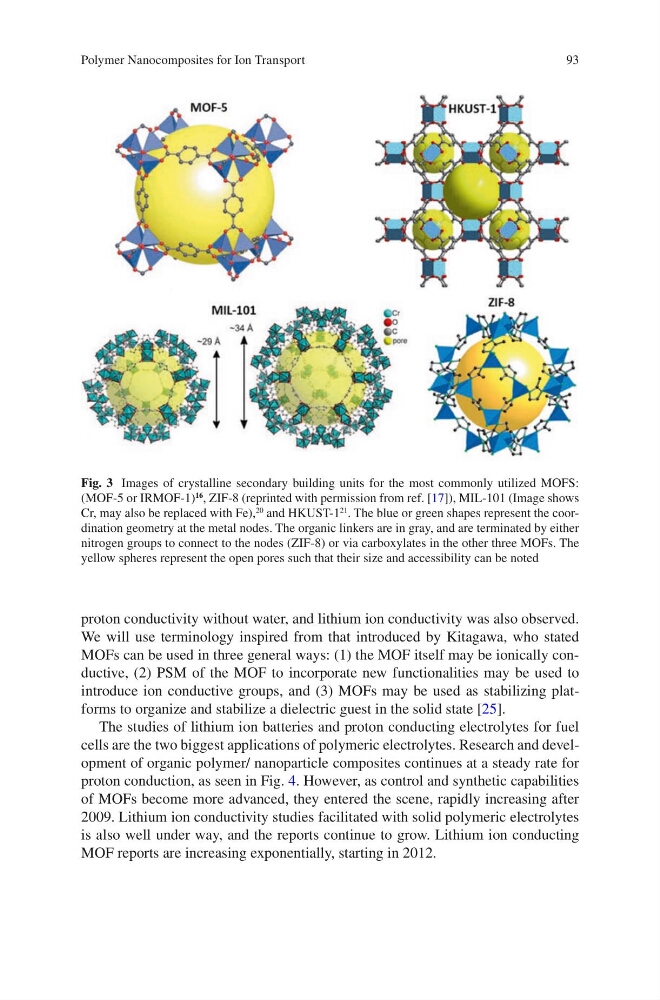
Fig. 3 Images of crystalline secondary building units for the most commonly utilized MOFS:
(MOF-5 or IRMOF-1)
16
, ZIF-8 (reprinted with permission from ref. [17]), MIL-101 (Image shows
Cr, may also be replaced with Fe),
20 and HKUST-1
21
. The blue or green shapes represent the coordination geometry at the metal nodes. The organic linkers are in gray, and are terminated by either
nitrogen groups to connect to the nodes (ZIF-8) or via carboxylates in the other three MOFs. The
yellow spheres represent the open pores such that their size and accessibility can be noted
Polymer Nanocomposites for Ion Transport
proton conductivity without water, and lithium ion conductivity was also observed.
We will use terminology inspired from that introduced by Kitagawa, who stated
MOFs can be used in three general ways: (1) the MOF itself may be ionically conductive, (2) PSM of the MOF to incorporate new functionalities may be used to
introduce ion conductive groups, and (3) MOFs may be used as stabilizing platforms to organize and stabilize a dielectric guest in the solid state [25].
The studies of lithium ion batteries and proton conducting electrolytes for fuel
cells are the two biggest applications of polymeric electrolytes. Research and development of organic polymer/ nanoparticle composites continues at a steady rate for
proton conduction, as seen in Fig. 4. However, as control and synthetic capabilities
of MOFs become more advanced, they entered the scene, rapidly increasing after
2009. Lithium ion conductivity studies facilitated with solid polymeric electrolytes
is also well under way, and the reports continue to grow. Lithium ion conducting
MOF reports are increasing exponentially, starting in 2012.
Fig. 3 Images of crystalline secondary building units for the most commonly utilized MOFS:
(MOF-5 or IRMOF-1)
16
, ZIF-8 (reprinted with permission from ref. [17]), MIL-101 (Image shows
Cr, may also be replaced with Fe),
20 and HKUST-1
21
. The blue or green shapes represent the coordination geometry at the metal nodes. The organic linkers are in gray, and are terminated by either
nitrogen groups to connect to the nodes (ZIF-8) or via carboxylates in the other three MOFs. The
yellow spheres represent the open pores such that their size and accessibility can be noted
Polymer Nanocomposites for Ion Transport