

94
3 Challenges
Temperature One of the biggest challenges for application of modern electronics
involves the temperature of operation. Liquids are relatively limited in their temperature range in terms of both decomposition and mass loss, as devices that use
them are susceptible to leaks and to evaporation. Modern devices may be required
to operate at high (deep oil drilling), low (space exploration), or moderate temperatures (automotive, industrial, etc.), and solids will often be more robust here. If
water-assisted conductivity is required for transport of ions, then the temperature
range is intrinsically more limited. For example, Nafion
®
, a state-of-the-art proton
conducting polymer, is operational only below 80 °C because of the need for continual hydration. Other polymeric systems can result in more stability over wider
temperature ranges. However, in most cases, polymers must be amorphous (or have
the ability to move and solvate) to allow for transport. Complex composites must
have a flexible group to allow for mobility of ions. For example, the common cationconducting polymer, PEO, crystallizes below 60 °C. MOFs show very impressive
thermal stability, and in many cases, surpass the thermal range of ionic liquids. As
MOFs are bound in multiple dimensions with strong coordination, the resulting
crystalline structures are stable to much higher temperatures than if the linker was
unbound. As an example, ZIF-8 is stable up to 550 °C [17, 26].
Robustness Materials that are stable to extremes in pH can be necessary for transport of ions. Additionally, formation into thin films for portable, lightweight
2003
0
10
20
30
40
50
60
MOFs/Li+
MOFs/H+
Polymers/Li+
Polymers/H+
2004 2005 2006 2007 2008 2009 2010 2011
Year
Frequency
2012 2013 2014 2015 2016 2017 2018
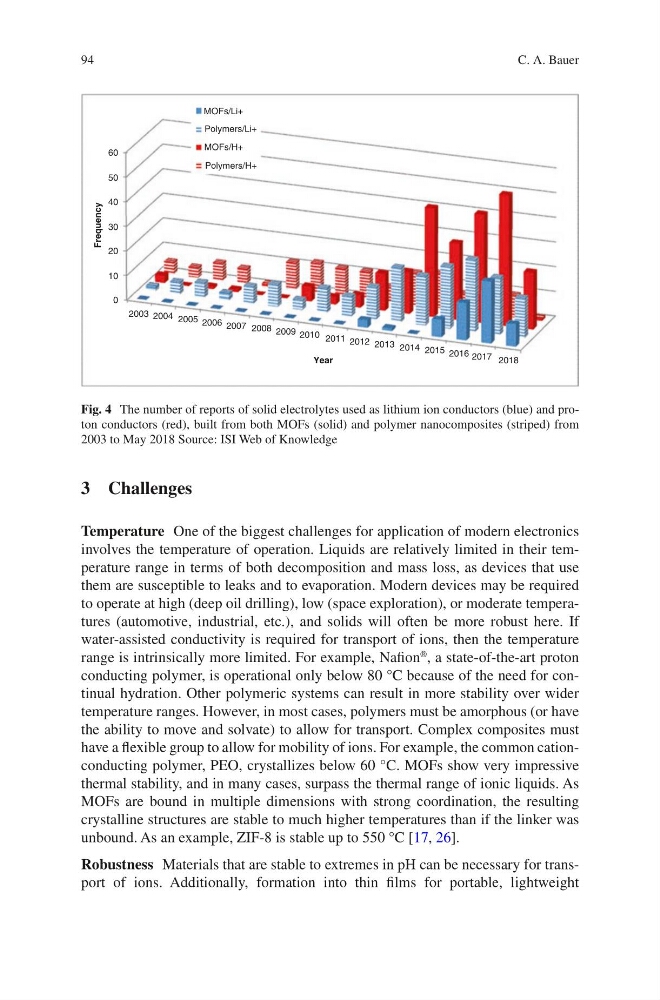
Fig. 4 The number of reports of solid electrolytes used as lithium ion conductors (blue) and proton conductors (red), built from both MOFs (solid) and polymer nanocomposites (striped) from
2003 to May 2018 Source: ISI Web of Knowledge
C. A. Bauer
3 Challenges
Temperature One of the biggest challenges for application of modern electronics
involves the temperature of operation. Liquids are relatively limited in their temperature range in terms of both decomposition and mass loss, as devices that use
them are susceptible to leaks and to evaporation. Modern devices may be required
to operate at high (deep oil drilling), low (space exploration), or moderate temperatures (automotive, industrial, etc.), and solids will often be more robust here. If
water-assisted conductivity is required for transport of ions, then the temperature
range is intrinsically more limited. For example, Nafion
®
, a state-of-the-art proton
conducting polymer, is operational only below 80 °C because of the need for continual hydration. Other polymeric systems can result in more stability over wider
temperature ranges. However, in most cases, polymers must be amorphous (or have
the ability to move and solvate) to allow for transport. Complex composites must
have a flexible group to allow for mobility of ions. For example, the common cationconducting polymer, PEO, crystallizes below 60 °C. MOFs show very impressive
thermal stability, and in many cases, surpass the thermal range of ionic liquids. As
MOFs are bound in multiple dimensions with strong coordination, the resulting
crystalline structures are stable to much higher temperatures than if the linker was
unbound. As an example, ZIF-8 is stable up to 550 °C [17, 26].
Robustness Materials that are stable to extremes in pH can be necessary for transport of ions. Additionally, formation into thin films for portable, lightweight
2003
0
10
20
30
40
50
60
MOFs/Li+
MOFs/H+
Polymers/Li+
Polymers/H+
2004 2005 2006 2007 2008 2009 2010 2011
Year
Frequency
2012 2013 2014 2015 2016 2017 2018
Fig. 4 The number of reports of solid electrolytes used as lithium ion conductors (blue) and proton conductors (red), built from both MOFs (solid) and polymer nanocomposites (striped) from
2003 to May 2018 Source: ISI Web of Knowledge
C. A. Bauer