

32
ß-, γ-, δ-, ε-, and λ-MnO 2 [28]. The crystallographic structure of MnO 2 can be
mainly described by the fundamental unit containing Mn
4+
ions in the octahedral
holes formed by hexagonally close-packed (hcp) oxide ions. This fundamental
MnO 6 octahedral units are linked via the edges and/or corners depending on the
formation of the crystal structure corresponding to the specific MnO 2 polymorph.
Benefiting from its 2 × 2 tunneled structure (size ~4.6 Å), α-MnO 2 was first demonstrated by Xu et al. as a cathode for ZIB using an aqueous electrolyte, for example, 1 M ZnSO 4 or Zn(NO 3 ) 2 [8]. Under mildly acidic electrolyte (pH ~ 4.2)
conditions, they found that Zn-ions could be intercalated/de-intercalated into/from
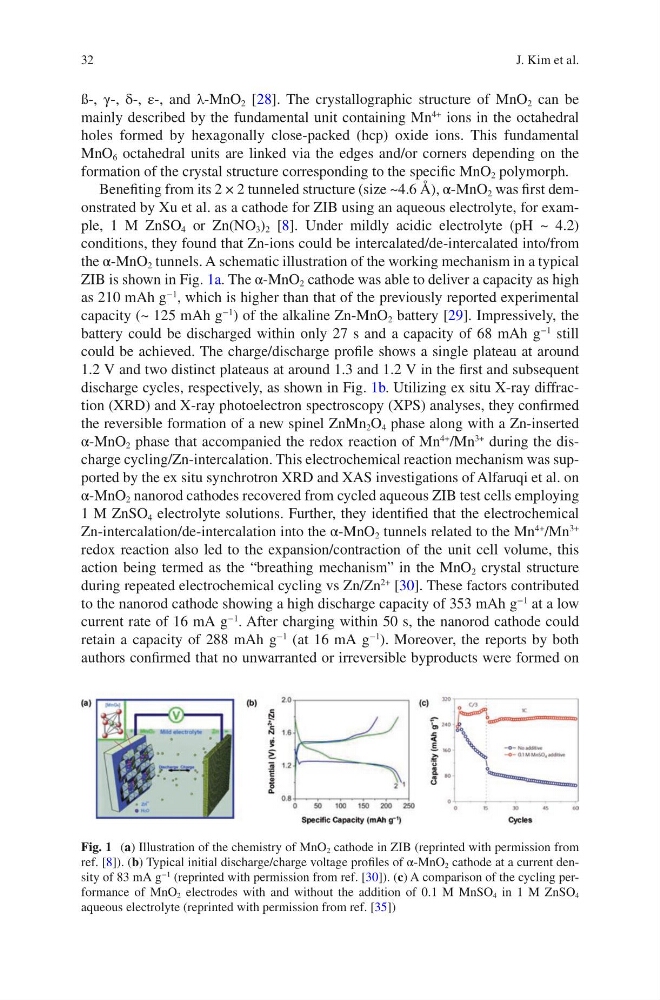
the α-MnO 2 tunnels. A schematic illustration of the working mechanism in a typical
ZIB is shown in Fig. 1a. The α-MnO 2 cathode was able to deliver a capacity as high
as 210 mAh g
−1
, which is higher than that of the previously reported experimental
capacity (~ 125 mAh g
−1
) of the alkaline Zn-MnO 2 battery [29]. Impressively, the
battery could be discharged within only 27 s and a capacity of 68 mAh g
−1
still
could be achieved. The charge/discharge profile shows a single plateau at around
1.2 V and two distinct plateaus at around 1.3 and 1.2 V in the first and subsequent
discharge cycles, respectively, as shown in Fig. 1b. Utilizing ex situ X-ray diffraction (XRD) and X-ray photoelectron spectroscopy (XPS) analyses, they confirmed
the reversible formation of a new spinel ZnMn 2 O 4 phase along with a Zn-inserted
α-MnO 2 phase that accompanied the redox reaction of Mn
4+
/Mn
3+
during the discharge cycling/Zn-intercalation. This electrochemical reaction mechanism was supported by the ex situ synchrotron XRD and XAS investigations of Alfaruqi et al. on
α-MnO 2 nanorod cathodes recovered from cycled aqueous ZIB test cells employing
1 M ZnSO 4 electrolyte solutions. Further, they identified that the electrochemical
Zn-intercalation/de-intercalation into the α-MnO 2 tunnels related to the Mn
4+
/Mn
3+
redox reaction also led to the expansion/contraction of the unit cell volume, this
action being termed as the “breathing mechanism” in the MnO 2 crystal structure
during repeated electrochemical cycling vs Zn/Zn
2+
[30]. These factors contributed
to the nanorod cathode showing a high discharge capacity of 353 mAh g
−1
at a low
current rate of 16 mA g
−1
. After charging within 50 s, the nanorod cathode could
retain a capacity of 288 mAh g
−1
(at 16 mA g
−1
). Moreover, the reports by both
authors confirmed that no unwarranted or irreversible byproducts were formed on
Fig. 1 (a) Illustration of the chemistry of MnO 2 cathode in ZIB (reprinted with permission from
ref. [8]). (b) Typical initial discharge/charge voltage profiles of α-MnO 2 cathode at a current density of 83 mA g
−1 (reprinted with permission from ref. [30]). (c) A comparison of the cycling performance of MnO 2 electrodes with and without the addition of 0.1 M MnSO 4 in 1 M ZnSO 4
aqueous electrolyte (reprinted with permission from ref. [35])
J. Kim et al.
ß-, γ-, δ-, ε-, and λ-MnO 2 [28]. The crystallographic structure of MnO 2 can be
mainly described by the fundamental unit containing Mn
4+
ions in the octahedral
holes formed by hexagonally close-packed (hcp) oxide ions. This fundamental
MnO 6 octahedral units are linked via the edges and/or corners depending on the
formation of the crystal structure corresponding to the specific MnO 2 polymorph.
Benefiting from its 2 × 2 tunneled structure (size ~4.6 Å), α-MnO 2 was first demonstrated by Xu et al. as a cathode for ZIB using an aqueous electrolyte, for example, 1 M ZnSO 4 or Zn(NO 3 ) 2 [8]. Under mildly acidic electrolyte (pH ~ 4.2)
conditions, they found that Zn-ions could be intercalated/de-intercalated into/from
the α-MnO 2 tunnels. A schematic illustration of the working mechanism in a typical
ZIB is shown in Fig. 1a. The α-MnO 2 cathode was able to deliver a capacity as high
as 210 mAh g
−1
, which is higher than that of the previously reported experimental
capacity (~ 125 mAh g
−1
) of the alkaline Zn-MnO 2 battery [29]. Impressively, the
battery could be discharged within only 27 s and a capacity of 68 mAh g
−1
still
could be achieved. The charge/discharge profile shows a single plateau at around
1.2 V and two distinct plateaus at around 1.3 and 1.2 V in the first and subsequent
discharge cycles, respectively, as shown in Fig. 1b. Utilizing ex situ X-ray diffraction (XRD) and X-ray photoelectron spectroscopy (XPS) analyses, they confirmed
the reversible formation of a new spinel ZnMn 2 O 4 phase along with a Zn-inserted
α-MnO 2 phase that accompanied the redox reaction of Mn
4+
/Mn
3+
during the discharge cycling/Zn-intercalation. This electrochemical reaction mechanism was supported by the ex situ synchrotron XRD and XAS investigations of Alfaruqi et al. on
α-MnO 2 nanorod cathodes recovered from cycled aqueous ZIB test cells employing
1 M ZnSO 4 electrolyte solutions. Further, they identified that the electrochemical
Zn-intercalation/de-intercalation into the α-MnO 2 tunnels related to the Mn
4+
/Mn
3+
redox reaction also led to the expansion/contraction of the unit cell volume, this
action being termed as the “breathing mechanism” in the MnO 2 crystal structure
during repeated electrochemical cycling vs Zn/Zn
2+
[30]. These factors contributed
to the nanorod cathode showing a high discharge capacity of 353 mAh g
−1
at a low
current rate of 16 mA g
−1
. After charging within 50 s, the nanorod cathode could
retain a capacity of 288 mAh g
−1
(at 16 mA g
−1
). Moreover, the reports by both
authors confirmed that no unwarranted or irreversible byproducts were formed on
Fig. 1 (a) Illustration of the chemistry of MnO 2 cathode in ZIB (reprinted with permission from
ref. [8]). (b) Typical initial discharge/charge voltage profiles of α-MnO 2 cathode at a current density of 83 mA g
−1 (reprinted with permission from ref. [30]). (c) A comparison of the cycling performance of MnO 2 electrodes with and without the addition of 0.1 M MnSO 4 in 1 M ZnSO 4
aqueous electrolyte (reprinted with permission from ref. [35])
J. Kim et al.