

31
2
3
4
2
Mn
Mn
Mn
s
s
aq
( )
+
( )
+
( )
+
↔
+
(5)
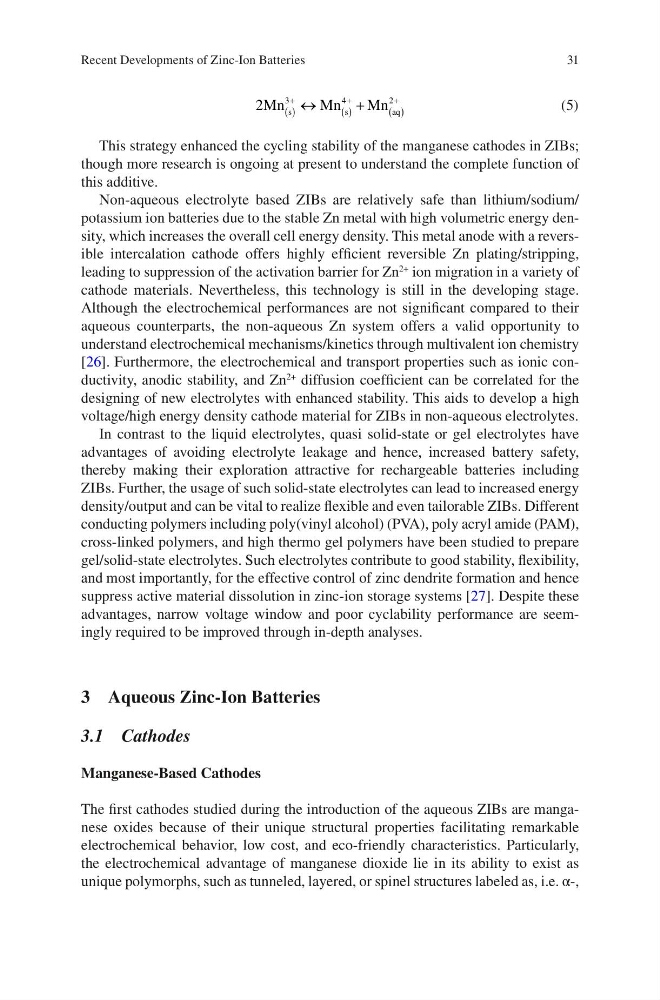
This strategy enhanced the cycling stability of the manganese cathodes in ZIBs;
though more research is ongoing at present to understand the complete function of
this additive.
Non-aqueous electrolyte based ZIBs are relatively safe than lithium/sodium/
potassium ion batteries due to the stable Zn metal with high volumetric energy density, which increases the overall cell energy density. This metal anode with a reversible intercalation cathode offers highly efficient reversible Zn plating/stripping,
leading to suppression of the activation barrier for Zn
2+
ion migration in a variety of
cathode materials. Nevertheless, this technology is still in the developing stage.
Although the electrochemical performances are not significant compared to their
aqueous counterparts, the non-aqueous Zn system offers a valid opportunity to
understand electrochemical mechanisms/kinetics through multivalent ion chemistry
[26]. Furthermore, the electrochemical and transport properties such as ionic conductivity, anodic stability, and Zn
2+
diffusion coefficient can be correlated for the
designing of new electrolytes with enhanced stability. This aids to develop a high
voltage/high energy density cathode material for ZIBs in non-aqueous electrolytes.
In contrast to the liquid electrolytes, quasi solid-state or gel electrolytes have
advantages of avoiding electrolyte leakage and hence, increased battery safety,
thereby making their exploration attractive for rechargeable batteries including
ZIBs. Further, the usage of such solid-state electrolytes can lead to increased energy
density/output and can be vital to realize flexible and even tailorable ZIBs. Different
conducting polymers including poly(vinyl alcohol) (PVA), poly acryl amide (PAM),
cross-linked polymers, and high thermo gel polymers have been studied to prepare
gel/solid-state electrolytes. Such electrolytes contribute to good stability, flexibility,
and most importantly, for the effective control of zinc dendrite formation and hence
suppress active material dissolution in zinc-ion storage systems [27]. Despite these
advantages, narrow voltage window and poor cyclability performance are seemingly required to be improved through in-depth analyses.
3 Aqueous Zinc-Ion Batteries
3.1 Cathodes
Manganese-Based Cathodes
The first cathodes studied during the introduction of the aqueous ZIBs are manganese oxides because of their unique structural properties facilitating remarkable
electrochemical behavior, low cost, and eco-friendly characteristics. Particularly,
the electrochemical advantage of manganese dioxide lie in its ability to exist as
unique polymorphs, such as tunneled, layered, or spinel structures labeled as, i.e. α-,
Recent Developments of Zinc-Ion Batteries
2
3
4
2
Mn
Mn
Mn
s
s
aq
( )
+
( )
+
( )
+
↔
+
(5)
This strategy enhanced the cycling stability of the manganese cathodes in ZIBs;
though more research is ongoing at present to understand the complete function of
this additive.
Non-aqueous electrolyte based ZIBs are relatively safe than lithium/sodium/
potassium ion batteries due to the stable Zn metal with high volumetric energy density, which increases the overall cell energy density. This metal anode with a reversible intercalation cathode offers highly efficient reversible Zn plating/stripping,
leading to suppression of the activation barrier for Zn
2+
ion migration in a variety of
cathode materials. Nevertheless, this technology is still in the developing stage.
Although the electrochemical performances are not significant compared to their
aqueous counterparts, the non-aqueous Zn system offers a valid opportunity to
understand electrochemical mechanisms/kinetics through multivalent ion chemistry
[26]. Furthermore, the electrochemical and transport properties such as ionic conductivity, anodic stability, and Zn
2+
diffusion coefficient can be correlated for the
designing of new electrolytes with enhanced stability. This aids to develop a high
voltage/high energy density cathode material for ZIBs in non-aqueous electrolytes.
In contrast to the liquid electrolytes, quasi solid-state or gel electrolytes have
advantages of avoiding electrolyte leakage and hence, increased battery safety,
thereby making their exploration attractive for rechargeable batteries including
ZIBs. Further, the usage of such solid-state electrolytes can lead to increased energy
density/output and can be vital to realize flexible and even tailorable ZIBs. Different
conducting polymers including poly(vinyl alcohol) (PVA), poly acryl amide (PAM),
cross-linked polymers, and high thermo gel polymers have been studied to prepare
gel/solid-state electrolytes. Such electrolytes contribute to good stability, flexibility,
and most importantly, for the effective control of zinc dendrite formation and hence
suppress active material dissolution in zinc-ion storage systems [27]. Despite these
advantages, narrow voltage window and poor cyclability performance are seemingly required to be improved through in-depth analyses.
3 Aqueous Zinc-Ion Batteries
3.1 Cathodes
Manganese-Based Cathodes
The first cathodes studied during the introduction of the aqueous ZIBs are manganese oxides because of their unique structural properties facilitating remarkable
electrochemical behavior, low cost, and eco-friendly characteristics. Particularly,
the electrochemical advantage of manganese dioxide lie in its ability to exist as
unique polymorphs, such as tunneled, layered, or spinel structures labeled as, i.e. α-,
Recent Developments of Zinc-Ion Batteries