

28
1 Introduction
Global electricity demand has increased twice as much to overall energy consumption since 1990 and is predicted to rise further by more than two-thirds for the next
20 years. Energy storage/conversion technologies have therefore become a crucial
research topic towards sustainable living in present-day society. Particularly, electrical energy storage is critical not only to support electronic, vehicular, and load-leveling applications but also to efficiently commercialize renewable solar and wind
power. For effective utilization of the electricity generated from these renewable
sources, energy storage systems (ESS) have become critically important. One of the
most prominent ESS is rechargeable batteries since many portable electronic
devices rely on exploiting the chemical energy stored in them. Rechargeable Li-ion
batteries (LIBs) are a promising technology that have defined the portable electronic
world and are set to control the electric and hybrid electric vehicle markets [1–3].
Bearing in mind the constraints in accessing global lithium resources, ecofriendliness, safety concerns, and the anticipated high cost of lithium, the practical
aspect of utilizing LIBs to meet the increasing demand for electrical grid and largescale ESS is stiffly challenging [4, 5]. This led to an exploration for new battery
chemistries, preferably by, exploiting the well-researched and easy-to-implement
LIB intercalation chemistry.
The pursuit for low-cost, less risk, eco-friendly, and high energy density battery
technologies has led to intense research on multivalent batteries based on Al-, Ca-,
Mg- or Zn-ions, particularly, Zn-based batteries [6–8]. Introduced in the 1950s, the
Zn-MnO 2 battery was composed of a Zn anode, MnO 2 cathode, and an alkaline
KOH electrolyte. The early Zn-MnO 2 batteries displayed disadvantages of the active
materials forming irreversible byproducts, both at the cathode (manganese hydroxides/oxides) and anode (Zn-hydroxide/oxide) during deep discharge cycling in alkaline electrolyte medium and the formation of Zn dendrites (at the anode), thereby
contributing to the drastic capacity fading upon repeated cycling [9, 10]. Hence,
despite the high theoretical capacities of the electrodes (MnO 2 ~ 617 mAh g
−1
;
Zn ~ 820 mAh g
−1
), the alkaline Zn-MnO 2 system is mostly used, even at present,
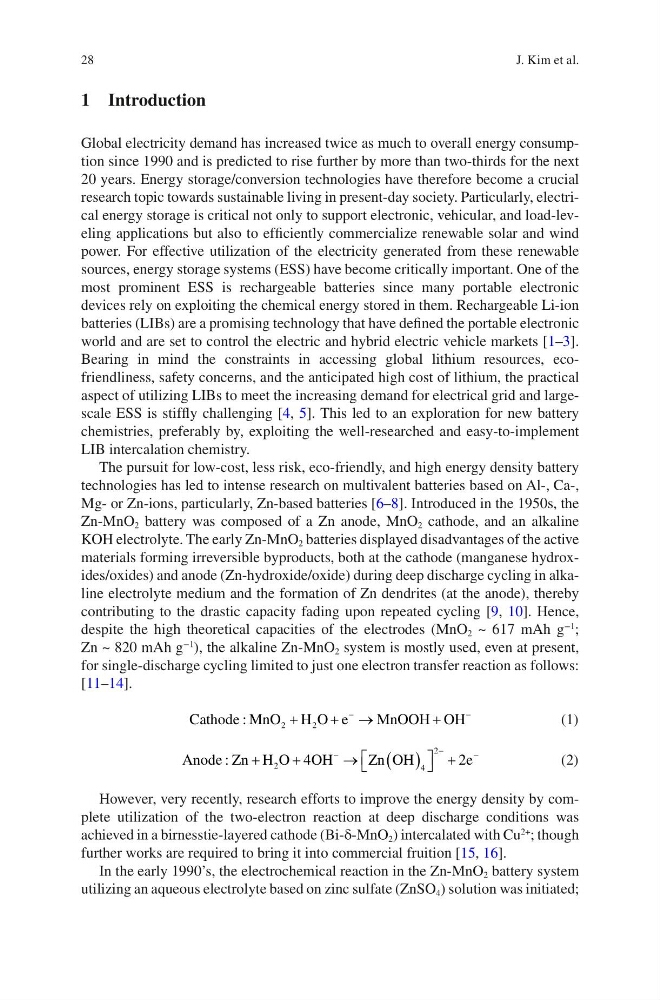
for single-discharge cycling limited to just one electron transfer reaction as follows:
[11–14].
Cathode MnO H O e
MnOOH OH
:
2
2
+
+ →
+
−
−
(1)
Anode Zn H O OH
Zn OH
e
: +
+
→
( )
+
−
−
−
2
4
2
4
2
(2)
However, very recently, research efforts to improve the energy density by complete utilization of the two-electron reaction at deep discharge conditions was
achieved in a birnesstie-layered cathode (Bi-δ-MnO 2 ) intercalated with Cu
2+
; though
further works are required to bring it into commercial fruition [15, 16].
In the early 1990’s, the electrochemical reaction in the Zn-MnO 2 battery system
utilizing an aqueous electrolyte based on zinc sulfate (ZnSO 4 ) solution was initiated;
J. Kim et al.
1 Introduction
Global electricity demand has increased twice as much to overall energy consumption since 1990 and is predicted to rise further by more than two-thirds for the next
20 years. Energy storage/conversion technologies have therefore become a crucial
research topic towards sustainable living in present-day society. Particularly, electrical energy storage is critical not only to support electronic, vehicular, and load-leveling applications but also to efficiently commercialize renewable solar and wind
power. For effective utilization of the electricity generated from these renewable
sources, energy storage systems (ESS) have become critically important. One of the
most prominent ESS is rechargeable batteries since many portable electronic
devices rely on exploiting the chemical energy stored in them. Rechargeable Li-ion
batteries (LIBs) are a promising technology that have defined the portable electronic
world and are set to control the electric and hybrid electric vehicle markets [1–3].
Bearing in mind the constraints in accessing global lithium resources, ecofriendliness, safety concerns, and the anticipated high cost of lithium, the practical
aspect of utilizing LIBs to meet the increasing demand for electrical grid and largescale ESS is stiffly challenging [4, 5]. This led to an exploration for new battery
chemistries, preferably by, exploiting the well-researched and easy-to-implement
LIB intercalation chemistry.
The pursuit for low-cost, less risk, eco-friendly, and high energy density battery
technologies has led to intense research on multivalent batteries based on Al-, Ca-,
Mg- or Zn-ions, particularly, Zn-based batteries [6–8]. Introduced in the 1950s, the
Zn-MnO 2 battery was composed of a Zn anode, MnO 2 cathode, and an alkaline
KOH electrolyte. The early Zn-MnO 2 batteries displayed disadvantages of the active
materials forming irreversible byproducts, both at the cathode (manganese hydroxides/oxides) and anode (Zn-hydroxide/oxide) during deep discharge cycling in alkaline electrolyte medium and the formation of Zn dendrites (at the anode), thereby
contributing to the drastic capacity fading upon repeated cycling [9, 10]. Hence,
despite the high theoretical capacities of the electrodes (MnO 2 ~ 617 mAh g
−1
;
Zn ~ 820 mAh g
−1
), the alkaline Zn-MnO 2 system is mostly used, even at present,
for single-discharge cycling limited to just one electron transfer reaction as follows:
[11–14].
Cathode MnO H O e
MnOOH OH
:
2
2
+
+ →
+
−
−
(1)
Anode Zn H O OH
Zn OH
e
: +
+
→
( )
+
−
−
−
2
4
2
4
2
(2)
However, very recently, research efforts to improve the energy density by complete utilization of the two-electron reaction at deep discharge conditions was
achieved in a birnesstie-layered cathode (Bi-δ-MnO 2 ) intercalated with Cu
2+
; though
further works are required to bring it into commercial fruition [15, 16].
In the early 1990’s, the electrochemical reaction in the Zn-MnO 2 battery system
utilizing an aqueous electrolyte based on zinc sulfate (ZnSO 4 ) solution was initiated;
J. Kim et al.