

145
synthesize TiO 2 nanotube is anodization of the titanium foil. Using this technique,
not only Ti is converted to the oxide but also the oxide layer will be in the form of
nanowells structure. Another advantage of this nanostructure is the flexibility of the
substrate [44]. Over the past years, several groups focused on this direction and
fabricated high quality TiO 2 nanotube and demonstrated their application in the
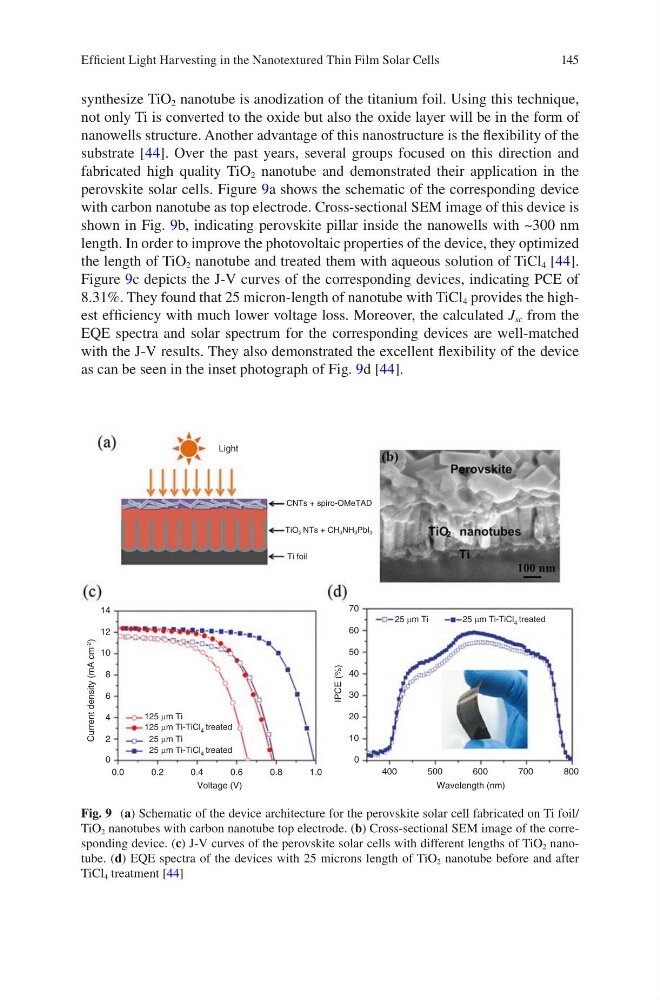
perovskite solar cells. Figure 9a shows the schematic of the corresponding device
with carbon nanotube as top electrode. Cross-sectional SEM image of this device is
shown in Fig. 9b, indicating perovskite pillar inside the nanowells with ~300 nm
length. In order to improve the photovoltaic properties of the device, they optimized
the length of TiO 2 nanotube and treated them with aqueous solution of TiCl 4 [44].
Figure 9c depicts the J-V curves of the corresponding devices, indicating PCE of
8.31%. They found that 25 micron-length of nanotube with TiCl 4 provides the highest efficiency with much lower voltage loss. Moreover, the calculated J sc from the
EQE spectra and solar spectrum for the corresponding devices are well-matched
with the J-V results. They also demonstrated the excellent flexibility of the device
as can be seen in the inset photograph of Fig. 9d [44].
Light
CNTs + spiro-OMeTAD
Ti foil
14
12
10
8
6
4
2
0
0.0
0.2
0.4
Voltage (V)
Wavelength (nm)
400
0
10
20
30
40
IPCE (%)
50
60
70
500
600
700
800
Current density (mA cm
-2
)
125 µm Ti
125 µm Ti-TiCl 4 treated
25 µm Ti
25 µm Ti-TiCl 4 treated
25 µm Ti-TiCl 4 treated
25 µm Ti
0.6
0.8
1.0
TiO2 NTs + CH3NH3PbI3
Fig. 9 (a) Schematic of the device architecture for the perovskite solar cell fabricated on Ti foil/
TiO 2 nanotubes with carbon nanotube top electrode. (b) Cross-sectional SEM image of the corresponding device. (c) J-V curves of the perovskite solar cells with different lengths of TiO 2 nanotube. (d) EQE spectra of the devices with 25 microns length of TiO 2 nanotube before and after
TiCl 4 treatment [44]
Efficient Light Harvesting in the Nanotextured Thin Film Solar Cells
synthesize TiO 2 nanotube is anodization of the titanium foil. Using this technique,
not only Ti is converted to the oxide but also the oxide layer will be in the form of
nanowells structure. Another advantage of this nanostructure is the flexibility of the
substrate [44]. Over the past years, several groups focused on this direction and
fabricated high quality TiO 2 nanotube and demonstrated their application in the
perovskite solar cells. Figure 9a shows the schematic of the corresponding device
with carbon nanotube as top electrode. Cross-sectional SEM image of this device is
shown in Fig. 9b, indicating perovskite pillar inside the nanowells with ~300 nm
length. In order to improve the photovoltaic properties of the device, they optimized
the length of TiO 2 nanotube and treated them with aqueous solution of TiCl 4 [44].
Figure 9c depicts the J-V curves of the corresponding devices, indicating PCE of
8.31%. They found that 25 micron-length of nanotube with TiCl 4 provides the highest efficiency with much lower voltage loss. Moreover, the calculated J sc from the
EQE spectra and solar spectrum for the corresponding devices are well-matched
with the J-V results. They also demonstrated the excellent flexibility of the device
as can be seen in the inset photograph of Fig. 9d [44].
Light
CNTs + spiro-OMeTAD
Ti foil
14
12
10
8
6
4
2
0
0.0
0.2
0.4
Voltage (V)
Wavelength (nm)
400
0
10
20
30
40
IPCE (%)
50
60
70
500
600
700
800
Current density (mA cm
-2
)
125 µm Ti
125 µm Ti-TiCl 4 treated
25 µm Ti
25 µm Ti-TiCl 4 treated
25 µm Ti-TiCl 4 treated
25 µm Ti
0.6
0.8
1.0
TiO2 NTs + CH3NH3PbI3
Fig. 9 (a) Schematic of the device architecture for the perovskite solar cell fabricated on Ti foil/
TiO 2 nanotubes with carbon nanotube top electrode. (b) Cross-sectional SEM image of the corresponding device. (c) J-V curves of the perovskite solar cells with different lengths of TiO 2 nanotube. (d) EQE spectra of the devices with 25 microns length of TiO 2 nanotube before and after
TiCl 4 treatment [44]
Efficient Light Harvesting in the Nanotextured Thin Film Solar Cells