

144
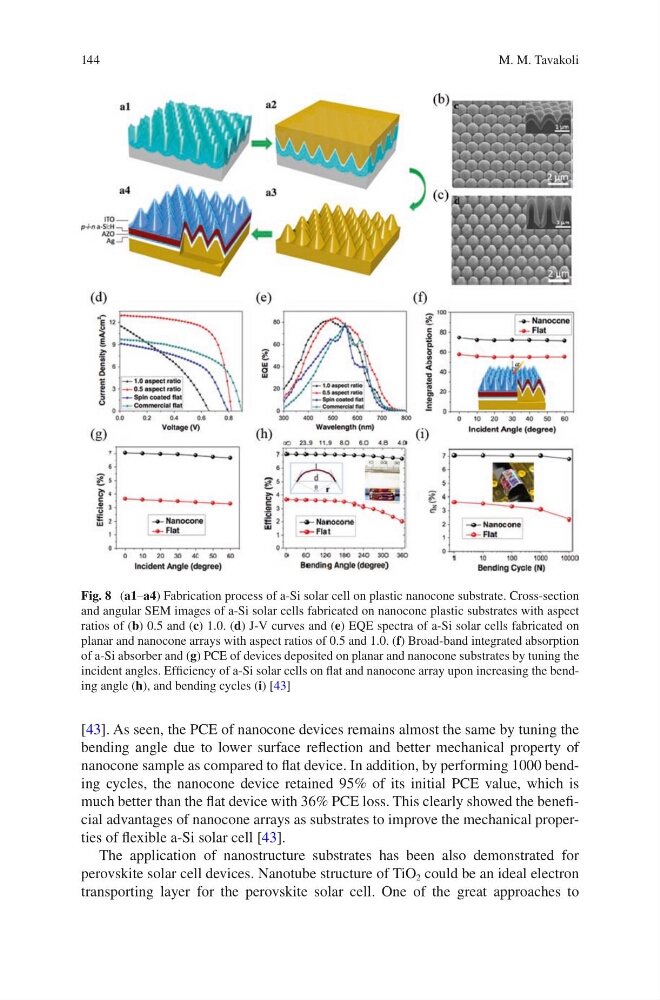
[43]. As seen, the PCE of nanocone devices remains almost the same by tuning the
bending angle due to lower surface reflection and better mechanical property of
nanocone sample as compared to flat device. In addition, by performing 1000 bending cycles, the nanocone device retained 95% of its initial PCE value, which is
much better than the flat device with 36% PCE loss. This clearly showed the beneficial advantages of nanocone arrays as substrates to improve the mechanical properties of flexible a-Si solar cell [43].
The application of nanostructure substrates has been also demonstrated for
perovskite solar cell devices. Nanotube structure of TiO 2 could be an ideal electron
transporting layer for the perovskite solar cell. One of the great approaches to
Fig. 8 (a1–a4) Fabrication process of a-Si solar cell on plastic nanocone substrate. Cross-section
and angular SEM images of a-Si solar cells fabricated on nanocone plastic substrates with aspect
ratios of (b) 0.5 and (c) 1.0. (d) J-V curves and (e) EQE spectra of a-Si solar cells fabricated on
planar and nanocone arrays with aspect ratios of 0.5 and 1.0. (f) Broad-band integrated absorption
of a-Si absorber and (g) PCE of devices deposited on planar and nanocone substrates by tuning the
incident angles. Efficiency of a-Si solar cells on flat and nanocone array upon increasing the bending angle (h), and bending cycles (i) [43]
M. M. Tavakoli
[43]. As seen, the PCE of nanocone devices remains almost the same by tuning the
bending angle due to lower surface reflection and better mechanical property of
nanocone sample as compared to flat device. In addition, by performing 1000 bending cycles, the nanocone device retained 95% of its initial PCE value, which is
much better than the flat device with 36% PCE loss. This clearly showed the beneficial advantages of nanocone arrays as substrates to improve the mechanical properties of flexible a-Si solar cell [43].
The application of nanostructure substrates has been also demonstrated for
perovskite solar cell devices. Nanotube structure of TiO 2 could be an ideal electron
transporting layer for the perovskite solar cell. One of the great approaches to
Fig. 8 (a1–a4) Fabrication process of a-Si solar cell on plastic nanocone substrate. Cross-section
and angular SEM images of a-Si solar cells fabricated on nanocone plastic substrates with aspect
ratios of (b) 0.5 and (c) 1.0. (d) J-V curves and (e) EQE spectra of a-Si solar cells fabricated on
planar and nanocone arrays with aspect ratios of 0.5 and 1.0. (f) Broad-band integrated absorption
of a-Si absorber and (g) PCE of devices deposited on planar and nanocone substrates by tuning the
incident angles. Efficiency of a-Si solar cells on flat and nanocone array upon increasing the bending angle (h), and bending cycles (i) [43]
M. M. Tavakoli