

141
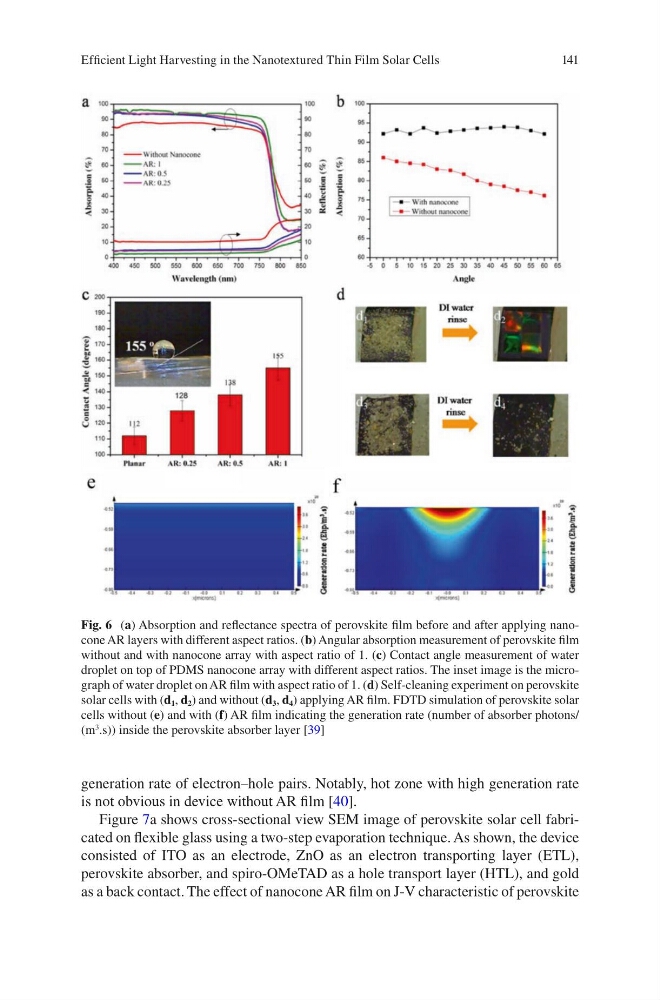
generation rate of electron–hole pairs. Notably, hot zone with high generation rate
is not obvious in device without AR film [40].
Figure 7a shows cross-sectional view SEM image of perovskite solar cell fabricated on flexible glass using a two-step evaporation technique. As shown, the device
consisted of ITO as an electrode, ZnO as an electron transporting layer (ETL),
perovskite absorber, and spiro-OMeTAD as a hole transport layer (HTL), and gold
as a back contact. The effect of nanocone AR film on J-V characteristic of perovskite
Fig. 6 (a) Absorption and reflectance spectra of perovskite film before and after applying nanocone AR layers with different aspect ratios. (b) Angular absorption measurement of perovskite film
without and with nanocone array with aspect ratio of 1. (c) Contact angle measurement of water
droplet on top of PDMS nanocone array with different aspect ratios. The inset image is the micrograph of water droplet on AR film with aspect ratio of 1. (d) Self-cleaning experiment on perovskite
solar cells with (d 1 , d 2 ) and without (d 3 , d 4 ) applying AR film. FDTD simulation of perovskite solar
cells without (e) and with (f) AR film indicating the generation rate (number of absorber photons/
(m
3
.s)) inside the perovskite absorber layer [39]
Efficient Light Harvesting in the Nanotextured Thin Film Solar Cells
generation rate of electron–hole pairs. Notably, hot zone with high generation rate
is not obvious in device without AR film [40].
Figure 7a shows cross-sectional view SEM image of perovskite solar cell fabricated on flexible glass using a two-step evaporation technique. As shown, the device
consisted of ITO as an electrode, ZnO as an electron transporting layer (ETL),
perovskite absorber, and spiro-OMeTAD as a hole transport layer (HTL), and gold
as a back contact. The effect of nanocone AR film on J-V characteristic of perovskite
Fig. 6 (a) Absorption and reflectance spectra of perovskite film before and after applying nanocone AR layers with different aspect ratios. (b) Angular absorption measurement of perovskite film
without and with nanocone array with aspect ratio of 1. (c) Contact angle measurement of water
droplet on top of PDMS nanocone array with different aspect ratios. The inset image is the micrograph of water droplet on AR film with aspect ratio of 1. (d) Self-cleaning experiment on perovskite
solar cells with (d 1 , d 2 ) and without (d 3 , d 4 ) applying AR film. FDTD simulation of perovskite solar
cells without (e) and with (f) AR film indicating the generation rate (number of absorber photons/
(m
3
.s)) inside the perovskite absorber layer [39]
Efficient Light Harvesting in the Nanotextured Thin Film Solar Cells