

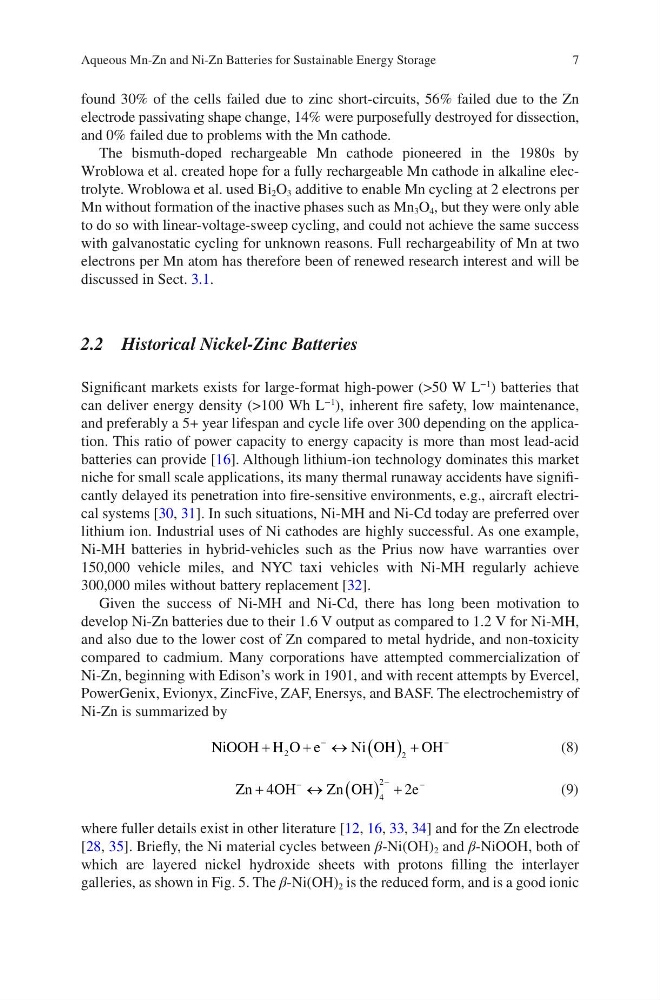
7
found 30% of the cells failed due to zinc short-circuits, 56% failed due to the Zn
electrode passivating shape change, 14% were purposefully destroyed for dissection,
and 0% failed due to problems with the Mn cathode.
The bismuth-doped rechargeable Mn cathode pioneered in the 1980s by
Wroblowa et al. created hope for a fully rechargeable Mn cathode in alkaline electrolyte. Wroblowa et al. used Bi 2 O 3 additive to enable Mn cycling at 2 electrons per
Mn without formation of the inactive phases such as Mn 3 O 4 , but they were only able
to do so with linear-voltage-sweep cycling, and could not achieve the same success
with galvanostatic cycling for unknown reasons. Full rechargeability of Mn at two
electrons per Mn atom has therefore been of renewed research interest and will be
discussed in Sect. 3.1.
2.2 Historical Nickel-Zinc Batteries
Significant markets exists for large-format high-power (>50 W L
−1
) batteries that
can deliver energy density (>100 Wh L
−1
), inherent fire safety, low maintenance,
and preferably a 5+ year lifespan and cycle life over 300 depending on the application. This ratio of power capacity to energy capacity is more than most lead-acid
batteries can provide [16]. Although lithium-ion technology dominates this market
niche for small scale applications, its many thermal runaway accidents have significantly delayed its penetration into fire-sensitive environments, e.g., aircraft electrical systems [30, 31]. In such situations, Ni-MH and Ni-Cd today are preferred over
lithium ion. Industrial uses of Ni cathodes are highly successful. As one example,
Ni-MH batteries in hybrid-vehicles such as the Prius now have warranties over
150,000 vehicle miles, and NYC taxi vehicles with Ni-MH regularly achieve
300,000 miles without battery replacement [32].
Given the success of Ni-MH and Ni-Cd, there has long been motivation to
develop Ni-Zn batteries due to their 1.6 V output as compared to 1.2 V for Ni-MH,
and also due to the lower cost of Zn compared to metal hydride, and non-toxicity
compared to cadmium. Many corporations have attempted commercialization of
Ni-Zn, beginning with Edison’s work in 1901, and with recent attempts by Evercel,
PowerGenix, Evionyx, ZincFive, ZAF, Enersys, and BASF. The electrochemistry of
Ni-Zn is summarized by
NiOOH H O e
Ni OH
OH
l
2
2
(8)
Zn OH
Zn OH
e
l
4
2
4
2
(9)
where fuller details exist in other literature [12, 16, 33, 34] and for the Zn electrode
[28, 35]. Briefly, the Ni material cycles between β-Ni(OH) 2 and β-NiOOH, both of
which are layered nickel hydroxide sheets with protons filling the interlayer
galleries, as shown in Fig. 5. The β-Ni(OH) 2 is the reduced form, and is a good ionic
Aqueous Mn-Zn and Ni-Zn Batteries for Sustainable Energy Storage
found 30% of the cells failed due to zinc short-circuits, 56% failed due to the Zn
electrode passivating shape change, 14% were purposefully destroyed for dissection,
and 0% failed due to problems with the Mn cathode.
The bismuth-doped rechargeable Mn cathode pioneered in the 1980s by
Wroblowa et al. created hope for a fully rechargeable Mn cathode in alkaline electrolyte. Wroblowa et al. used Bi 2 O 3 additive to enable Mn cycling at 2 electrons per
Mn without formation of the inactive phases such as Mn 3 O 4 , but they were only able
to do so with linear-voltage-sweep cycling, and could not achieve the same success
with galvanostatic cycling for unknown reasons. Full rechargeability of Mn at two
electrons per Mn atom has therefore been of renewed research interest and will be
discussed in Sect. 3.1.
2.2 Historical Nickel-Zinc Batteries
Significant markets exists for large-format high-power (>50 W L
−1
) batteries that
can deliver energy density (>100 Wh L
−1
), inherent fire safety, low maintenance,
and preferably a 5+ year lifespan and cycle life over 300 depending on the application. This ratio of power capacity to energy capacity is more than most lead-acid
batteries can provide [16]. Although lithium-ion technology dominates this market
niche for small scale applications, its many thermal runaway accidents have significantly delayed its penetration into fire-sensitive environments, e.g., aircraft electrical systems [30, 31]. In such situations, Ni-MH and Ni-Cd today are preferred over
lithium ion. Industrial uses of Ni cathodes are highly successful. As one example,
Ni-MH batteries in hybrid-vehicles such as the Prius now have warranties over
150,000 vehicle miles, and NYC taxi vehicles with Ni-MH regularly achieve
300,000 miles without battery replacement [32].
Given the success of Ni-MH and Ni-Cd, there has long been motivation to
develop Ni-Zn batteries due to their 1.6 V output as compared to 1.2 V for Ni-MH,
and also due to the lower cost of Zn compared to metal hydride, and non-toxicity
compared to cadmium. Many corporations have attempted commercialization of
Ni-Zn, beginning with Edison’s work in 1901, and with recent attempts by Evercel,
PowerGenix, Evionyx, ZincFive, ZAF, Enersys, and BASF. The electrochemistry of
Ni-Zn is summarized by
NiOOH H O e
Ni OH
OH
l
2
2
(8)
Zn OH
Zn OH
e
l
4
2
4
2
(9)
where fuller details exist in other literature [12, 16, 33, 34] and for the Zn electrode
[28, 35]. Briefly, the Ni material cycles between β-Ni(OH) 2 and β-NiOOH, both of
which are layered nickel hydroxide sheets with protons filling the interlayer
galleries, as shown in Fig. 5. The β-Ni(OH) 2 is the reduced form, and is a good ionic
Aqueous Mn-Zn and Ni-Zn Batteries for Sustainable Energy Storage