

6
ment at Urban Electric Power corporation as of 2020. EMD can theoretically cycle up
to 0.7 electrons per Mn [19] if the MnOOH material can reversibly intercalate H
+
into
EMD’s mixture of pyrolusite and ramsdellite crystals, as shown in Fig. 3. The effect
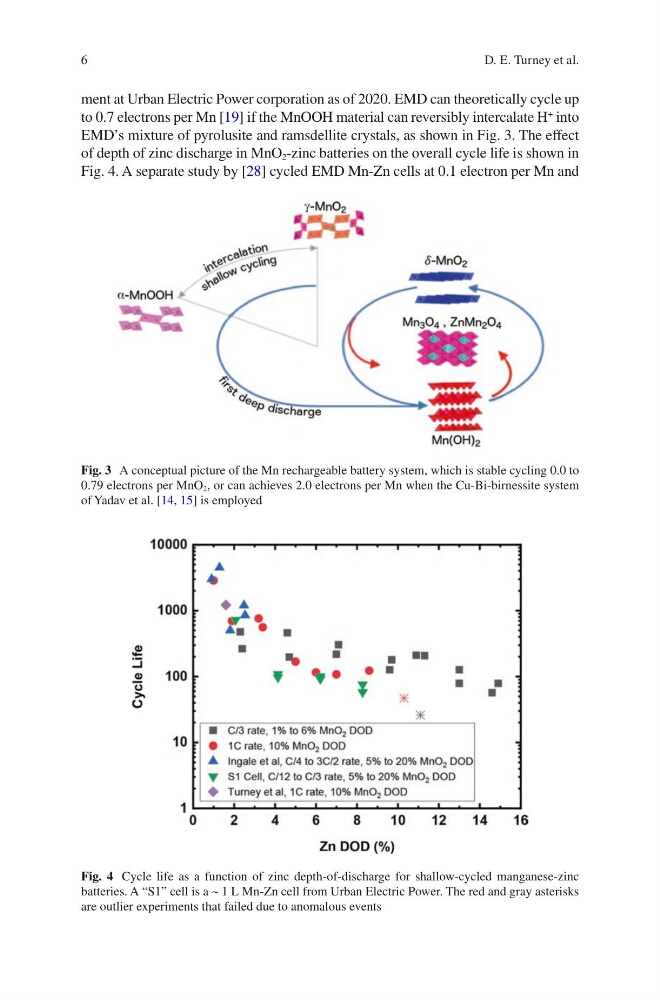
of depth of zinc discharge in MnO 2 -zinc batteries on the overall cycle life is shown in
Fig. 4. A separate study by [28] cycled EMD Mn-Zn cells at 0.1 electron per Mn and
Fig. 3 A conceptual picture of the Mn rechargeable battery system, which is stable cycling 0.0 to
0.79 electrons per MnO 2 , or can achieves 2.0 electrons per Mn when the Cu-Bi-birnessite system
of Yadav et al. [14, 15] is employed
Fig. 4 Cycle life as a function of zinc depth-of-discharge for shallow-cycled manganese-zinc
batteries. A “S1” cell is a ~ 1 L Mn-Zn cell from Urban Electric Power. The red and gray asterisks
are outlier experiments that failed due to anomalous events
D. E. Turney et al.
ment at Urban Electric Power corporation as of 2020. EMD can theoretically cycle up
to 0.7 electrons per Mn [19] if the MnOOH material can reversibly intercalate H
+
into
EMD’s mixture of pyrolusite and ramsdellite crystals, as shown in Fig. 3. The effect
of depth of zinc discharge in MnO 2 -zinc batteries on the overall cycle life is shown in
Fig. 4. A separate study by [28] cycled EMD Mn-Zn cells at 0.1 electron per Mn and
Fig. 3 A conceptual picture of the Mn rechargeable battery system, which is stable cycling 0.0 to
0.79 electrons per MnO 2 , or can achieves 2.0 electrons per Mn when the Cu-Bi-birnessite system
of Yadav et al. [14, 15] is employed
Fig. 4 Cycle life as a function of zinc depth-of-discharge for shallow-cycled manganese-zinc
batteries. A “S1” cell is a ~ 1 L Mn-Zn cell from Urban Electric Power. The red and gray asterisks
are outlier experiments that failed due to anomalous events
D. E. Turney et al.