

102
treated somewhat like a low-density filler, analogous to the polymer/nanoparticle
composites that came before. For example, phytic acid was incorporated into
MIL-101, and used as a filler for Nafion
®
. Enhancement of the thermal and mechanical properties of Nafion
®
was noted, and conductivities that were 2.8 and 11.0 times
higher than that of pristine membrane were measured for some different variations
[43]. Additionally, MIL-101 was impregnated with binary ionic liquid to function
safely above 100 °C, allowing for anhydrous proton conductivity. The ionic liquid
1-(1-Ethyl-3-imidazolium)propane-3-sulfonate (EIMS, pK a ≈ 6.8) is a zwitterionic
liquid, which has both a cation and anion that are tethered together and cannot
migrate along potential gradients, and thus may favor only proton conduction in
MIL 101 [44].
MOF frameworks can be anionic, cationic, or neutral, depending on their components. In the case where a neutral MOF demonstrates appreciable inherent proton
conductivity, open metal sites will often behave as Lewis acids to facilitate ion
transport. An example of conductivity of a neutral MOF can be found in Cu-based
HKUST-1, which contains accessible Cu coordination sites. These open metal sites
are acidic enough to react with coordinated water molecules and increase the number of protons available for transport within the methanol guests. This conductivity
does require a polar solvent to solvate the proton, and drops significantly in acetonitrile, becoming negligible in hexane. As the solvents can be exchanged within the
pores, the conductivity can be readily tuned [48].
In other neutral MOFs, the organic linker may be functionalized to allow for a
charge, whereby acidic groups within the framework structure can be used to coordinate to and transport protons. Kitagawa reported on the rational design of highly
proton-conductive MOFs. In that work, three specific types of changes were made.
In the simplest of the three, acid groups could be placed into the pores of frameworks to introduce them directly as counter-ions such as NH 4
+
, H 3 O
+
, and HSO 4
−
.
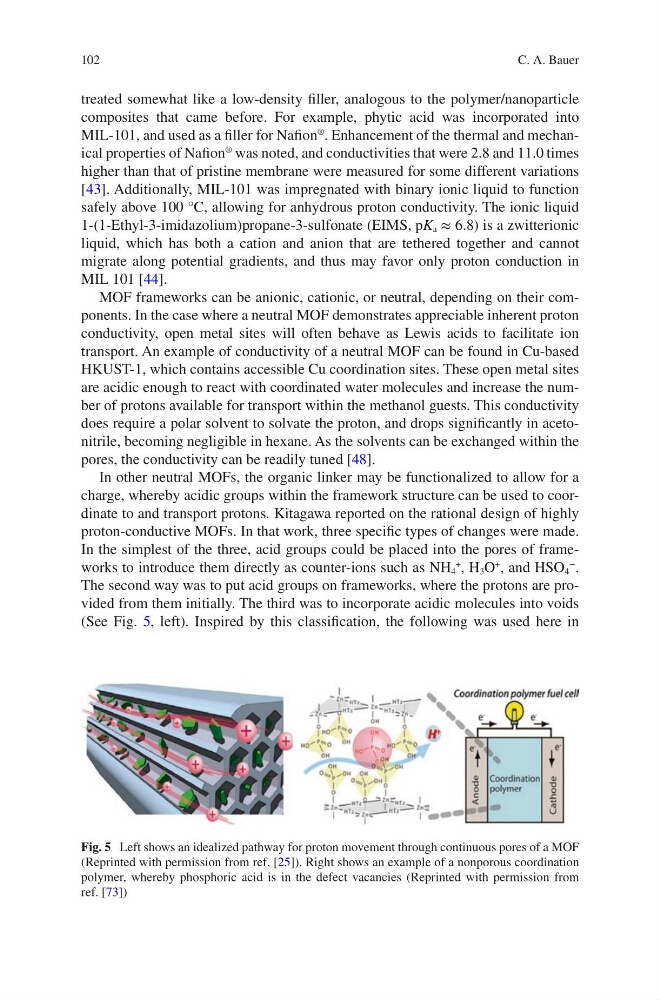
The second way was to put acid groups on frameworks, where the protons are provided from them initially. The third was to incorporate acidic molecules into voids
(See Fig. 5, left). Inspired by this classification, the following was used here in
Fig. 5 Left shows an idealized pathway for proton movement through continuous pores of a MOF
(Reprinted with permission from ref. [25]). Right shows an example of a nonporous coordination
polymer, whereby phosphoric acid is in the defect vacancies (Reprinted with permission from
ref. [73])
C. A. Bauer
treated somewhat like a low-density filler, analogous to the polymer/nanoparticle
composites that came before. For example, phytic acid was incorporated into
MIL-101, and used as a filler for Nafion
®
. Enhancement of the thermal and mechanical properties of Nafion
®
was noted, and conductivities that were 2.8 and 11.0 times
higher than that of pristine membrane were measured for some different variations
[43]. Additionally, MIL-101 was impregnated with binary ionic liquid to function
safely above 100 °C, allowing for anhydrous proton conductivity. The ionic liquid
1-(1-Ethyl-3-imidazolium)propane-3-sulfonate (EIMS, pK a ≈ 6.8) is a zwitterionic
liquid, which has both a cation and anion that are tethered together and cannot
migrate along potential gradients, and thus may favor only proton conduction in
MIL 101 [44].
MOF frameworks can be anionic, cationic, or neutral, depending on their components. In the case where a neutral MOF demonstrates appreciable inherent proton
conductivity, open metal sites will often behave as Lewis acids to facilitate ion
transport. An example of conductivity of a neutral MOF can be found in Cu-based
HKUST-1, which contains accessible Cu coordination sites. These open metal sites
are acidic enough to react with coordinated water molecules and increase the number of protons available for transport within the methanol guests. This conductivity
does require a polar solvent to solvate the proton, and drops significantly in acetonitrile, becoming negligible in hexane. As the solvents can be exchanged within the
pores, the conductivity can be readily tuned [48].
In other neutral MOFs, the organic linker may be functionalized to allow for a
charge, whereby acidic groups within the framework structure can be used to coordinate to and transport protons. Kitagawa reported on the rational design of highly
proton-conductive MOFs. In that work, three specific types of changes were made.
In the simplest of the three, acid groups could be placed into the pores of frameworks to introduce them directly as counter-ions such as NH 4
+
, H 3 O
+
, and HSO 4
−
.
The second way was to put acid groups on frameworks, where the protons are provided from them initially. The third was to incorporate acidic molecules into voids
(See Fig. 5, left). Inspired by this classification, the following was used here in
Fig. 5 Left shows an idealized pathway for proton movement through continuous pores of a MOF
(Reprinted with permission from ref. [25]). Right shows an example of a nonporous coordination
polymer, whereby phosphoric acid is in the defect vacancies (Reprinted with permission from
ref. [73])
C. A. Bauer