

99
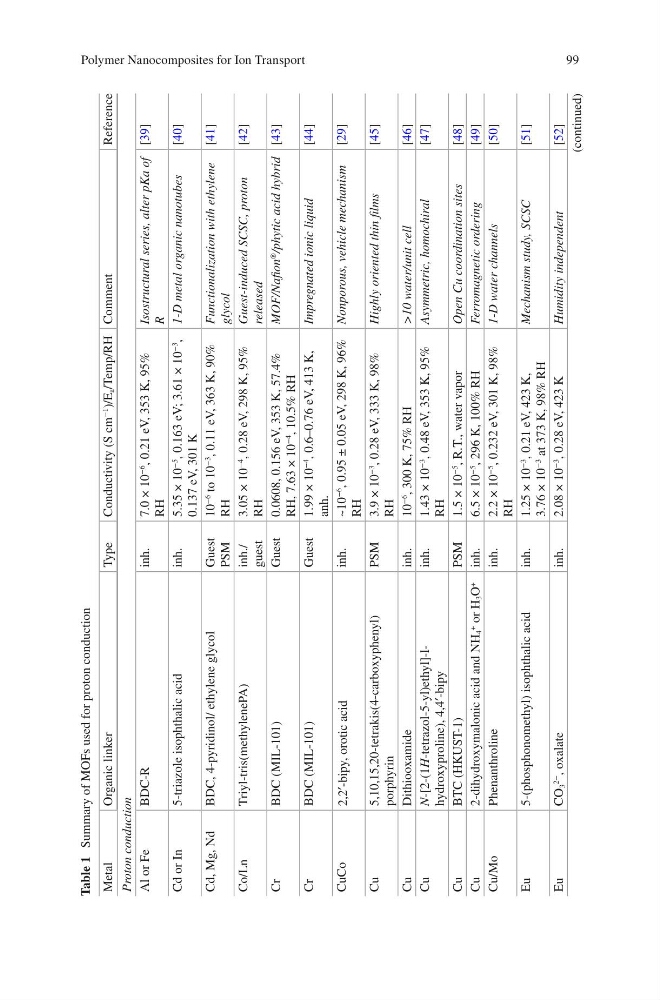
Table 1 Summary of MOFs used for proton conduction
Metal
Organic linker
Type
Conductivity (S cm
−1
)/E
a /Temp/RH Comment
Reference
Proton conduction
Al or Fe
BDC-R
inh.
7.0 × 10
−6
, 0.21 eV, 353 K, 95%
RH
Isostructural series, alter pKa of
R
[39]
Cd or In
5-triazole isophthalic acid
inh.
5.35 × 10
−5
, 0.163 eV; 3.61 × 10
−3
,
0.137 eV, 301 K
1-D metal organic nanotubes
[40]
Cd, Mg, Nd
BDC, 4-pyridinol/ ethylene glycol
Guest
PSM
10
−6
to 10
−3
, 0.11 eV, 363 K, 90%
RH
Functionalization with ethylene
glycol
[41]
Co/Ln
Triyl-tris(methylenePA)
inh./
guest
3.05 × 10
−4
, 0.28 eV, 298 K, 95%
RH
Guest-induced SCSC, proton
released
[42]
Cr
BDC (MIL-101)
Guest
0.0608, 0.156 eV, 353 K, 57.4%
RH, 7.63 × 10
−4
, 10.5% RH
MOF/Nafion
®
/phytic acid hybrid
[43]
Cr
BDC (MIL-101)
Guest
1.99 × 10
−4
, 0.6–0.76 eV, 413 K,
anh.
Impregnated ionic liquid
[44]
CuCo
2,2′-bipy, orotic acid
inh.
~10
−6
, 0.95 ± 0.05 eV, 298 K, 96%
RH
Nonporous, vehicle mechanism
[29]
Cu
5,10,15,20-tetrakis(4-carboxyphenyl)
porphyrin
PSM
3.9 × 10
−3
, 0.28 eV, 333 K, 98%
RH
Highly oriented thin films
[45]
Cu
Dithiooxamide
inh.
10
−6
, 300 K, 75% RH
>10 water/unit cell
[46]
Cu
N-[2-(1H-tetrazol-5-yl)ethyl]-lhydroxyproline), 4,4′-bipy
inh.
1.43 × 10
−3
, 0.48 eV, 353 K, 95%
RH
Asymmetric, homochiral
[47]
Cu
BTC (HKUST-1)
PSM
1.5 × 10
−5
, R.T., water vapor
Open Cu coordination sites
[48]
Cu
2-dihydroxymalonic acid and NH
4
+
or H
3 O
+
inh.
6.5 × 10
−5
, 296 K, 100% RH
Ferromagnetic ordering
[49]
Cu/Mo
Phenanthroline
inh.
2.2 × 10
−5
, 0.232 eV, 301 K, 98%
RH
1-D water channels
[50]
Eu
5-(phosphonomethyl) isophthalic acid
inh.
1.25 × 10
−3
, 0.21 eV, 423 K,
3.76 × 10
−3
at 373 K, 98% RH
Mechanism study, SCSC
[51]
Eu
CO
3
2−
, oxalate
inh.
2.08 × 10
−3
, 0.28 eV, 423 K
Humidity independent
[52]
(continued)
Polymer Nanocomposites for Ion Transport
Table 1 Summary of MOFs used for proton conduction
Metal
Organic linker
Type
Conductivity (S cm
−1
)/E
a /Temp/RH Comment
Reference
Proton conduction
Al or Fe
BDC-R
inh.
7.0 × 10
−6
, 0.21 eV, 353 K, 95%
RH
Isostructural series, alter pKa of
R
[39]
Cd or In
5-triazole isophthalic acid
inh.
5.35 × 10
−5
, 0.163 eV; 3.61 × 10
−3
,
0.137 eV, 301 K
1-D metal organic nanotubes
[40]
Cd, Mg, Nd
BDC, 4-pyridinol/ ethylene glycol
Guest
PSM
10
−6
to 10
−3
, 0.11 eV, 363 K, 90%
RH
Functionalization with ethylene
glycol
[41]
Co/Ln
Triyl-tris(methylenePA)
inh./
guest
3.05 × 10
−4
, 0.28 eV, 298 K, 95%
RH
Guest-induced SCSC, proton
released
[42]
Cr
BDC (MIL-101)
Guest
0.0608, 0.156 eV, 353 K, 57.4%
RH, 7.63 × 10
−4
, 10.5% RH
MOF/Nafion
®
/phytic acid hybrid
[43]
Cr
BDC (MIL-101)
Guest
1.99 × 10
−4
, 0.6–0.76 eV, 413 K,
anh.
Impregnated ionic liquid
[44]
CuCo
2,2′-bipy, orotic acid
inh.
~10
−6
, 0.95 ± 0.05 eV, 298 K, 96%
RH
Nonporous, vehicle mechanism
[29]
Cu
5,10,15,20-tetrakis(4-carboxyphenyl)
porphyrin
PSM
3.9 × 10
−3
, 0.28 eV, 333 K, 98%
RH
Highly oriented thin films
[45]
Cu
Dithiooxamide
inh.
10
−6
, 300 K, 75% RH
>10 water/unit cell
[46]
Cu
N-[2-(1H-tetrazol-5-yl)ethyl]-lhydroxyproline), 4,4′-bipy
inh.
1.43 × 10
−3
, 0.48 eV, 353 K, 95%
RH
Asymmetric, homochiral
[47]
Cu
BTC (HKUST-1)
PSM
1.5 × 10
−5
, R.T., water vapor
Open Cu coordination sites
[48]
Cu
2-dihydroxymalonic acid and NH
4
+
or H
3 O
+
inh.
6.5 × 10
−5
, 296 K, 100% RH
Ferromagnetic ordering
[49]
Cu/Mo
Phenanthroline
inh.
2.2 × 10
−5
, 0.232 eV, 301 K, 98%
RH
1-D water channels
[50]
Eu
5-(phosphonomethyl) isophthalic acid
inh.
1.25 × 10
−3
, 0.21 eV, 423 K,
3.76 × 10
−3
at 373 K, 98% RH
Mechanism study, SCSC
[51]
Eu
CO
3
2−
, oxalate
inh.
2.08 × 10
−3
, 0.28 eV, 423 K
Humidity independent
[52]
(continued)
Polymer Nanocomposites for Ion Transport