

acid, glucose, xylose, and resin as carbonaceous materials (Yang et al. 2018; Tang
et al. 2012).
3.3.1 Top-Down Method
Arc Discharge Method
In arc discharge method, a helium gas of 660 mbar pressure is electrically broken
down to generate plasma using electric current at the anode and cathode. The pure
graphite rod acts as the cathode which is 16 mm in diameter and 40 mm in length,
while the anode is also made up of graphite rod which is 6 mm in diameter and
100 mm in length. The anode is further drilled to make a hole of 3.5 mm in diameter
and 40 mm deep filled with carbon precursor along with catalysts. The arc discharge
was generated by applying 100 A current and 30 V potential between the anode and
cathode kept at a constant distance of 3 mm. Mixtures of metals, Ni–Co, Co–Y, and
Ni–Y, in different atomic percentages were used as catalysts. The high-temperature
plasma sublimes the carbon precursor. The carbon vapor moves toward the cathode
where it cools down due to temperature gradient and is collected from the walls of
the chamber (Journet et al. 1997). Xu et al. (2004) devised arc discharge method for
the preparation of single-walled carbon nanotube exploiting soot which is condensed
on the chamber walls.
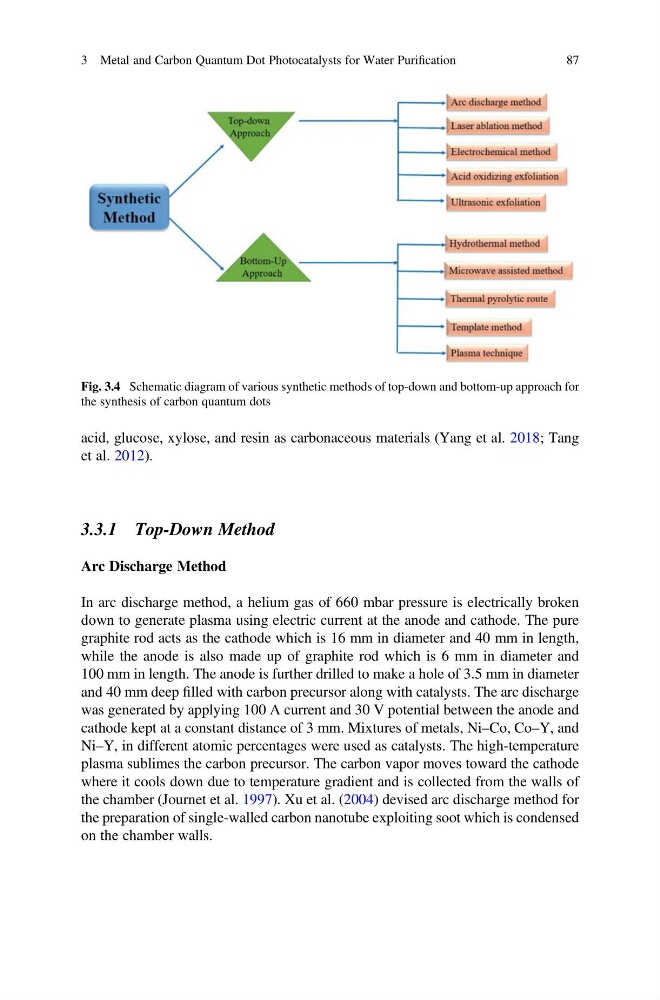
Fig. 3.4 Schematic diagram of various synthetic methods of top-down and bottom-up approach for
the synthesis of carbon quantum dots
3 Metal and Carbon Quantum Dot Photocatalysts for Water Purification
87
et al. 2012).
3.3.1 Top-Down Method
Arc Discharge Method
In arc discharge method, a helium gas of 660 mbar pressure is electrically broken
down to generate plasma using electric current at the anode and cathode. The pure
graphite rod acts as the cathode which is 16 mm in diameter and 40 mm in length,
while the anode is also made up of graphite rod which is 6 mm in diameter and
100 mm in length. The anode is further drilled to make a hole of 3.5 mm in diameter
and 40 mm deep filled with carbon precursor along with catalysts. The arc discharge
was generated by applying 100 A current and 30 V potential between the anode and
cathode kept at a constant distance of 3 mm. Mixtures of metals, Ni–Co, Co–Y, and
Ni–Y, in different atomic percentages were used as catalysts. The high-temperature
plasma sublimes the carbon precursor. The carbon vapor moves toward the cathode
where it cools down due to temperature gradient and is collected from the walls of
the chamber (Journet et al. 1997). Xu et al. (2004) devised arc discharge method for
the preparation of single-walled carbon nanotube exploiting soot which is condensed
on the chamber walls.
Fig. 3.4 Schematic diagram of various synthetic methods of top-down and bottom-up approach for
the synthesis of carbon quantum dots
3 Metal and Carbon Quantum Dot Photocatalysts for Water Purification
87