

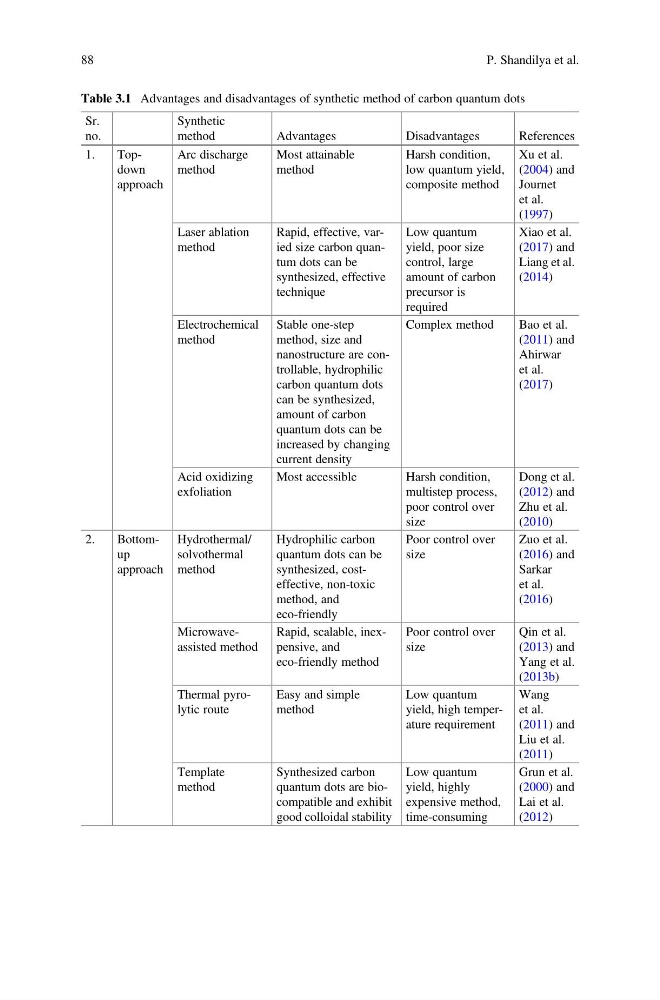
Table 3.1 Advantages and disadvantages of synthetic method of carbon quantum dots
Sr.
no.
Synthetic
method
Advantages
Disadvantages
References
1.
Topdown
approach
Arc discharge
method
Most attainable
method
Harsh condition,
low quantum yield,
composite method
Xu et al.
(2004) and
Journet
et al.
(1997)
Laser ablation
method
Rapid, effective, varied size carbon quantum dots can be
synthesized, effective
technique
Low quantum
yield, poor size
control, large
amount of carbon
precursor is
required
Xiao et al.
(2017) and
Liang et al.
(2014)
Electrochemical
method
Stable one-step
method, size and
nanostructure are controllable, hydrophilic
carbon quantum dots
can be synthesized,
amount of carbon
quantum dots can be
increased by changing
current density
Complex method
Bao et al.
(2011) and
Ahirwar
et al.
(2017)
Acid oxidizing
exfoliation
Most accessible
Harsh condition,
multistep process,
poor control over
size
Dong et al.
(2012) and
Zhu et al.
(2010)
2.
Bottomup
approach
Hydrothermal/
solvothermal
method
Hydrophilic carbon
quantum dots can be
synthesized, costeffective, non-toxic
method, and
eco-friendly
Poor control over
size
Zuo et al.
(2016) and
Sarkar
et al.
(2016)
Microwaveassisted method
Rapid, scalable, inexpensive, and
eco-friendly method
Poor control over
size
Qin et al.
(2013) and
Yang et al.
(2013b)
Thermal pyrolytic route
Easy and simple
method
Low quantum
yield, high temperature requirement
Wang
et al.
(2011) and
Liu et al.
(2011)
Template
method
Synthesized carbon
quantum dots are biocompatible and exhibit
good colloidal stability
Low quantum
yield, highly
expensive method,
time-consuming
Grun et al.
(2000) and
Lai et al.
(2012)
88
P. Shandilya et al.
Sr.
no.
Synthetic
method
Advantages
Disadvantages
References
1.
Topdown
approach
Arc discharge
method
Most attainable
method
Harsh condition,
low quantum yield,
composite method
Xu et al.
(2004) and
Journet
et al.
(1997)
Laser ablation
method
Rapid, effective, varied size carbon quantum dots can be
synthesized, effective
technique
Low quantum
yield, poor size
control, large
amount of carbon
precursor is
required
Xiao et al.
(2017) and
Liang et al.
(2014)
Electrochemical
method
Stable one-step
method, size and
nanostructure are controllable, hydrophilic
carbon quantum dots
can be synthesized,
amount of carbon
quantum dots can be
increased by changing
current density
Complex method
Bao et al.
(2011) and
Ahirwar
et al.
(2017)
Acid oxidizing
exfoliation
Most accessible
Harsh condition,
multistep process,
poor control over
size
Dong et al.
(2012) and
Zhu et al.
(2010)
2.
Bottomup
approach
Hydrothermal/
solvothermal
method
Hydrophilic carbon
quantum dots can be
synthesized, costeffective, non-toxic
method, and
eco-friendly
Poor control over
size
Zuo et al.
(2016) and
Sarkar
et al.
(2016)
Microwaveassisted method
Rapid, scalable, inexpensive, and
eco-friendly method
Poor control over
size
Qin et al.
(2013) and
Yang et al.
(2013b)
Thermal pyrolytic route
Easy and simple
method
Low quantum
yield, high temperature requirement
Wang
et al.
(2011) and
Liu et al.
(2011)
Template
method
Synthesized carbon
quantum dots are biocompatible and exhibit
good colloidal stability
Low quantum
yield, highly
expensive method,
time-consuming
Grun et al.
(2000) and
Lai et al.
(2012)
88
P. Shandilya et al.