

incorporation of Fe 2 O 3 , there was disappearance of 12.8
(100) diffraction peak
which was attributed to Π–Π interaction and van der Waals forces present in g-C 3 N 4 .
Yan et al. (2019) improved photooxidation of bisphenol A via peroxydisulfatemediated g-C 3 N 4 /Fe 2 O 3 photocatalyst and was inferred that SO 4
À2 , OH
À and singlet
oxygen are main reactive species responsible for 92.2% bisphenol A degradation
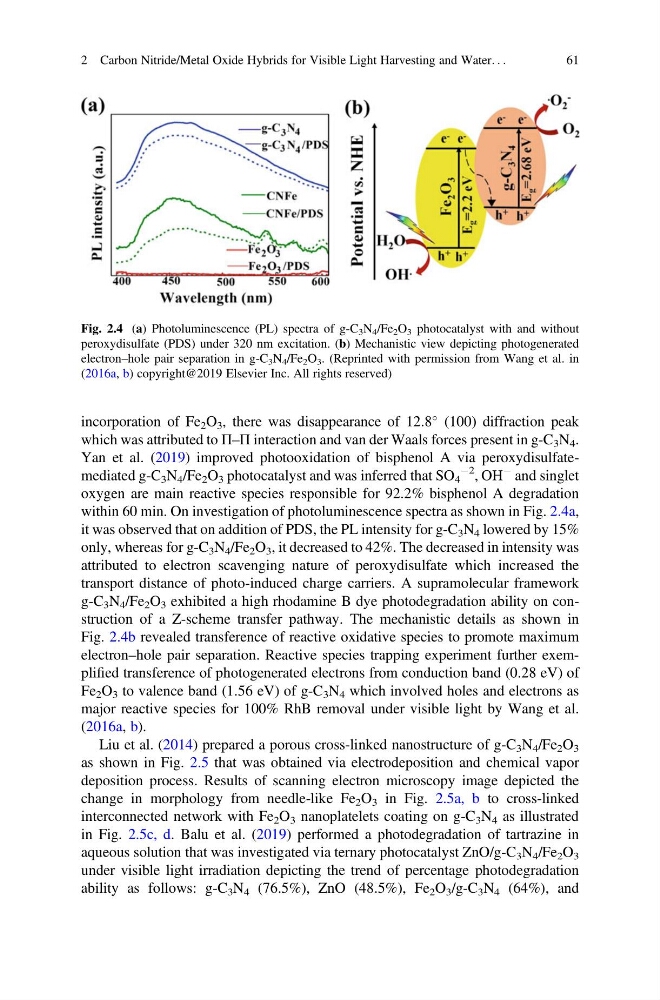
within 60 min. On investigation of photoluminescence spectra as shown in Fig. 2.4a,
it was observed that on addition of PDS, the PL intensity for g-C 3 N 4 lowered by 15%
only, whereas for g-C 3 N 4 /Fe 2 O 3 , it decreased to 42%. The decreased in intensity was
attributed to electron scavenging nature of peroxydisulfate which increased the
transport distance of photo-induced charge carriers. A supramolecular framework
g-C 3 N 4 /Fe 2 O 3 exhibited a high rhodamine B dye photodegradation ability on construction of a Z-scheme transfer pathway. The mechanistic details as shown in
Fig. 2.4b revealed transference of reactive oxidative species to promote maximum
electron–hole pair separation. Reactive species trapping experiment further exemplified transference of photogenerated electrons from conduction band (0.28 eV) of
Fe 2 O 3 to valence band (1.56 eV) of g-C 3 N 4 which involved holes and electrons as
major reactive species for 100% RhB removal under visible light by Wang et al.
(2016a, b).
Liu et al. (2014) prepared a porous cross-linked nanostructure of g-C 3 N 4 /Fe 2 O 3
as shown in Fig. 2.5 that was obtained via electrodeposition and chemical vapor
deposition process. Results of scanning electron microscopy image depicted the
change in morphology from needle-like Fe 2 O 3 in Fig. 2.5a, b to cross-linked
interconnected network with Fe 2 O 3 nanoplatelets coating on g-C 3 N 4 as illustrated
in Fig. 2.5c, d. Balu et al. (2019) performed a photodegradation of tartrazine in
aqueous solution that was investigated via ternary photocatalyst ZnO/g-C 3 N 4 /Fe 2 O 3
under visible light irradiation depicting the trend of percentage photodegradation
ability as follows: g-C 3 N 4 (76.5%), ZnO (48.5%), Fe 2 O 3 /g-C 3 N 4 (64%), and
Fig. 2.4 (a) Photoluminescence (PL) spectra of g-C 3 N 4 /Fe 2 O 3 photocatalyst with and without
peroxydisulfate (PDS) under 320 nm excitation. (b) Mechanistic view depicting photogenerated
electron–hole pair separation in g-C 3 N 4 /Fe 2 O 3 . (Reprinted with permission from Wang et al. in
(2016a, b) copyright@2019 Elsevier Inc. All rights reserved)
2 Carbon Nitride/Metal Oxide Hybrids for Visible Light Harvesting and Water. . .
61
(100) diffraction peak
which was attributed to Π–Π interaction and van der Waals forces present in g-C 3 N 4 .
Yan et al. (2019) improved photooxidation of bisphenol A via peroxydisulfatemediated g-C 3 N 4 /Fe 2 O 3 photocatalyst and was inferred that SO 4
À2 , OH
À and singlet
oxygen are main reactive species responsible for 92.2% bisphenol A degradation
within 60 min. On investigation of photoluminescence spectra as shown in Fig. 2.4a,
it was observed that on addition of PDS, the PL intensity for g-C 3 N 4 lowered by 15%
only, whereas for g-C 3 N 4 /Fe 2 O 3 , it decreased to 42%. The decreased in intensity was
attributed to electron scavenging nature of peroxydisulfate which increased the
transport distance of photo-induced charge carriers. A supramolecular framework
g-C 3 N 4 /Fe 2 O 3 exhibited a high rhodamine B dye photodegradation ability on construction of a Z-scheme transfer pathway. The mechanistic details as shown in
Fig. 2.4b revealed transference of reactive oxidative species to promote maximum
electron–hole pair separation. Reactive species trapping experiment further exemplified transference of photogenerated electrons from conduction band (0.28 eV) of
Fe 2 O 3 to valence band (1.56 eV) of g-C 3 N 4 which involved holes and electrons as
major reactive species for 100% RhB removal under visible light by Wang et al.
(2016a, b).
Liu et al. (2014) prepared a porous cross-linked nanostructure of g-C 3 N 4 /Fe 2 O 3
as shown in Fig. 2.5 that was obtained via electrodeposition and chemical vapor
deposition process. Results of scanning electron microscopy image depicted the
change in morphology from needle-like Fe 2 O 3 in Fig. 2.5a, b to cross-linked
interconnected network with Fe 2 O 3 nanoplatelets coating on g-C 3 N 4 as illustrated
in Fig. 2.5c, d. Balu et al. (2019) performed a photodegradation of tartrazine in
aqueous solution that was investigated via ternary photocatalyst ZnO/g-C 3 N 4 /Fe 2 O 3
under visible light irradiation depicting the trend of percentage photodegradation
ability as follows: g-C 3 N 4 (76.5%), ZnO (48.5%), Fe 2 O 3 /g-C 3 N 4 (64%), and
Fig. 2.4 (a) Photoluminescence (PL) spectra of g-C 3 N 4 /Fe 2 O 3 photocatalyst with and without
peroxydisulfate (PDS) under 320 nm excitation. (b) Mechanistic view depicting photogenerated
electron–hole pair separation in g-C 3 N 4 /Fe 2 O 3 . (Reprinted with permission from Wang et al. in
(2016a, b) copyright@2019 Elsevier Inc. All rights reserved)
2 Carbon Nitride/Metal Oxide Hybrids for Visible Light Harvesting and Water. . .
61