

aforementioned spectacular features accentuate α-Fe 2 O 3 to significantly augment
removal of recalcitrant pollutants from water bodies. Nevertheless, α-Fe 2 O 3 is
accompanied with surface instability and rapid charge carrier recombination; therefore, heterojunction interface with a suitable band structure for spatial electron and
hole pair separation is required (Christoforidis et al. (2016)). The explosive interests
in the arena of hybrid nanocomposites in heterojunction with g-C 3 N 4 have inevitably
led to novel discoveries as discussed in the following section.
Development of photocatalytic nanocomposites with desirable magnetic and
reusable properties has reached a boom, as evident from the literature. The method
opted, persisting environmental conditions, and precursor type are significant
aspects for achieving required characteristics of nanohybrid. The use of wide
temperature range for appropriate designing of heterojunction between Fe 2 O 3 and
g-C 3 N 4 has been widely taken into account. Wang et al. (2016a, b) performed
calcination of precursors ferric nitrate (Fe (NO 3 ) 3 ) and melamine at 500
C in
argon atmosphere to obtain nanorod g-C 3 N 4 /Fe 2 O 3 heterojunction. Similar precursors were used by Li et al. (2017) and Yan et al. (2019) for the preparation of a
synergistic hybrid g-C 3 N 4 /Fe 2 O 3 composite via in situ calcination treatment at
550
C for 3 h. For the first time, an innovative, eco-friendly synthesis technique
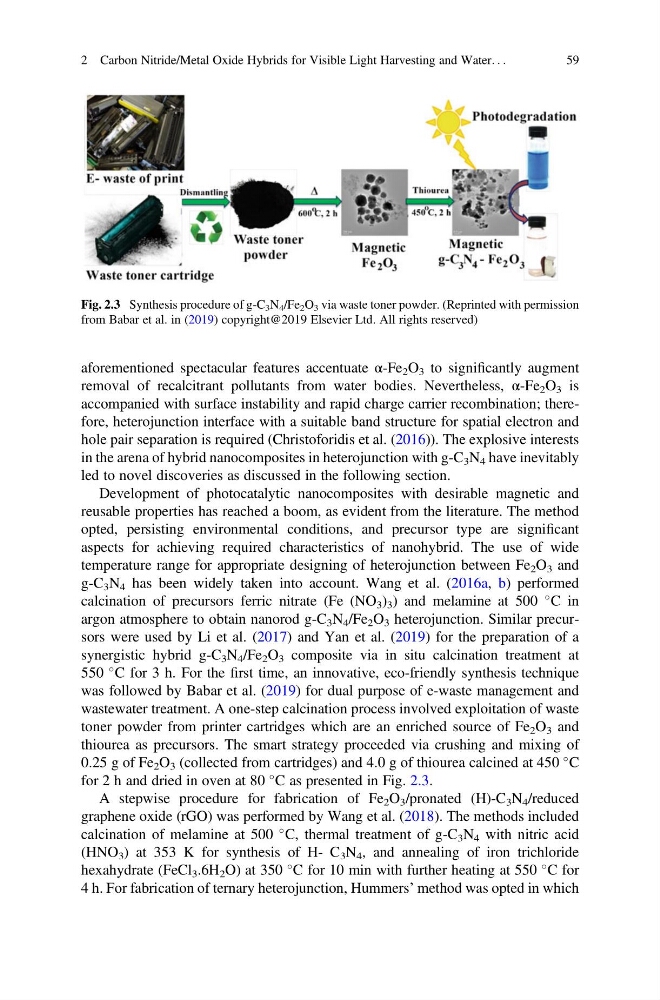
was followed by Babar et al. (2019) for dual purpose of e-waste management and
wastewater treatment. A one-step calcination process involved exploitation of waste
toner powder from printer cartridges which are an enriched source of Fe 2 O 3 and
thiourea as precursors. The smart strategy proceeded via crushing and mixing of
0.25 g of Fe 2 O 3 (collected from cartridges) and 4.0 g of thiourea calcined at 450
C
for 2 h and dried in oven at 80
C as presented in Fig. 2.3.
A stepwise procedure for fabrication of Fe 2 O 3 /pronated (H)-C 3 N 4 /reduced
graphene oxide (rGO) was performed by Wang et al. (2018). The methods included
calcination of melamine at 500
C, thermal treatment of g-C 3 N 4 with nitric acid
(HNO 3 ) at 353 K for synthesis of H- C 3 N 4 , and annealing of iron trichloride
hexahydrate (FeCl 3 .6H 2 O) at 350
C for 10 min with further heating at 550
C for
4 h. For fabrication of ternary heterojunction, Hummers’ method was opted in which
Fig. 2.3 Synthesis procedure of g-C 3 N 4 /Fe 2 O 3 via waste toner powder. (Reprinted with permission
from Babar et al. in (2019) copyright@2019 Elsevier Ltd. All rights reserved)
2 Carbon Nitride/Metal Oxide Hybrids for Visible Light Harvesting and Water. . .
59
removal of recalcitrant pollutants from water bodies. Nevertheless, α-Fe 2 O 3 is
accompanied with surface instability and rapid charge carrier recombination; therefore, heterojunction interface with a suitable band structure for spatial electron and
hole pair separation is required (Christoforidis et al. (2016)). The explosive interests
in the arena of hybrid nanocomposites in heterojunction with g-C 3 N 4 have inevitably
led to novel discoveries as discussed in the following section.
Development of photocatalytic nanocomposites with desirable magnetic and
reusable properties has reached a boom, as evident from the literature. The method
opted, persisting environmental conditions, and precursor type are significant
aspects for achieving required characteristics of nanohybrid. The use of wide
temperature range for appropriate designing of heterojunction between Fe 2 O 3 and
g-C 3 N 4 has been widely taken into account. Wang et al. (2016a, b) performed
calcination of precursors ferric nitrate (Fe (NO 3 ) 3 ) and melamine at 500
C in
argon atmosphere to obtain nanorod g-C 3 N 4 /Fe 2 O 3 heterojunction. Similar precursors were used by Li et al. (2017) and Yan et al. (2019) for the preparation of a
synergistic hybrid g-C 3 N 4 /Fe 2 O 3 composite via in situ calcination treatment at
550
C for 3 h. For the first time, an innovative, eco-friendly synthesis technique
was followed by Babar et al. (2019) for dual purpose of e-waste management and
wastewater treatment. A one-step calcination process involved exploitation of waste
toner powder from printer cartridges which are an enriched source of Fe 2 O 3 and
thiourea as precursors. The smart strategy proceeded via crushing and mixing of
0.25 g of Fe 2 O 3 (collected from cartridges) and 4.0 g of thiourea calcined at 450
C
for 2 h and dried in oven at 80
C as presented in Fig. 2.3.
A stepwise procedure for fabrication of Fe 2 O 3 /pronated (H)-C 3 N 4 /reduced
graphene oxide (rGO) was performed by Wang et al. (2018). The methods included
calcination of melamine at 500
C, thermal treatment of g-C 3 N 4 with nitric acid
(HNO 3 ) at 353 K for synthesis of H- C 3 N 4 , and annealing of iron trichloride
hexahydrate (FeCl 3 .6H 2 O) at 350
C for 10 min with further heating at 550
C for
4 h. For fabrication of ternary heterojunction, Hummers’ method was opted in which
Fig. 2.3 Synthesis procedure of g-C 3 N 4 /Fe 2 O 3 via waste toner powder. (Reprinted with permission
from Babar et al. in (2019) copyright@2019 Elsevier Ltd. All rights reserved)
2 Carbon Nitride/Metal Oxide Hybrids for Visible Light Harvesting and Water. . .
59