

2.2 Synthetic Strategies for Fabrication of g-C 3 N 4 /Fe 2 O 3
The value-added physicochemical properties of magnetic oxide nanocomposites
include facile separation and optical, electrical, and magnetic properties which
allow their practical applicability in realms of environment conservation. Specifically, their ability to exhibit confinement effect, with specific porous surface area,
flexibility, equal size distribution, and good recyclability, makes them a suitable
benign nanostructure (Ashik et al. 2018). Iron oxide exists in the following crystalline phases: hematite (α-Fe 2 O 3 ), magnetite (Fe 3 O 4 ), wustite (FeO), and maghemite
(γ- Fe 2 O 3 ) (Medynska (2018)). Among them, hematite (α-Fe 2 O 3 ) has gained
immense attention due to its cost-effective, non-toxic, and thermodynamically stable
nature. Moreover, appropriate band gap of 2.2 eV and 600 nm absorption range
makes α-Fe 2 O 3 a potential visible light-driven photocatalyst. The high chemical
reactivity of α-Fe 2 O 3 is owed to its lower band-edge potential (2.48 eV) that
improves its photodegradation ability (Li et al. (2017)). Another outstanding benefit
accounts for its rapid processability, photostability, and easy separation forming
solution via external magnetic field as claimed by Santhosh et al. (2019). The
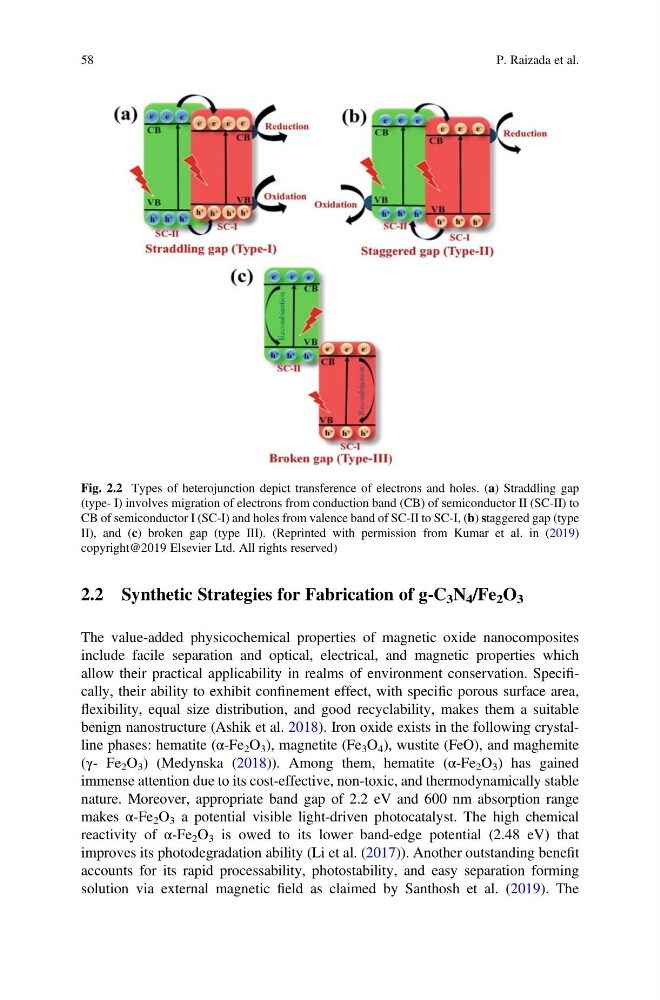
Fig. 2.2 Types of heterojunction depict transference of electrons and holes. (a) Straddling gap
(type- I) involves migration of electrons from conduction band (CB) of semiconductor II (SC-II) to
CB of semiconductor I (SC-I) and holes from valence band of SC-II to SC-I, (b) staggered gap (type
II), and (c) broken gap (type III). (Reprinted with permission from Kumar et al. in (2019)
copyright@2019 Elsevier Ltd. All rights reserved)
58
P. Raizada et al.
The value-added physicochemical properties of magnetic oxide nanocomposites
include facile separation and optical, electrical, and magnetic properties which
allow their practical applicability in realms of environment conservation. Specifically, their ability to exhibit confinement effect, with specific porous surface area,
flexibility, equal size distribution, and good recyclability, makes them a suitable
benign nanostructure (Ashik et al. 2018). Iron oxide exists in the following crystalline phases: hematite (α-Fe 2 O 3 ), magnetite (Fe 3 O 4 ), wustite (FeO), and maghemite
(γ- Fe 2 O 3 ) (Medynska (2018)). Among them, hematite (α-Fe 2 O 3 ) has gained
immense attention due to its cost-effective, non-toxic, and thermodynamically stable
nature. Moreover, appropriate band gap of 2.2 eV and 600 nm absorption range
makes α-Fe 2 O 3 a potential visible light-driven photocatalyst. The high chemical
reactivity of α-Fe 2 O 3 is owed to its lower band-edge potential (2.48 eV) that
improves its photodegradation ability (Li et al. (2017)). Another outstanding benefit
accounts for its rapid processability, photostability, and easy separation forming
solution via external magnetic field as claimed by Santhosh et al. (2019). The
Fig. 2.2 Types of heterojunction depict transference of electrons and holes. (a) Straddling gap
(type- I) involves migration of electrons from conduction band (CB) of semiconductor II (SC-II) to
CB of semiconductor I (SC-I) and holes from valence band of SC-II to SC-I, (b) staggered gap (type
II), and (c) broken gap (type III). (Reprinted with permission from Kumar et al. in (2019)
copyright@2019 Elsevier Ltd. All rights reserved)
58
P. Raizada et al.