

the case of cobalt (Co)-doped TiO 2 /polymer membrane than that of TiO 2 /Ti for both
4-chlorophenol and 2,4-dichlorophenol. These results can be explained by the fact
that doping the transition metal cobalt (Co) into TiO 2 lattice leads to obtaining a
narrow band gap due to the spin exchange interactions which leads the enhancement
of photocatalytic activity.
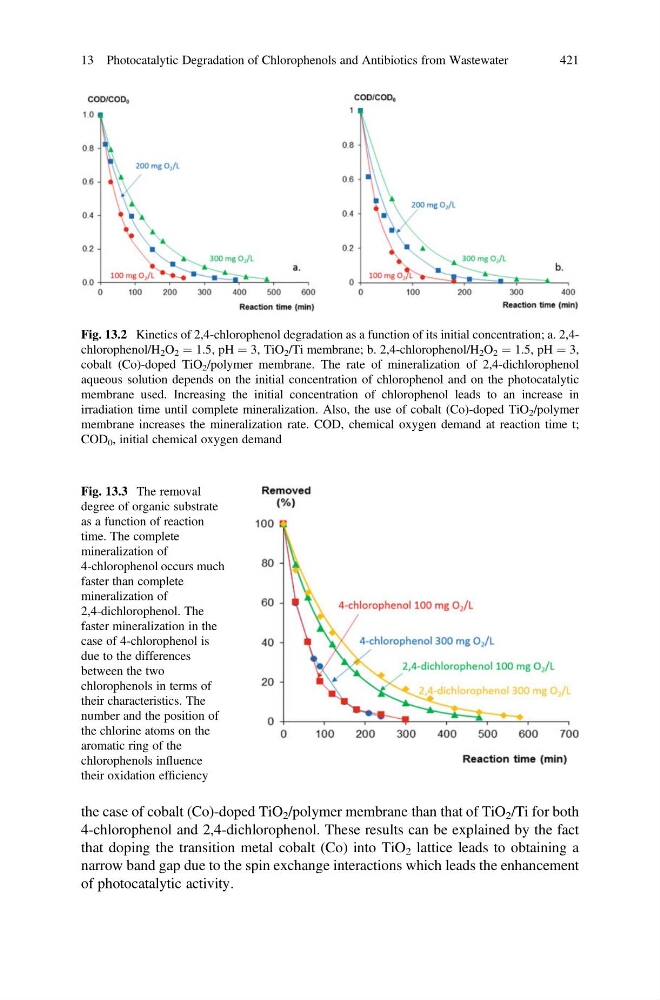
Fig. 13.3 The removal
degree of organic substrate
as a function of reaction
time. The complete
mineralization of
4-chlorophenol occurs much
faster than complete
mineralization of
2,4-dichlorophenol. The
faster mineralization in the
case of 4-chlorophenol is
due to the differences
between the two
chlorophenols in terms of
their characteristics. The
number and the position of
the chlorine atoms on the
aromatic ring of the
chlorophenols influence
their oxidation efficiency
Fig. 13.2 Kinetics of 2,4-chlorophenol degradation as a function of its initial concentration; a. 2,4chlorophenol/H 2 O 2 ¼ 1.5, pH ¼ 3, TiO 2 /Ti membrane; b. 2,4-chlorophenol/H 2 O 2 ¼ 1.5, pH ¼ 3,
cobalt (Co)-doped TiO 2 /polymer membrane. The rate of mineralization of 2,4-dichlorophenol
aqueous solution depends on the initial concentration of chlorophenol and on the photocatalytic
membrane used. Increasing the initial concentration of chlorophenol leads to an increase in
irradiation time until complete mineralization. Also, the use of cobalt (Co)-doped TiO 2 /polymer
membrane increases the mineralization rate. COD, chemical oxygen demand at reaction time t;
COD 0 , initial chemical oxygen demand
13 Photocatalytic Degradation of Chlorophenols and Antibiotics from Wastewater
421
4-chlorophenol and 2,4-dichlorophenol. These results can be explained by the fact
that doping the transition metal cobalt (Co) into TiO 2 lattice leads to obtaining a
narrow band gap due to the spin exchange interactions which leads the enhancement
of photocatalytic activity.
Fig. 13.3 The removal
degree of organic substrate
as a function of reaction
time. The complete
mineralization of
4-chlorophenol occurs much
faster than complete
mineralization of
2,4-dichlorophenol. The
faster mineralization in the
case of 4-chlorophenol is
due to the differences
between the two
chlorophenols in terms of
their characteristics. The
number and the position of
the chlorine atoms on the
aromatic ring of the
chlorophenols influence
their oxidation efficiency
Fig. 13.2 Kinetics of 2,4-chlorophenol degradation as a function of its initial concentration; a. 2,4chlorophenol/H 2 O 2 ¼ 1.5, pH ¼ 3, TiO 2 /Ti membrane; b. 2,4-chlorophenol/H 2 O 2 ¼ 1.5, pH ¼ 3,
cobalt (Co)-doped TiO 2 /polymer membrane. The rate of mineralization of 2,4-dichlorophenol
aqueous solution depends on the initial concentration of chlorophenol and on the photocatalytic
membrane used. Increasing the initial concentration of chlorophenol leads to an increase in
irradiation time until complete mineralization. Also, the use of cobalt (Co)-doped TiO 2 /polymer
membrane increases the mineralization rate. COD, chemical oxygen demand at reaction time t;
COD 0 , initial chemical oxygen demand
13 Photocatalytic Degradation of Chlorophenols and Antibiotics from Wastewater
421