

13.4.2 Results and Discussion
Photocatalytic Degradation of Chlorophenols
The photocatalytic activity of the two membranes, namely, TiO 2 /Ti and cobalt (Co)doped TiO 2 /polymer, was tested for the two types of chlorophenols, namely,
4-chlorophenol and 2,4-dichlorophenol, at three different values of their equivalent
concentration in the initial solution, namely, 100 mg O 2 /L, 200 mg O 2 /L, and
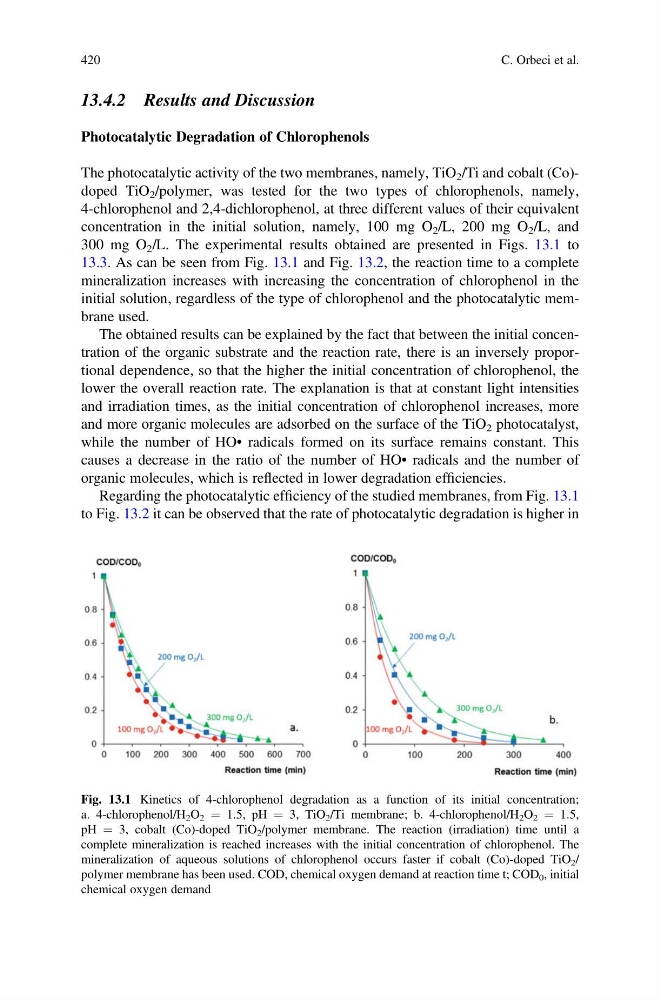
300 mg O 2 /L. The experimental results obtained are presented in Figs. 13.1 to
13.3. As can be seen from Fig. 13.1 and Fig. 13.2, the reaction time to a complete
mineralization increases with increasing the concentration of chlorophenol in the
initial solution, regardless of the type of chlorophenol and the photocatalytic membrane used.
The obtained results can be explained by the fact that between the initial concentration of the organic substrate and the reaction rate, there is an inversely proportional dependence, so that the higher the initial concentration of chlorophenol, the
lower the overall reaction rate. The explanation is that at constant light intensities
and irradiation times, as the initial concentration of chlorophenol increases, more
and more organic molecules are adsorbed on the surface of the TiO 2 photocatalyst,
while the number of HO• radicals formed on its surface remains constant. This
causes a decrease in the ratio of the number of HO• radicals and the number of
organic molecules, which is reflected in lower degradation efficiencies.
Regarding the photocatalytic efficiency of the studied membranes, from Fig. 13.1
to Fig. 13.2 it can be observed that the rate of photocatalytic degradation is higher in
Fig. 13.1 Kinetics of 4-chlorophenol degradation as a function of its initial concentration;
a. 4-chlorophenol/H 2 O 2 ¼ 1.5, pH ¼ 3, TiO 2 /Ti membrane; b. 4-chlorophenol/H 2 O 2 ¼ 1.5,
pH ¼ 3, cobalt (Co)-doped TiO 2 /polymer membrane. The reaction (irradiation) time until a
complete mineralization is reached increases with the initial concentration of chlorophenol. The
mineralization of aqueous solutions of chlorophenol occurs faster if cobalt (Co)-doped TiO 2 /
polymer membrane has been used. COD, chemical oxygen demand at reaction time t; COD 0 , initial
chemical oxygen demand
420
C. Orbeci et al.
Photocatalytic Degradation of Chlorophenols
The photocatalytic activity of the two membranes, namely, TiO 2 /Ti and cobalt (Co)doped TiO 2 /polymer, was tested for the two types of chlorophenols, namely,
4-chlorophenol and 2,4-dichlorophenol, at three different values of their equivalent
concentration in the initial solution, namely, 100 mg O 2 /L, 200 mg O 2 /L, and
300 mg O 2 /L. The experimental results obtained are presented in Figs. 13.1 to
13.3. As can be seen from Fig. 13.1 and Fig. 13.2, the reaction time to a complete
mineralization increases with increasing the concentration of chlorophenol in the
initial solution, regardless of the type of chlorophenol and the photocatalytic membrane used.
The obtained results can be explained by the fact that between the initial concentration of the organic substrate and the reaction rate, there is an inversely proportional dependence, so that the higher the initial concentration of chlorophenol, the
lower the overall reaction rate. The explanation is that at constant light intensities
and irradiation times, as the initial concentration of chlorophenol increases, more
and more organic molecules are adsorbed on the surface of the TiO 2 photocatalyst,
while the number of HO• radicals formed on its surface remains constant. This
causes a decrease in the ratio of the number of HO• radicals and the number of
organic molecules, which is reflected in lower degradation efficiencies.
Regarding the photocatalytic efficiency of the studied membranes, from Fig. 13.1
to Fig. 13.2 it can be observed that the rate of photocatalytic degradation is higher in
Fig. 13.1 Kinetics of 4-chlorophenol degradation as a function of its initial concentration;
a. 4-chlorophenol/H 2 O 2 ¼ 1.5, pH ¼ 3, TiO 2 /Ti membrane; b. 4-chlorophenol/H 2 O 2 ¼ 1.5,
pH ¼ 3, cobalt (Co)-doped TiO 2 /polymer membrane. The reaction (irradiation) time until a
complete mineralization is reached increases with the initial concentration of chlorophenol. The
mineralization of aqueous solutions of chlorophenol occurs faster if cobalt (Co)-doped TiO 2 /
polymer membrane has been used. COD, chemical oxygen demand at reaction time t; COD 0 , initial
chemical oxygen demand
420
C. Orbeci et al.