

It was found from Table 12.4 as serial number 12 and Fig. 12.4, 1D that only
22.42% of methylene blue was degraded in 60 min without using catalyst, under
atmospheric air irradiation. On the other hand, 46.78% degradation efficiency of
methylene blue was obtained with 5 mg catalyst as shown in Table 12.4, serial
number 1 and Fig. 12.4, 1B. The improvement in the degradation efficiencies was
observed as 65.31% and 77.76% with higher catalyst loadings of 7.5 mg and 10 mg,
respectively, as given in Table 12.4, serial numbers 2–3 and Fig. 12.4, 1B. Comparatively less improvement was observed in photodegradation of methylene blue
with the catalyst loading above 10 mg as shown in Table 12.4, serial numbers 4–5,
and Fig. 12.4, 1B. This implies that the photo-induced electrons and holes are
produced at lesser rate with high catalyst loadings and leads to a limiting factor for
degradation. Catalyst loading of 10 mg is found to be a better choice for the
photodegradation of methylene blue.
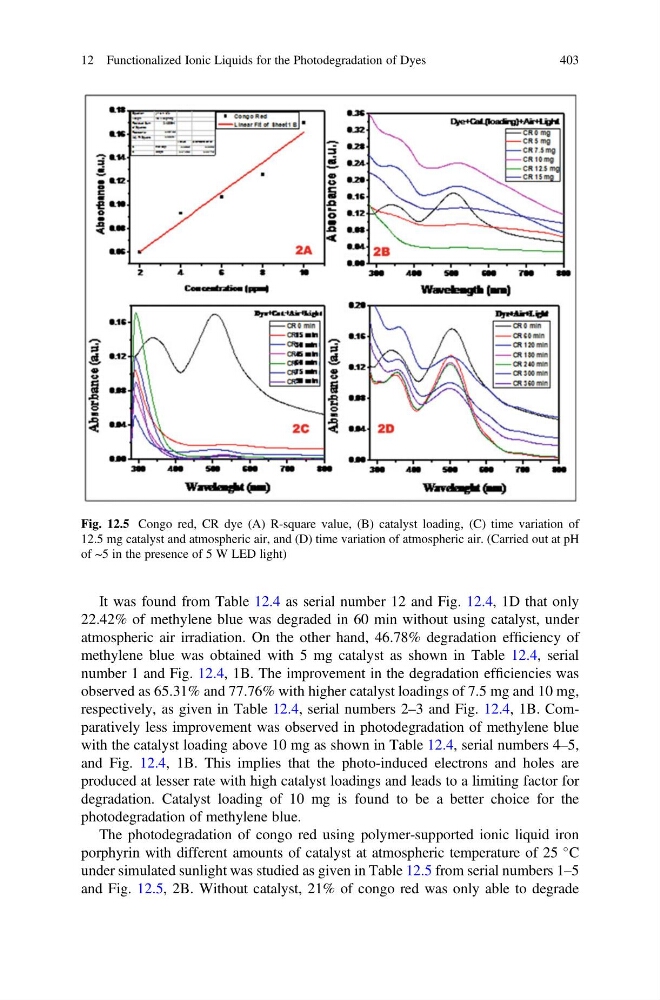
The photodegradation of congo red using polymer-supported ionic liquid iron
porphyrin with different amounts of catalyst at atmospheric temperature of 25
C
under simulated sunlight was studied as given in Table 12.5 from serial numbers 1–5
and Fig. 12.5, 2B. Without catalyst, 21% of congo red was only able to degrade
Fig. 12.5 Congo red, CR dye (A) R-square value, (B) catalyst loading, (C) time variation of
12.5 mg catalyst and atmospheric air, and (D) time variation of atmospheric air. (Carried out at pH
of ~5 in the presence of 5 W LED light)
12 Functionalized Ionic Liquids for the Photodegradation of Dyes
403
22.42% of methylene blue was degraded in 60 min without using catalyst, under
atmospheric air irradiation. On the other hand, 46.78% degradation efficiency of
methylene blue was obtained with 5 mg catalyst as shown in Table 12.4, serial
number 1 and Fig. 12.4, 1B. The improvement in the degradation efficiencies was
observed as 65.31% and 77.76% with higher catalyst loadings of 7.5 mg and 10 mg,
respectively, as given in Table 12.4, serial numbers 2–3 and Fig. 12.4, 1B. Comparatively less improvement was observed in photodegradation of methylene blue
with the catalyst loading above 10 mg as shown in Table 12.4, serial numbers 4–5,
and Fig. 12.4, 1B. This implies that the photo-induced electrons and holes are
produced at lesser rate with high catalyst loadings and leads to a limiting factor for
degradation. Catalyst loading of 10 mg is found to be a better choice for the
photodegradation of methylene blue.
The photodegradation of congo red using polymer-supported ionic liquid iron
porphyrin with different amounts of catalyst at atmospheric temperature of 25
C
under simulated sunlight was studied as given in Table 12.5 from serial numbers 1–5
and Fig. 12.5, 2B. Without catalyst, 21% of congo red was only able to degrade
Fig. 12.5 Congo red, CR dye (A) R-square value, (B) catalyst loading, (C) time variation of
12.5 mg catalyst and atmospheric air, and (D) time variation of atmospheric air. (Carried out at pH
of ~5 in the presence of 5 W LED light)
12 Functionalized Ionic Liquids for the Photodegradation of Dyes
403