

1 H NMR (400 MHz, DMSO-d 6 ): δ 0.52 (s, 1H), 0.74 (br. 1H), 1.08 (br. 1H), 1.29
(s, 1H), 1.92 (s, 1H), 5.65 (s, 4H), 7.36 (br. 6H), 7.73 (br. 1H), 10.13 (d, 2H,
J ¼ 8.97 Hz), 15.79 (br. 1H).
13 C NMR (100 MHz, DMSO-d 6 ): 190.77, 161.74,
159.18, 136.94, 135.46, 131.29, 129.18, 127.15, 122.94, 118.64, 114.49, 49.76.
FT-IR – (KBr, v/cm
À1 ): 3377.36, 3018.60, 2926.01, 1654.92, 1612.49, 1558.48,
1487.12, 1444.68, 1371.39, 1282.66, 1249.87, 1188.15, 1151.50, 1016.49,929.69,
842.89, 744.52, 698.23, 632.65, 540.07, 497.63, 424.34.
Synthesis
of
3-(2-carboxyethyl)-1-(3-formyl-4-hydroxybenzyl)-1H-benzo[d]
imidazol-3-ium bromide, 1-B
The synthesis of 3-(2-carboxyethyl)-1-(3-formyl-4-hydroxybenzyl)-1H-benzo[d]
imidazol-3-ium bromide was carried out according to the procedure given in
(Muskawar et al. 2013; Khiratkar et al. 2016) with slight modification. 5-(1-Hbenzo[d]imidazole-1-yl) methyl)-2-hydroxybenzaldehyde-(BMSA), 7.56 g/
30 mmol was stirred for 1 h in toluene solution of 50 ml at 60
C. Then,
3-bromopropionic acid of 6.08 g/40 mmol in toluene was added drop wise for
30 min and stirred for next 14 h at 85
C. After this, the whitish solid product was
obtained, after the decantation of toluene and washing with ethyl acetate, 3 Â 20 mL
and diethyl ether, 3 Â 25 mL with yield of 73.33%, and melting point of 205
C.
1 H NMR (400 MHz, DMSO-d 6 ): δ 2.63 (s, 2H), 4.33 (s, 2H), 5.35 (s, 2H), 6.67
(s, 1H),7.15 (s, 1H), 7.29 (s, 1H), 7.50 (d, 1H, J ¼ 19.52 Hz), 7.75 (s, 1H), 9.24 (s,
1H), 9.58 (s, 1H), 9.88 (s, 1H), 10.55 (s, 1H), 12.32 (1H, br), 15.58 (1H, br),
13 C
NMR (100 MHz, DMSO-d 6 ): 190.97, 172.31, 161.49, 161.32, 142.40, 142.57,
136.53, 129.55, 127.12, 126.01, 125.24, 122.90, 118.48, 116.31, 114.47, 114.34,
113.51, 65.36, 49.56, 33.21, 15.63. FT-IR – (KBr, v/cm
À1 ): 3360, 3120, 1720, 1560,
1440, 1249, 1184, 1128, 989, 823, 744, 626, 495.
Synthesis of 1,1
0 1
00 -(((20-(5-((3-(4-(sec-butyl)benzyl)-1H-benzo[d]imidazole-3ium-1-yl)methyl)-2-hydroxyphenyl)porohyrin-5,10,15-triyl)tris
(4-hydroxybenzene-3,1-diyl))tris (methylene))tris(3-(2-carboxyethyl)-1H-benzo
[d]imidazole-3-ium) tribromide chloride, (PSILPP) ligand 1-C
1-(4-(sec-butyl)benzyl)-3-(3-formyl-4-hydroxybenzyl)-1H-benzo[d]imidazol-3ium chloride, 1-A of 1.01 g/2.5 mmol and 3-(2-carboxyethyl)-1-(3-formyl-4hydroxybenzyl)-1H-benzo[d]imidazol-3-ium bromide, and 1-B of 3.039 g/
7.5 mmol were mixed thoroughly in propionic acid, 20 mL at 60
C for 30 min.
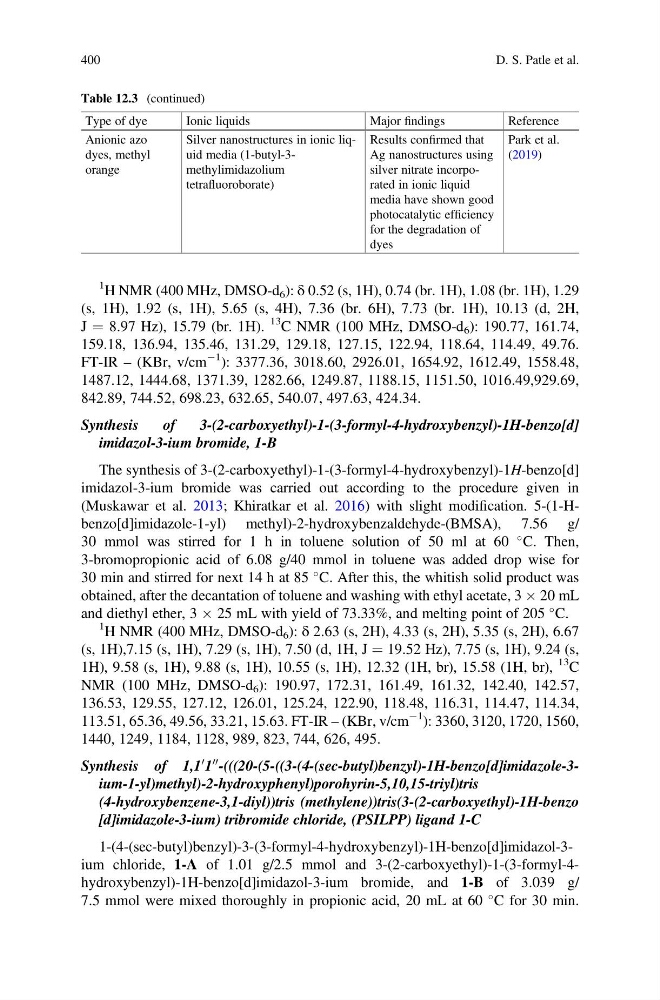
Table 12.3 (continued)
Type of dye
Ionic liquids
Major findings
Reference
Anionic azo
dyes, methyl
orange
Silver nanostructures in ionic liquid media (1-butyl-3methylimidazolium
tetrafluoroborate)
Results confirmed that
Ag nanostructures using
silver nitrate incorporated in ionic liquid
media have shown good
photocatalytic efficiency
for the degradation of
dyes
Park et al.
(2019)
400
D. S. Patle et al.
(s, 1H), 1.92 (s, 1H), 5.65 (s, 4H), 7.36 (br. 6H), 7.73 (br. 1H), 10.13 (d, 2H,
J ¼ 8.97 Hz), 15.79 (br. 1H).
13 C NMR (100 MHz, DMSO-d 6 ): 190.77, 161.74,
159.18, 136.94, 135.46, 131.29, 129.18, 127.15, 122.94, 118.64, 114.49, 49.76.
FT-IR – (KBr, v/cm
À1 ): 3377.36, 3018.60, 2926.01, 1654.92, 1612.49, 1558.48,
1487.12, 1444.68, 1371.39, 1282.66, 1249.87, 1188.15, 1151.50, 1016.49,929.69,
842.89, 744.52, 698.23, 632.65, 540.07, 497.63, 424.34.
Synthesis
of
3-(2-carboxyethyl)-1-(3-formyl-4-hydroxybenzyl)-1H-benzo[d]
imidazol-3-ium bromide, 1-B
The synthesis of 3-(2-carboxyethyl)-1-(3-formyl-4-hydroxybenzyl)-1H-benzo[d]
imidazol-3-ium bromide was carried out according to the procedure given in
(Muskawar et al. 2013; Khiratkar et al. 2016) with slight modification. 5-(1-Hbenzo[d]imidazole-1-yl) methyl)-2-hydroxybenzaldehyde-(BMSA), 7.56 g/
30 mmol was stirred for 1 h in toluene solution of 50 ml at 60
C. Then,
3-bromopropionic acid of 6.08 g/40 mmol in toluene was added drop wise for
30 min and stirred for next 14 h at 85
C. After this, the whitish solid product was
obtained, after the decantation of toluene and washing with ethyl acetate, 3 Â 20 mL
and diethyl ether, 3 Â 25 mL with yield of 73.33%, and melting point of 205
C.
1 H NMR (400 MHz, DMSO-d 6 ): δ 2.63 (s, 2H), 4.33 (s, 2H), 5.35 (s, 2H), 6.67
(s, 1H),7.15 (s, 1H), 7.29 (s, 1H), 7.50 (d, 1H, J ¼ 19.52 Hz), 7.75 (s, 1H), 9.24 (s,
1H), 9.58 (s, 1H), 9.88 (s, 1H), 10.55 (s, 1H), 12.32 (1H, br), 15.58 (1H, br),
13 C
NMR (100 MHz, DMSO-d 6 ): 190.97, 172.31, 161.49, 161.32, 142.40, 142.57,
136.53, 129.55, 127.12, 126.01, 125.24, 122.90, 118.48, 116.31, 114.47, 114.34,
113.51, 65.36, 49.56, 33.21, 15.63. FT-IR – (KBr, v/cm
À1 ): 3360, 3120, 1720, 1560,
1440, 1249, 1184, 1128, 989, 823, 744, 626, 495.
Synthesis of 1,1
0 1
00 -(((20-(5-((3-(4-(sec-butyl)benzyl)-1H-benzo[d]imidazole-3ium-1-yl)methyl)-2-hydroxyphenyl)porohyrin-5,10,15-triyl)tris
(4-hydroxybenzene-3,1-diyl))tris (methylene))tris(3-(2-carboxyethyl)-1H-benzo
[d]imidazole-3-ium) tribromide chloride, (PSILPP) ligand 1-C
1-(4-(sec-butyl)benzyl)-3-(3-formyl-4-hydroxybenzyl)-1H-benzo[d]imidazol-3ium chloride, 1-A of 1.01 g/2.5 mmol and 3-(2-carboxyethyl)-1-(3-formyl-4hydroxybenzyl)-1H-benzo[d]imidazol-3-ium bromide, and 1-B of 3.039 g/
7.5 mmol were mixed thoroughly in propionic acid, 20 mL at 60
C for 30 min.
Table 12.3 (continued)
Type of dye
Ionic liquids
Major findings
Reference
Anionic azo
dyes, methyl
orange
Silver nanostructures in ionic liquid media (1-butyl-3methylimidazolium
tetrafluoroborate)
Results confirmed that
Ag nanostructures using
silver nitrate incorporated in ionic liquid
media have shown good
photocatalytic efficiency
for the degradation of
dyes
Park et al.
(2019)
400
D. S. Patle et al.