

The structural and electronic features of applied photo-anodes/cathodes in
nanomaterials are the main factors affecting the photoelectrochemical water splitting
mechanism. Various visible light materials were applied in photoelectrochemical
water splitting as photo-electrodes. Recently, Bi-based materials have been widely
used in the manufacturing of photo-electrodes in visible light materials systems. For
instance, BiFeO 3 photo-anodes were synthesized by using dual-source low-pressure
chemical vapor deposition and used in photocatalytic and photoelectrochemical
water splitting induced by solar light. Results of incident photon-to-electron conversion efficiency suggested 23% efficiency for photoelectrochemical water splitting
activated by light illumination (400 nm) (Moniz et al. 2015). Another work has
reported high efficient nanoporous Bi 2 WO 6 photo-anodes which synthesized by
facile drop-casting method (Dong et al. 2017). The Bi 2 WO 6 photo-electrode showed
highly significant efficiency for photoelectrochemical water splitting which
exhibited photocurrent almost ten times higher than traditional photo-electrodes.
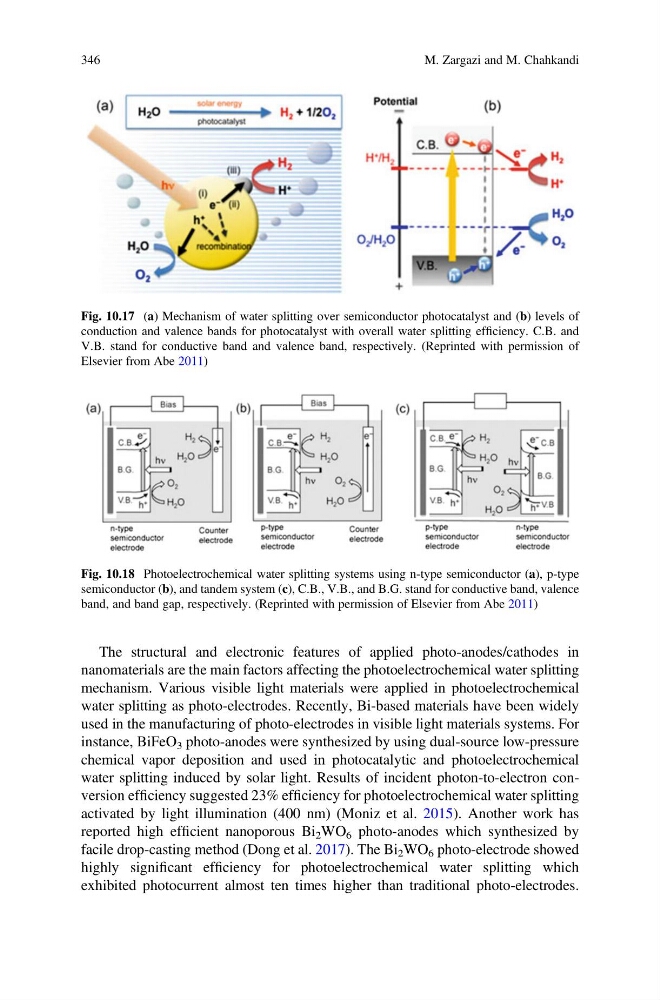
Fig. 10.17 (a) Mechanism of water splitting over semiconductor photocatalyst and (b) levels of
conduction and valence bands for photocatalyst with overall water splitting efficiency. C.B. and
V.B. stand for conductive band and valence band, respectively. (Reprinted with permission of
Elsevier from Abe 2011)
Fig. 10.18 Photoelectrochemical water splitting systems using n-type semiconductor (a), p-type
semiconductor (b), and tandem system (c), C.B., V.B., and B.G. stand for conductive band, valence
band, and band gap, respectively. (Reprinted with permission of Elsevier from Abe 2011)
346
M. Zargazi and M. Chahkandi
nanomaterials are the main factors affecting the photoelectrochemical water splitting
mechanism. Various visible light materials were applied in photoelectrochemical
water splitting as photo-electrodes. Recently, Bi-based materials have been widely
used in the manufacturing of photo-electrodes in visible light materials systems. For
instance, BiFeO 3 photo-anodes were synthesized by using dual-source low-pressure
chemical vapor deposition and used in photocatalytic and photoelectrochemical
water splitting induced by solar light. Results of incident photon-to-electron conversion efficiency suggested 23% efficiency for photoelectrochemical water splitting
activated by light illumination (400 nm) (Moniz et al. 2015). Another work has
reported high efficient nanoporous Bi 2 WO 6 photo-anodes which synthesized by
facile drop-casting method (Dong et al. 2017). The Bi 2 WO 6 photo-electrode showed
highly significant efficiency for photoelectrochemical water splitting which
exhibited photocurrent almost ten times higher than traditional photo-electrodes.
Fig. 10.17 (a) Mechanism of water splitting over semiconductor photocatalyst and (b) levels of
conduction and valence bands for photocatalyst with overall water splitting efficiency. C.B. and
V.B. stand for conductive band and valence band, respectively. (Reprinted with permission of
Elsevier from Abe 2011)
Fig. 10.18 Photoelectrochemical water splitting systems using n-type semiconductor (a), p-type
semiconductor (b), and tandem system (c), C.B., V.B., and B.G. stand for conductive band, valence
band, and band gap, respectively. (Reprinted with permission of Elsevier from Abe 2011)
346
M. Zargazi and M. Chahkandi