

10.3.2 Water Splitting
Energy frugality in the near future will be a major challenge around the world.
Scientists are focused on researches providing clean and sustainable energy sources
to decrease probability of complete disappear the unrenewable energies and to
manage the pollutants. Burning of hydrogen in the presence of oxygen is not emitted
any contaminants. Hence, hydrogen can be considered as a promising renewable fuel
which is applied in vehicles, aircrafts, and electrical devices. Water splitting is a
promising way to produce H 2 . Different techniques for water splitting have been
applied such as photoelectrochemical systems (Chen et al. 2016b), photocatalytic
(Ni et al. 2007), photobiological (Poudyal et al. 2015), and thermal decomposition
(Lapicque 1983). Among them, photoelectrochemical and photocatalytic water
splitting are known as simplest, cost-effective, and efficient methods for hydrogen
production which mechanism of H 2 production depicted in Fig. 10.17 (Abe 2011).
Photoelectrochemical water splitting manners are categorized in three types
which are depicted in Fig. 10.18. The solar light is considered as effective source
by ZÀscheme compared to the conversional process. Therefore, the hydrogen
evolution occurred under proton reduction by electrons of conduction band and
oxygen evolution take place by holes of valence band. It can be concluded that the
water hydrolysis progressed through the event of cyclic redox pair. Figure 10.18a, b
shows n- and p-type semiconductors involved in water splitting. Figure 10.18c
illustrates the combination of two various photo electrodes, as oxidation and reduction reactions can be simultaneously done and can more effectively employ solar
energy. Over the surface of nanomaterials having high ratio of surface to volume, the
charge carriers are generated because of the reduced size with high surface area,
different shapes, and controlled morphology. Therefore, nanomaterials can be
applied in water splitting process established at the nanomaterials surface. Many
researches demonstrate the 50–90% increment in the efficiency of
photoelectrochemical water splitting.
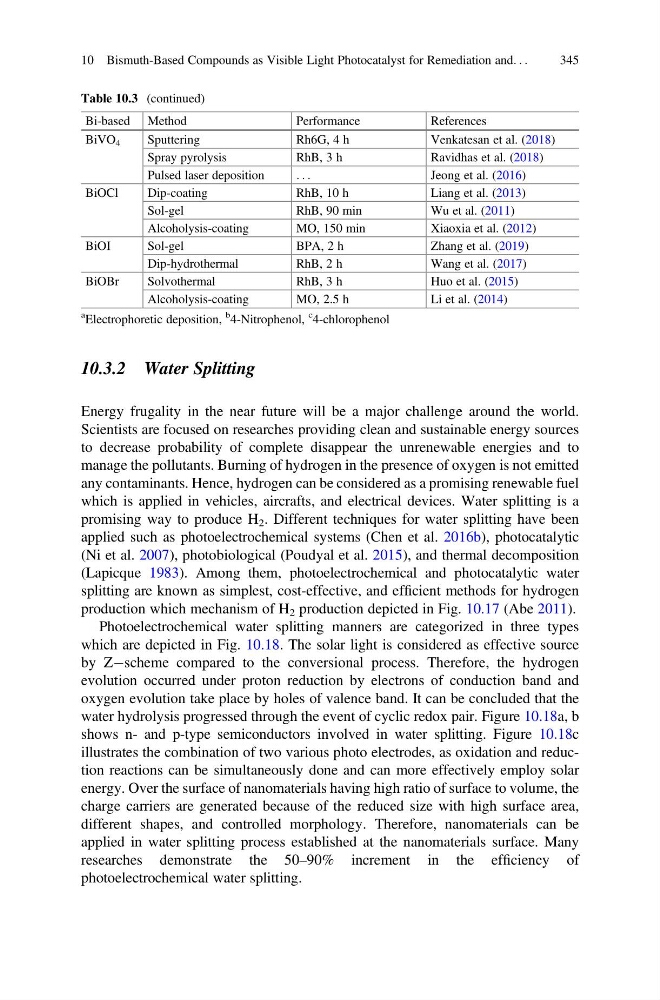
Table 10.3 (continued)
Bi-based Method
Performance
References
BiVO 4
Sputtering
Rh6G, 4 h
Venkatesan et al. (2018)
Spray pyrolysis
RhB, 3 h
Ravidhas et al. (2018)
Pulsed laser deposition
. . .
Jeong et al. (2016)
BiOCl
Dip-coating
RhB, 10 h
Liang et al. (2013)
Sol-gel
RhB, 90 min
Wu et al. (2011)
Alcoholysis-coating
MO, 150 min
Xiaoxia et al. (2012)
BiOI
Sol-gel
BPA, 2 h
Zhang et al. (2019)
Dip-hydrothermal
RhB, 2 h
Wang et al. (2017)
BiOBr
Solvothermal
RhB, 3 h
Huo et al. (2015)
Alcoholysis-coating
MO, 2.5 h
Li et al. (2014)
a Electrophoretic deposition,
b
4-Nitrophenol,
c 4-chlorophenol
10 Bismuth-Based Compounds as Visible Light Photocatalyst for Remediation and. . .
345
Energy frugality in the near future will be a major challenge around the world.
Scientists are focused on researches providing clean and sustainable energy sources
to decrease probability of complete disappear the unrenewable energies and to
manage the pollutants. Burning of hydrogen in the presence of oxygen is not emitted
any contaminants. Hence, hydrogen can be considered as a promising renewable fuel
which is applied in vehicles, aircrafts, and electrical devices. Water splitting is a
promising way to produce H 2 . Different techniques for water splitting have been
applied such as photoelectrochemical systems (Chen et al. 2016b), photocatalytic
(Ni et al. 2007), photobiological (Poudyal et al. 2015), and thermal decomposition
(Lapicque 1983). Among them, photoelectrochemical and photocatalytic water
splitting are known as simplest, cost-effective, and efficient methods for hydrogen
production which mechanism of H 2 production depicted in Fig. 10.17 (Abe 2011).
Photoelectrochemical water splitting manners are categorized in three types
which are depicted in Fig. 10.18. The solar light is considered as effective source
by ZÀscheme compared to the conversional process. Therefore, the hydrogen
evolution occurred under proton reduction by electrons of conduction band and
oxygen evolution take place by holes of valence band. It can be concluded that the
water hydrolysis progressed through the event of cyclic redox pair. Figure 10.18a, b
shows n- and p-type semiconductors involved in water splitting. Figure 10.18c
illustrates the combination of two various photo electrodes, as oxidation and reduction reactions can be simultaneously done and can more effectively employ solar
energy. Over the surface of nanomaterials having high ratio of surface to volume, the
charge carriers are generated because of the reduced size with high surface area,
different shapes, and controlled morphology. Therefore, nanomaterials can be
applied in water splitting process established at the nanomaterials surface. Many
researches demonstrate the 50–90% increment in the efficiency of
photoelectrochemical water splitting.
Table 10.3 (continued)
Bi-based Method
Performance
References
BiVO 4
Sputtering
Rh6G, 4 h
Venkatesan et al. (2018)
Spray pyrolysis
RhB, 3 h
Ravidhas et al. (2018)
Pulsed laser deposition
. . .
Jeong et al. (2016)
BiOCl
Dip-coating
RhB, 10 h
Liang et al. (2013)
Sol-gel
RhB, 90 min
Wu et al. (2011)
Alcoholysis-coating
MO, 150 min
Xiaoxia et al. (2012)
BiOI
Sol-gel
BPA, 2 h
Zhang et al. (2019)
Dip-hydrothermal
RhB, 2 h
Wang et al. (2017)
BiOBr
Solvothermal
RhB, 3 h
Huo et al. (2015)
Alcoholysis-coating
MO, 2.5 h
Li et al. (2014)
a Electrophoretic deposition,
b
4-Nitrophenol,
c 4-chlorophenol
10 Bismuth-Based Compounds as Visible Light Photocatalyst for Remediation and. . .
345