

between double ZÀscheme heterojunctions. Some of ZÀscheme heterojunctions
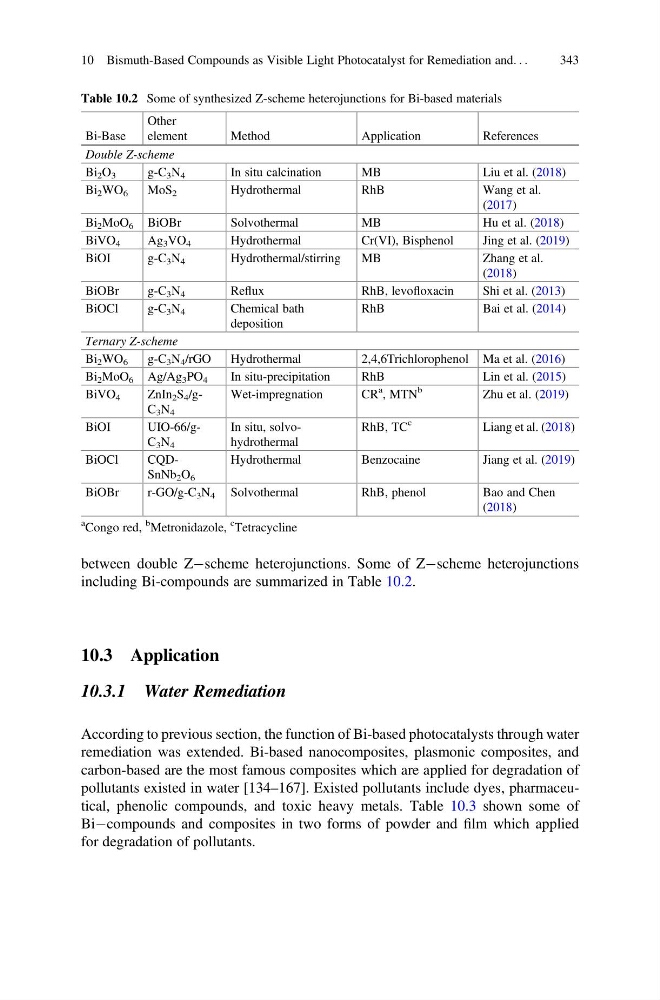
including Bi-compounds are summarized in Table 10.2.
10.3 Application
10.3.1 Water Remediation
According to previous section, the function of Bi-based photocatalysts through water
remediation was extended. Bi-based nanocomposites, plasmonic composites, and
carbon-based are the most famous composites which are applied for degradation of
pollutants existed in water [134–167]. Existed pollutants include dyes, pharmaceutical, phenolic compounds, and toxic heavy metals. Table 10.3 shown some of
BiÀcompounds and composites in two forms of powder and film which applied
for degradation of pollutants.
Table 10.2 Some of synthesized Z-scheme heterojunctions for Bi-based materials
Bi-Base
Other
element
Method
Application
References
Double Z-scheme
Bi 2 O 3
g-C 3 N 4
In situ calcination
MB
Liu et al. (2018)
Bi 2 WO 6
MoS 2
Hydrothermal
RhB
Wang et al.
(2017)
Bi 2 MoO 6 BiOBr
Solvothermal
MB
Hu et al. (2018)
BiVO 4
Ag 3 VO 4
Hydrothermal
Cr(VI), Bisphenol
Jing et al. (2019)
BiOI
g-C 3 N 4
Hydrothermal/stirring
MB
Zhang et al.
(2018)
BiOBr
g-C 3 N 4
Reflux
RhB, levofloxacin
Shi et al. (2013)
BiOCl
g-C 3 N 4
Chemical bath
deposition
RhB
Bai et al. (2014)
Ternary Z-scheme
Bi 2 WO 6
g-C 3 N 4 /rGO
Hydrothermal
2,4,6Trichlorophenol Ma et al. (2016)
Bi 2 MoO 6 Ag/Ag 3 PO 4
In situ-precipitation
RhB
Lin et al. (2015)
BiVO 4
ZnIn 2 S 4 /gC 3 N 4
Wet-impregnation
CR
a , MTN
b
Zhu et al. (2019)
BiOI
UIO-66/gC 3 N 4
In situ, solvohydrothermal
RhB, TC
c
Liang et al. (2018)
BiOCl
CQDSnNb 2 O 6
Hydrothermal
Benzocaine
Jiang et al. (2019)
BiOBr
r-GO/g-C 3 N 4 Solvothermal
RhB, phenol
Bao and Chen
(2018)
a Congo red,
b
Metronidazole,
c Tetracycline
10 Bismuth-Based Compounds as Visible Light Photocatalyst for Remediation and. . .
343
including Bi-compounds are summarized in Table 10.2.
10.3 Application
10.3.1 Water Remediation
According to previous section, the function of Bi-based photocatalysts through water
remediation was extended. Bi-based nanocomposites, plasmonic composites, and
carbon-based are the most famous composites which are applied for degradation of
pollutants existed in water [134–167]. Existed pollutants include dyes, pharmaceutical, phenolic compounds, and toxic heavy metals. Table 10.3 shown some of
BiÀcompounds and composites in two forms of powder and film which applied
for degradation of pollutants.
Table 10.2 Some of synthesized Z-scheme heterojunctions for Bi-based materials
Bi-Base
Other
element
Method
Application
References
Double Z-scheme
Bi 2 O 3
g-C 3 N 4
In situ calcination
MB
Liu et al. (2018)
Bi 2 WO 6
MoS 2
Hydrothermal
RhB
Wang et al.
(2017)
Bi 2 MoO 6 BiOBr
Solvothermal
MB
Hu et al. (2018)
BiVO 4
Ag 3 VO 4
Hydrothermal
Cr(VI), Bisphenol
Jing et al. (2019)
BiOI
g-C 3 N 4
Hydrothermal/stirring
MB
Zhang et al.
(2018)
BiOBr
g-C 3 N 4
Reflux
RhB, levofloxacin
Shi et al. (2013)
BiOCl
g-C 3 N 4
Chemical bath
deposition
RhB
Bai et al. (2014)
Ternary Z-scheme
Bi 2 WO 6
g-C 3 N 4 /rGO
Hydrothermal
2,4,6Trichlorophenol Ma et al. (2016)
Bi 2 MoO 6 Ag/Ag 3 PO 4
In situ-precipitation
RhB
Lin et al. (2015)
BiVO 4
ZnIn 2 S 4 /gC 3 N 4
Wet-impregnation
CR
a , MTN
b
Zhu et al. (2019)
BiOI
UIO-66/gC 3 N 4
In situ, solvohydrothermal
RhB, TC
c
Liang et al. (2018)
BiOCl
CQDSnNb 2 O 6
Hydrothermal
Benzocaine
Jiang et al. (2019)
BiOBr
r-GO/g-C 3 N 4 Solvothermal
RhB, phenol
Bao and Chen
(2018)
a Congo red,
b
Metronidazole,
c Tetracycline
10 Bismuth-Based Compounds as Visible Light Photocatalyst for Remediation and. . .
343