

two semiconductors (I, II) acted as cite for charge transfer. The ZÀscheme
heterojunction has the same structure to a conventional heterojunction (type II),
while charge transfer is different for two heterojunctions (Fig. 10.14b). In a
ZÀscheme heterojunction, charge transferring occurred by the built-in field at the
interface of two semiconductors, while spatial separation conducted in
heterojunction (type II). Cost-effective and high redox ability are the most prominent
features for direct ZÀscheme heterojunction. Numerous Bi-based ZÀscheme
heterojunctions have been fabricated and suggested. For example, BiOBr/gÀC 3 N 4
direct ZÀscheme heterojunction was prepared via simple reflux method. The
resulted BiOBr/gÀC 3 N 4 indicated more photocatalytic efficiency for remediation
of rhodamine B, levofloxacin in comparison with BiOBr, or gÀC 3 N 4 alone. Meanwhile, BiVO 4 and Ag 3 VO 4 composited together under hydrothermal treatment to
form direct ZÀscheme. The obtained composite has high photocatalytic activity for
degradation and reduction of bisphenol and Cr(VI), respectively (Jing et al. 2019).
Ternary ZÀscheme heterojunctions synthesized for Bi-based compounds such as
Bi 2 WO 6 /gÀC 3 N 4 /rGO show enhanced efficiency by transferring of electrons
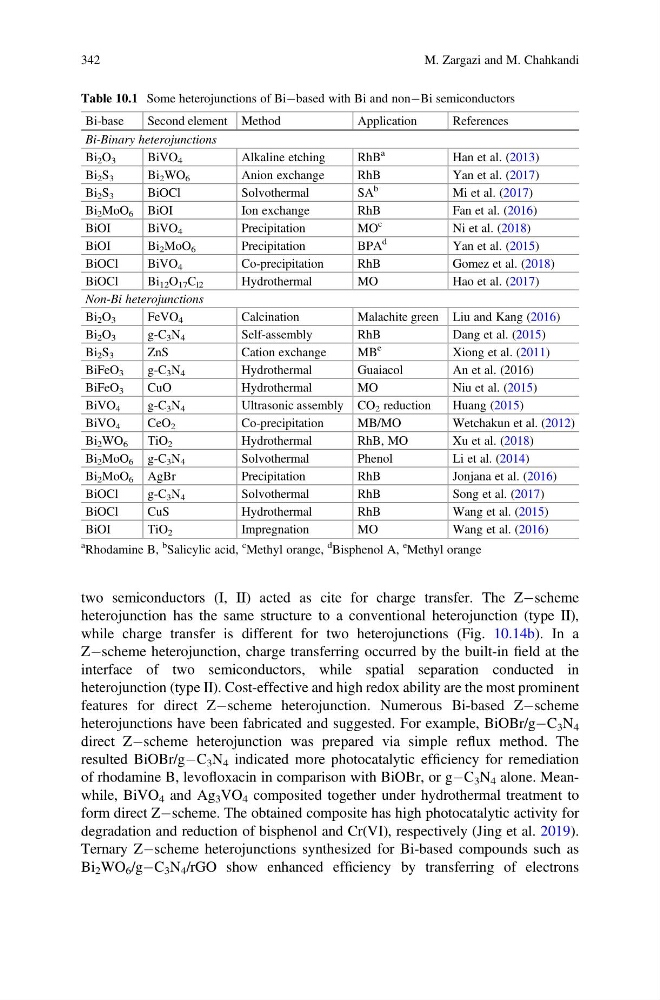
Table 10.1 Some heterojunctions of BiÀbased with Bi and nonÀBi semiconductors
Bi-base
Second element Method
Application
References
Bi-Binary heterojunctions
Bi 2 O 3
BiVO 4
Alkaline etching
RhB
a
Han et al. (2013)
Bi 2 S 3
Bi 2 WO 6
Anion exchange
RhB
Yan et al. (2017)
Bi 2 S 3
BiOCl
Solvothermal
SA
b
Mi et al. (2017)
Bi 2 MoO 6 BiOI
Ion exchange
RhB
Fan et al. (2016)
BiOI
BiVO 4
Precipitation
MO
c
Ni et al. (2018)
BiOI
Bi 2 MoO 6
Precipitation
BPA
d
Yan et al. (2015)
BiOCl
BiVO 4
Co-precipitation
RhB
Gomez et al. (2018)
BiOCl
Bi 12 O 17 C l2
Hydrothermal
MO
Hao et al. (2017)
Non-Bi heterojunctions
Bi 2 O 3
FeVO 4
Calcination
Malachite green Liu and Kang (2016)
Bi 2 O 3
g-C 3 N 4
Self-assembly
RhB
Dang et al. (2015)
Bi 2 S 3
ZnS
Cation exchange
MB
e
Xiong et al. (2011)
BiFeO 3
g-C 3 N 4
Hydrothermal
Guaiacol
An et al. (2016)
BiFeO 3
CuO
Hydrothermal
MO
Niu et al. (2015)
BiVO 4
g-C 3 N 4
Ultrasonic assembly CO 2 reduction
Huang (2015)
BiVO 4
CeO 2
Co-precipitation
MB/MO
Wetchakun et al. (2012)
Bi 2 WO 6
TiO 2
Hydrothermal
RhB, MO
Xu et al. (2018)
Bi 2 MoO 6 g-C 3 N 4
Solvothermal
Phenol
Li et al. (2014)
Bi 2 MoO 6 AgBr
Precipitation
RhB
Jonjana et al. (2016)
BiOCl
g-C 3 N 4
Solvothermal
RhB
Song et al. (2017)
BiOCl
CuS
Hydrothermal
RhB
Wang et al. (2015)
BiOI
TiO 2
Impregnation
MO
Wang et al. (2016)
a Rhodamine B,
b
Salicylic acid,
c Methyl orange,
d
Bisphenol A,
e Methyl orange
342
M. Zargazi and M. Chahkandi
heterojunction has the same structure to a conventional heterojunction (type II),
while charge transfer is different for two heterojunctions (Fig. 10.14b). In a
ZÀscheme heterojunction, charge transferring occurred by the built-in field at the
interface of two semiconductors, while spatial separation conducted in
heterojunction (type II). Cost-effective and high redox ability are the most prominent
features for direct ZÀscheme heterojunction. Numerous Bi-based ZÀscheme
heterojunctions have been fabricated and suggested. For example, BiOBr/gÀC 3 N 4
direct ZÀscheme heterojunction was prepared via simple reflux method. The
resulted BiOBr/gÀC 3 N 4 indicated more photocatalytic efficiency for remediation
of rhodamine B, levofloxacin in comparison with BiOBr, or gÀC 3 N 4 alone. Meanwhile, BiVO 4 and Ag 3 VO 4 composited together under hydrothermal treatment to
form direct ZÀscheme. The obtained composite has high photocatalytic activity for
degradation and reduction of bisphenol and Cr(VI), respectively (Jing et al. 2019).
Ternary ZÀscheme heterojunctions synthesized for Bi-based compounds such as
Bi 2 WO 6 /gÀC 3 N 4 /rGO show enhanced efficiency by transferring of electrons
Table 10.1 Some heterojunctions of BiÀbased with Bi and nonÀBi semiconductors
Bi-base
Second element Method
Application
References
Bi-Binary heterojunctions
Bi 2 O 3
BiVO 4
Alkaline etching
RhB
a
Han et al. (2013)
Bi 2 S 3
Bi 2 WO 6
Anion exchange
RhB
Yan et al. (2017)
Bi 2 S 3
BiOCl
Solvothermal
SA
b
Mi et al. (2017)
Bi 2 MoO 6 BiOI
Ion exchange
RhB
Fan et al. (2016)
BiOI
BiVO 4
Precipitation
MO
c
Ni et al. (2018)
BiOI
Bi 2 MoO 6
Precipitation
BPA
d
Yan et al. (2015)
BiOCl
BiVO 4
Co-precipitation
RhB
Gomez et al. (2018)
BiOCl
Bi 12 O 17 C l2
Hydrothermal
MO
Hao et al. (2017)
Non-Bi heterojunctions
Bi 2 O 3
FeVO 4
Calcination
Malachite green Liu and Kang (2016)
Bi 2 O 3
g-C 3 N 4
Self-assembly
RhB
Dang et al. (2015)
Bi 2 S 3
ZnS
Cation exchange
MB
e
Xiong et al. (2011)
BiFeO 3
g-C 3 N 4
Hydrothermal
Guaiacol
An et al. (2016)
BiFeO 3
CuO
Hydrothermal
MO
Niu et al. (2015)
BiVO 4
g-C 3 N 4
Ultrasonic assembly CO 2 reduction
Huang (2015)
BiVO 4
CeO 2
Co-precipitation
MB/MO
Wetchakun et al. (2012)
Bi 2 WO 6
TiO 2
Hydrothermal
RhB, MO
Xu et al. (2018)
Bi 2 MoO 6 g-C 3 N 4
Solvothermal
Phenol
Li et al. (2014)
Bi 2 MoO 6 AgBr
Precipitation
RhB
Jonjana et al. (2016)
BiOCl
g-C 3 N 4
Solvothermal
RhB
Song et al. (2017)
BiOCl
CuS
Hydrothermal
RhB
Wang et al. (2015)
BiOI
TiO 2
Impregnation
MO
Wang et al. (2016)
a Rhodamine B,
b
Salicylic acid,
c Methyl orange,
d
Bisphenol A,
e Methyl orange
342
M. Zargazi and M. Chahkandi