

BiÀcompounds and many other reviewing literature about the photocatalyst field
were done (Zhao et al. 2014; Meng and Zhang 2016; He et al. 2018). The present
review focused on the photocatalytic activity of various BiÀcompounds.
Bi 2 X 3
Bi 2 X 3 (X ¼ O, S, Se, Te) compounds including Bi and other elements of group VI
are generally named bismuth chalcogenides with nomenclature of Bi 2 O 3 , Bi 2 S 3 ,
Bi 2 Se 3 , and Bi 2 T 3 . Bi 2 O 3 , based on the phase structures has different band gap
values in the range of 2.1–2.8 eV, causing for consideration as a durable
photoactivated by the white light. Bi 2 O 3 formed from different polymorph phases
which include α, β, δ, γ, and ω with crystal network of monoclinic, tetragonal, bodycentered cubic, face-centered cubic, and triclinic, respectively. Various Bi 2 O 3
known phases have low stability which lead to quick interphase conversion through
switching of the temperature condition. Bi 2 O 3 nanostructures have remarkable
physicochemical characters such as band gap having low energy, dielectric permittivity, ion conductivity, and photoconductivity which the highlighted properties
make Bi 2 O 3 as a stable visible light photocatalytic candidates within water splitting
and remediation of organic polluters. Recently, controlled synthetization of Bi 2 O 3
with specified morphology and certain phase has become a hotspot for
photocatalysis researchers. For instance, uniform hierarchical bismuth oxide structures were synthesized and demonstrated excellent visible light activity about degradation of rhodamine B (Zhou et al. 2009). Monoclinic phase of Bi 2 O 3 was
prepared via calcination of hydrothermal production from (BiO) 2 CO 3 precursor
and indicated excellent photoactivated degradation of NO gas and formaldehyde
via visible light radiance (Ai et al. 2011b). Bi 2 S 3 was exhibited as a wonderful lightharvesting photocatalyst because of having tight band gap ~1.7 eV and excited in
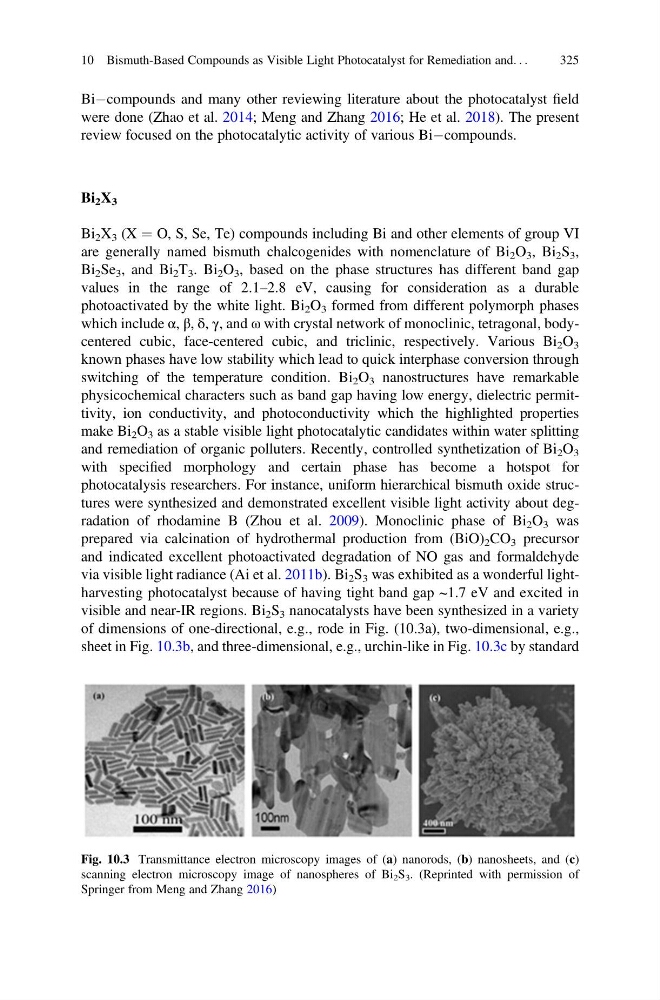
visible and near-IR regions. Bi 2 S 3 nanocatalysts have been synthesized in a variety
of dimensions of one-directional, e.g., rode in Fig. (10.3a), two-dimensional, e.g.,
sheet in Fig. 10.3b, and three-dimensional, e.g., urchin-like in Fig. 10.3c by standard
Fig. 10.3 Transmittance electron microscopy images of (a) nanorods, (b) nanosheets, and (c)
scanning electron microscopy image of nanospheres of Bi 2 S 3 . (Reprinted with permission of
Springer from Meng and Zhang 2016)
10 Bismuth-Based Compounds as Visible Light Photocatalyst for Remediation and. . .
325
were done (Zhao et al. 2014; Meng and Zhang 2016; He et al. 2018). The present
review focused on the photocatalytic activity of various BiÀcompounds.
Bi 2 X 3
Bi 2 X 3 (X ¼ O, S, Se, Te) compounds including Bi and other elements of group VI
are generally named bismuth chalcogenides with nomenclature of Bi 2 O 3 , Bi 2 S 3 ,
Bi 2 Se 3 , and Bi 2 T 3 . Bi 2 O 3 , based on the phase structures has different band gap
values in the range of 2.1–2.8 eV, causing for consideration as a durable
photoactivated by the white light. Bi 2 O 3 formed from different polymorph phases
which include α, β, δ, γ, and ω with crystal network of monoclinic, tetragonal, bodycentered cubic, face-centered cubic, and triclinic, respectively. Various Bi 2 O 3
known phases have low stability which lead to quick interphase conversion through
switching of the temperature condition. Bi 2 O 3 nanostructures have remarkable
physicochemical characters such as band gap having low energy, dielectric permittivity, ion conductivity, and photoconductivity which the highlighted properties
make Bi 2 O 3 as a stable visible light photocatalytic candidates within water splitting
and remediation of organic polluters. Recently, controlled synthetization of Bi 2 O 3
with specified morphology and certain phase has become a hotspot for
photocatalysis researchers. For instance, uniform hierarchical bismuth oxide structures were synthesized and demonstrated excellent visible light activity about degradation of rhodamine B (Zhou et al. 2009). Monoclinic phase of Bi 2 O 3 was
prepared via calcination of hydrothermal production from (BiO) 2 CO 3 precursor
and indicated excellent photoactivated degradation of NO gas and formaldehyde
via visible light radiance (Ai et al. 2011b). Bi 2 S 3 was exhibited as a wonderful lightharvesting photocatalyst because of having tight band gap ~1.7 eV and excited in
visible and near-IR regions. Bi 2 S 3 nanocatalysts have been synthesized in a variety
of dimensions of one-directional, e.g., rode in Fig. (10.3a), two-dimensional, e.g.,
sheet in Fig. 10.3b, and three-dimensional, e.g., urchin-like in Fig. 10.3c by standard
Fig. 10.3 Transmittance electron microscopy images of (a) nanorods, (b) nanosheets, and (c)
scanning electron microscopy image of nanospheres of Bi 2 S 3 . (Reprinted with permission of
Springer from Meng and Zhang 2016)
10 Bismuth-Based Compounds as Visible Light Photocatalyst for Remediation and. . .
325