

10.2 Photocatalyst Semiconductors
A good photocatalyst should have special properties including (a) sensitive to light,
(b) activation under visible or UV light, (c) biological and chemical inert, (d) stable
under light without photocorrosion phenomena, (e) affordable, and
(f) environmentally safety. To achieve this purpose, vast ranges of semiconductors
have been used in photocatalysis process. Effective photocatalysts should produce
capability of active radicals (OH
•
, O 2
• ) for oxidation of pollutants which shown in
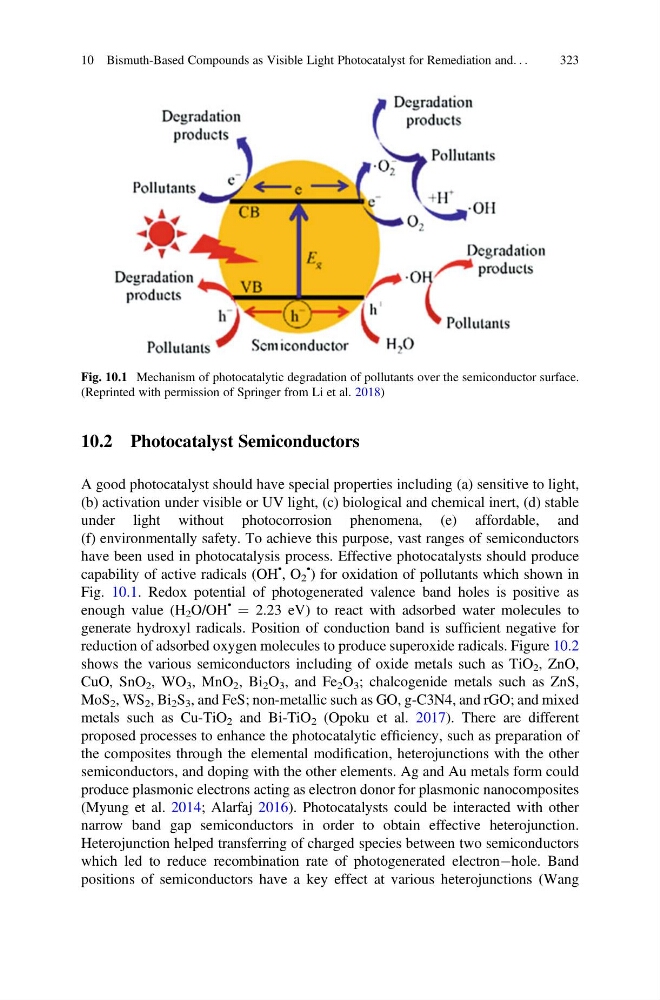
Fig. 10.1. Redox potential of photogenerated valence band holes is positive as
enough value (H 2 O/OH
• ¼ 2.23 eV) to react with adsorbed water molecules to
generate hydroxyl radicals. Position of conduction band is sufficient negative for
reduction of adsorbed oxygen molecules to produce superoxide radicals. Figure 10.2
shows the various semiconductors including of oxide metals such as TiO 2 , ZnO,
CuO, SnO 2 , WO 3 , MnO 2 , Bi 2 O 3 , and Fe 2 O 3 ; chalcogenide metals such as ZnS,
MoS 2 , WS 2 , Bi 2 S 3 , and FeS; non-metallic such as GO, g-C3N4, and rGO; and mixed
metals such as Cu-TiO 2 and Bi-TiO 2 (Opoku et al. 2017). There are different
proposed processes to enhance the photocatalytic efficiency, such as preparation of
the composites through the elemental modification, heterojunctions with the other
semiconductors, and doping with the other elements. Ag and Au metals form could
produce plasmonic electrons acting as electron donor for plasmonic nanocomposites
(Myung et al. 2014; Alarfaj 2016). Photocatalysts could be interacted with other
narrow band gap semiconductors in order to obtain effective heterojunction.
Heterojunction helped transferring of charged species between two semiconductors
which led to reduce recombination rate of photogenerated electronÀhole. Band
positions of semiconductors have a key effect at various heterojunctions (Wang
Fig. 10.1 Mechanism of photocatalytic degradation of pollutants over the semiconductor surface.
(Reprinted with permission of Springer from Li et al. 2018)
10 Bismuth-Based Compounds as Visible Light Photocatalyst for Remediation and. . .
323
A good photocatalyst should have special properties including (a) sensitive to light,
(b) activation under visible or UV light, (c) biological and chemical inert, (d) stable
under light without photocorrosion phenomena, (e) affordable, and
(f) environmentally safety. To achieve this purpose, vast ranges of semiconductors
have been used in photocatalysis process. Effective photocatalysts should produce
capability of active radicals (OH
•
, O 2
• ) for oxidation of pollutants which shown in
Fig. 10.1. Redox potential of photogenerated valence band holes is positive as
enough value (H 2 O/OH
• ¼ 2.23 eV) to react with adsorbed water molecules to
generate hydroxyl radicals. Position of conduction band is sufficient negative for
reduction of adsorbed oxygen molecules to produce superoxide radicals. Figure 10.2
shows the various semiconductors including of oxide metals such as TiO 2 , ZnO,
CuO, SnO 2 , WO 3 , MnO 2 , Bi 2 O 3 , and Fe 2 O 3 ; chalcogenide metals such as ZnS,
MoS 2 , WS 2 , Bi 2 S 3 , and FeS; non-metallic such as GO, g-C3N4, and rGO; and mixed
metals such as Cu-TiO 2 and Bi-TiO 2 (Opoku et al. 2017). There are different
proposed processes to enhance the photocatalytic efficiency, such as preparation of
the composites through the elemental modification, heterojunctions with the other
semiconductors, and doping with the other elements. Ag and Au metals form could
produce plasmonic electrons acting as electron donor for plasmonic nanocomposites
(Myung et al. 2014; Alarfaj 2016). Photocatalysts could be interacted with other
narrow band gap semiconductors in order to obtain effective heterojunction.
Heterojunction helped transferring of charged species between two semiconductors
which led to reduce recombination rate of photogenerated electronÀhole. Band
positions of semiconductors have a key effect at various heterojunctions (Wang
Fig. 10.1 Mechanism of photocatalytic degradation of pollutants over the semiconductor surface.
(Reprinted with permission of Springer from Li et al. 2018)
10 Bismuth-Based Compounds as Visible Light Photocatalyst for Remediation and. . .
323