

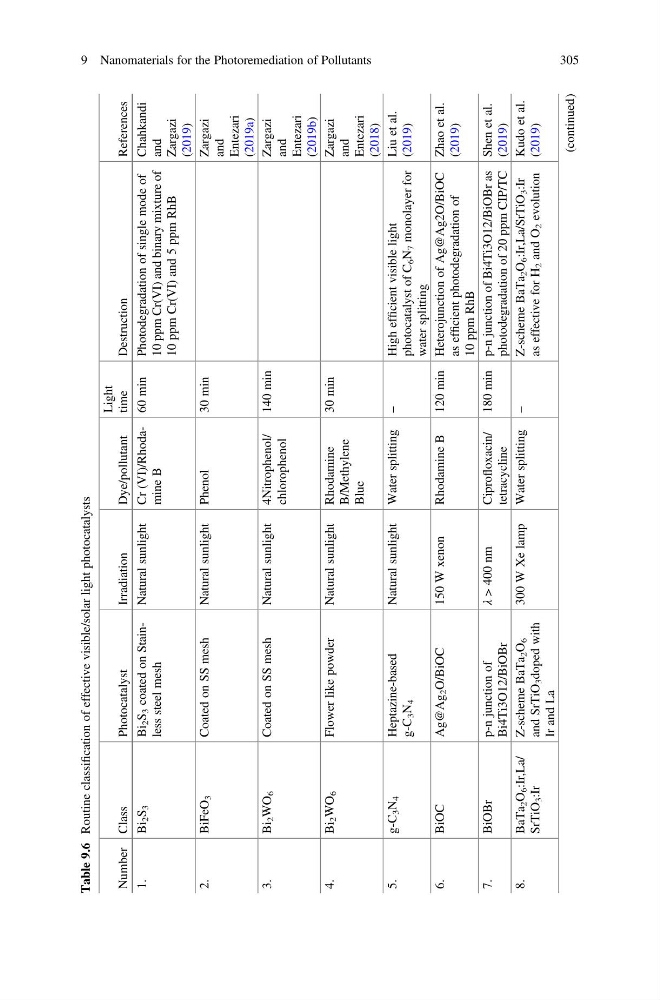
Table 9.6
Routine classification of effective visible/solar light photocatalysts
Number Class
Photocatalyst
Irradiation
Dye/pollutant
Light
time
Destruction
References
1.
Bi
2 S
3
Bi
2 S
3 coated on Stainless steel mesh
Natural sunlight Cr (VI)/Rhodamine B
60 min
Photodegradation of single mode of
10 ppm Cr(VI) and binary mixture of
10 ppm Cr(VI) and 5 ppm RhB
Chahkandi
and
Zargazi
(2019)
2.
BiFeO
3
Coated on SS mesh
Natural sunlight Phenol
30 min
Zargazi
and
Entezari
(2019a)
3.
Bi
2 WO
6
Coated on SS mesh
Natural sunlight 4Nitrophenol/
chlorophenol
140 min
Zargazi
and
Entezari
(2019b)
4.
Bi
2 WO
6
Flower like powder
Natural sunlight Rhodamine
B/Methylene
Blue
30 min
Zargazi
and
Entezari
(2018)
5.
g-C
3 N
4
Heptazine-based
g-C
3 N
4
Natural sunlight Water splitting
–
High efficient visible light
photocatalyst of C
6 N
7 monolayer for
water splitting
Liu et al.
(2019)
6.
BiOC
Ag@Ag
2 O/BiOC
150 W xenon
Rhodamine B
120 min Heterojunction of Ag@Ag2O/BiOC
as efficient photodegradation of
10 ppm RhB
Zhao et al.
(2019)
7.
BiOBr
p-n junction of
Bi4Ti3O12/BiOBr
λ > 400 nm
Ciprofloxacin/
tetracycline
180 min p-n junction of Bi4Ti3O12/BiOBr as
photodegradation of 20 ppm CIP/TC
Shen et al.
(2019)
8.
BaTa
2 O
6 :Ir,La/
SrTiO
3 :Ir
Z-scheme BaTa
2 O
6
and SrTiO
3 doped with
Ir and La
300 W Xe lamp Water splitting
–
Z-scheme BaTa
2 O
6 :Ir,La/SrTiO
3 :Ir
as effective for H
2 and O
2 evolution
Kudo et al.
(2019)
(continued)
9 Nanomaterials for the Photoremediation of Pollutants
305
Routine classification of effective visible/solar light photocatalysts
Number Class
Photocatalyst
Irradiation
Dye/pollutant
Light
time
Destruction
References
1.
Bi
2 S
3
Bi
2 S
3 coated on Stainless steel mesh
Natural sunlight Cr (VI)/Rhodamine B
60 min
Photodegradation of single mode of
10 ppm Cr(VI) and binary mixture of
10 ppm Cr(VI) and 5 ppm RhB
Chahkandi
and
Zargazi
(2019)
2.
BiFeO
3
Coated on SS mesh
Natural sunlight Phenol
30 min
Zargazi
and
Entezari
(2019a)
3.
Bi
2 WO
6
Coated on SS mesh
Natural sunlight 4Nitrophenol/
chlorophenol
140 min
Zargazi
and
Entezari
(2019b)
4.
Bi
2 WO
6
Flower like powder
Natural sunlight Rhodamine
B/Methylene
Blue
30 min
Zargazi
and
Entezari
(2018)
5.
g-C
3 N
4
Heptazine-based
g-C
3 N
4
Natural sunlight Water splitting
–
High efficient visible light
photocatalyst of C
6 N
7 monolayer for
water splitting
Liu et al.
(2019)
6.
BiOC
Ag@Ag
2 O/BiOC
150 W xenon
Rhodamine B
120 min Heterojunction of Ag@Ag2O/BiOC
as efficient photodegradation of
10 ppm RhB
Zhao et al.
(2019)
7.
BiOBr
p-n junction of
Bi4Ti3O12/BiOBr
λ > 400 nm
Ciprofloxacin/
tetracycline
180 min p-n junction of Bi4Ti3O12/BiOBr as
photodegradation of 20 ppm CIP/TC
Shen et al.
(2019)
8.
BaTa
2 O
6 :Ir,La/
SrTiO
3 :Ir
Z-scheme BaTa
2 O
6
and SrTiO
3 doped with
Ir and La
300 W Xe lamp Water splitting
–
Z-scheme BaTa
2 O
6 :Ir,La/SrTiO
3 :Ir
as effective for H
2 and O
2 evolution
Kudo et al.
(2019)
(continued)
9 Nanomaterials for the Photoremediation of Pollutants
305