

Moreover, agricultural wastewater with a high content of nutrients, especially
nitrogen and phosphorus, can lead to eutrophication of water bodies.
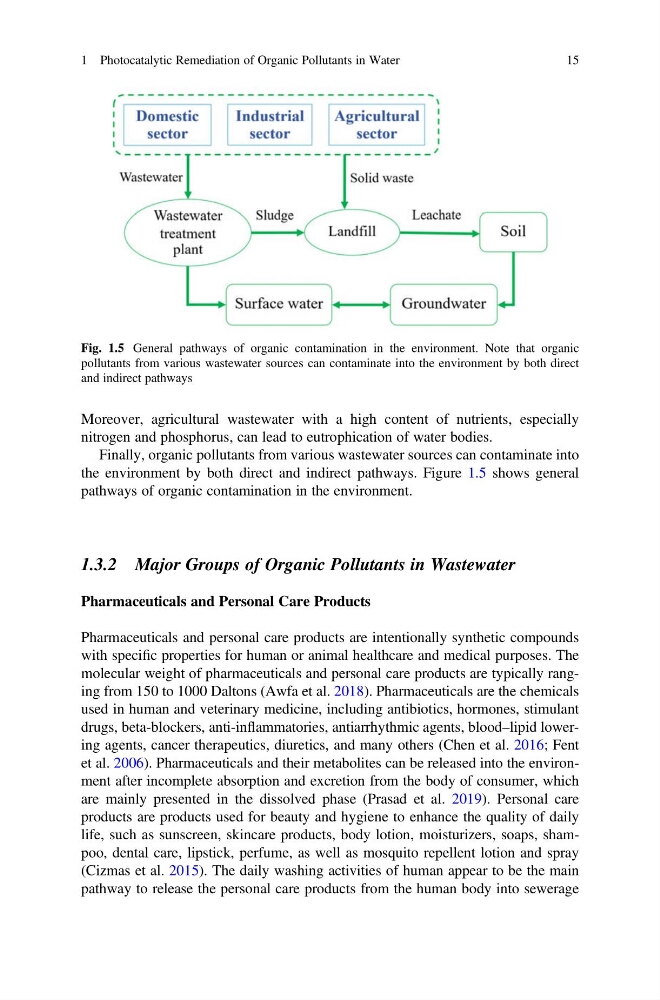
Finally, organic pollutants from various wastewater sources can contaminate into
the environment by both direct and indirect pathways. Figure 1.5 shows general
pathways of organic contamination in the environment.
1.3.2 Major Groups of Organic Pollutants in Wastewater
Pharmaceuticals and Personal Care Products
Pharmaceuticals and personal care products are intentionally synthetic compounds
with specific properties for human or animal healthcare and medical purposes. The
molecular weight of pharmaceuticals and personal care products are typically ranging from 150 to 1000 Daltons (Awfa et al. 2018). Pharmaceuticals are the chemicals
used in human and veterinary medicine, including antibiotics, hormones, stimulant
drugs, beta-blockers, anti-inflammatories, antiarrhythmic agents, blood–lipid lowering agents, cancer therapeutics, diuretics, and many others (Chen et al. 2016; Fent
et al. 2006). Pharmaceuticals and their metabolites can be released into the environment after incomplete absorption and excretion from the body of consumer, which
are mainly presented in the dissolved phase (Prasad et al. 2019). Personal care
products are products used for beauty and hygiene to enhance the quality of daily
life, such as sunscreen, skincare products, body lotion, moisturizers, soaps, shampoo, dental care, lipstick, perfume, as well as mosquito repellent lotion and spray
(Cizmas et al. 2015). The daily washing activities of human appear to be the main
pathway to release the personal care products from the human body into sewerage
Fig. 1.5 General pathways of organic contamination in the environment. Note that organic
pollutants from various wastewater sources can contaminate into the environment by both direct
and indirect pathways
1 Photocatalytic Remediation of Organic Pollutants in Water
15
nitrogen and phosphorus, can lead to eutrophication of water bodies.
Finally, organic pollutants from various wastewater sources can contaminate into
the environment by both direct and indirect pathways. Figure 1.5 shows general
pathways of organic contamination in the environment.
1.3.2 Major Groups of Organic Pollutants in Wastewater
Pharmaceuticals and Personal Care Products
Pharmaceuticals and personal care products are intentionally synthetic compounds
with specific properties for human or animal healthcare and medical purposes. The
molecular weight of pharmaceuticals and personal care products are typically ranging from 150 to 1000 Daltons (Awfa et al. 2018). Pharmaceuticals are the chemicals
used in human and veterinary medicine, including antibiotics, hormones, stimulant
drugs, beta-blockers, anti-inflammatories, antiarrhythmic agents, blood–lipid lowering agents, cancer therapeutics, diuretics, and many others (Chen et al. 2016; Fent
et al. 2006). Pharmaceuticals and their metabolites can be released into the environment after incomplete absorption and excretion from the body of consumer, which
are mainly presented in the dissolved phase (Prasad et al. 2019). Personal care
products are products used for beauty and hygiene to enhance the quality of daily
life, such as sunscreen, skincare products, body lotion, moisturizers, soaps, shampoo, dental care, lipstick, perfume, as well as mosquito repellent lotion and spray
(Cizmas et al. 2015). The daily washing activities of human appear to be the main
pathway to release the personal care products from the human body into sewerage
Fig. 1.5 General pathways of organic contamination in the environment. Note that organic
pollutants from various wastewater sources can contaminate into the environment by both direct
and indirect pathways
1 Photocatalytic Remediation of Organic Pollutants in Water
15