

achieve consistently high purity levels, wherein permeate from the first pass
becomes the feed to the second pass. The concentrated reject water is dispersed
into the sea with a diffuser to prevent any sort of salinity shocks to organisms of the
sea. Since the process requires strict control of physical, biological, and chemical
parameters, operator efficiency plays an important role.
Brackish Water Desalination Brackish water desalination is the viable alternative
for remote areas having brackish water as the only source of water. With the
dissolved contents being much lower compared to seawater, these plants can be
operated at much lower operating pressures. The process is similar to seawater
reverse osmosis, but parameters of design and operation are different.
Capacities of brackish water plants are far less compared to seawater desalination
plants due to nonavailability of adequate raw water. The composition of the brackish
water may vary from source to source, particularly with respect to hardness and trace
metals. The raw water may be nearly free of suspended matter and microorganisms.
Accordingly, the pretreatment system may be relatively less complicated. Most of
the brackish water plants particularly small-capacity plants are located in rural or
remote areas, may not operate round the clock, and hence may require protection
measures to prevent faster deterioration of the membranes. The reject disposal is a
big challenge, as it would find its way to the groundwater resulting in the increase of
salinity over time, over and above the increase in salinity in the normal course due to
constant withdrawal. Therefore, the design should be directed toward conserving the
water resources with dual quality usage. Further, the design should be flexible with a
provision for reject recycle so that one can deliver constant quality of product water
albeit at different recoveries (Prabhakar et al. 1989; Sarkar et al. 2008). Depending
on the salinity of the feed, the withdrawal amount of groundwater may vary, but the
plant would operate at constant output quality and capacity. Further, the flexibility
would lead to conservation of groundwater to the extent possible.
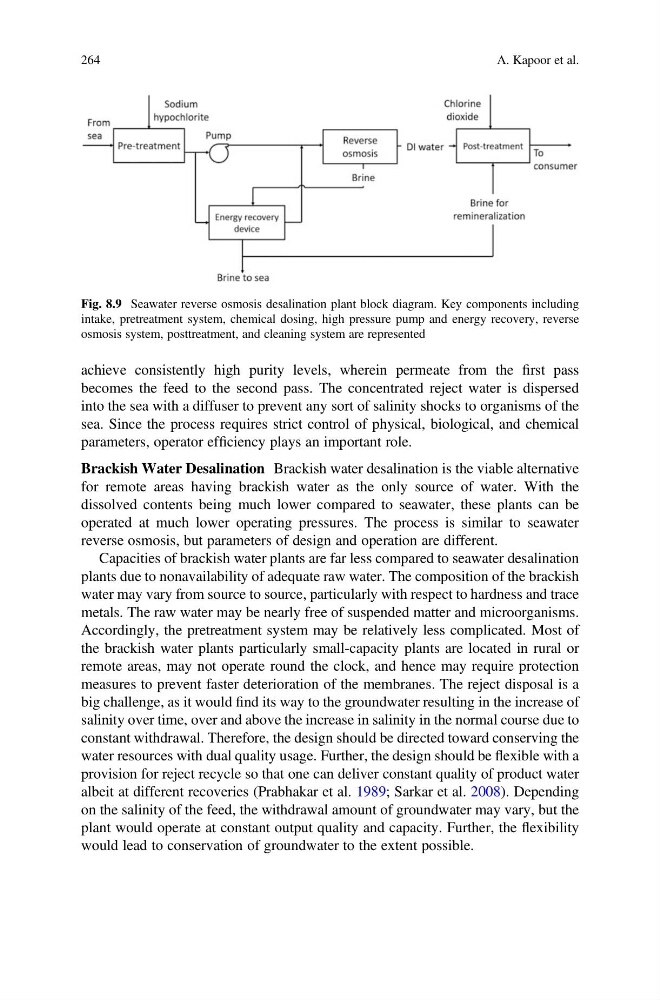
Fig. 8.9 Seawater reverse osmosis desalination plant block diagram. Key components including
intake, pretreatment system, chemical dosing, high pressure pump and energy recovery, reverse
osmosis system, posttreatment, and cleaning system are represented
264
A. Kapoor et al.
becomes the feed to the second pass. The concentrated reject water is dispersed
into the sea with a diffuser to prevent any sort of salinity shocks to organisms of the
sea. Since the process requires strict control of physical, biological, and chemical
parameters, operator efficiency plays an important role.
Brackish Water Desalination Brackish water desalination is the viable alternative
for remote areas having brackish water as the only source of water. With the
dissolved contents being much lower compared to seawater, these plants can be
operated at much lower operating pressures. The process is similar to seawater
reverse osmosis, but parameters of design and operation are different.
Capacities of brackish water plants are far less compared to seawater desalination
plants due to nonavailability of adequate raw water. The composition of the brackish
water may vary from source to source, particularly with respect to hardness and trace
metals. The raw water may be nearly free of suspended matter and microorganisms.
Accordingly, the pretreatment system may be relatively less complicated. Most of
the brackish water plants particularly small-capacity plants are located in rural or
remote areas, may not operate round the clock, and hence may require protection
measures to prevent faster deterioration of the membranes. The reject disposal is a
big challenge, as it would find its way to the groundwater resulting in the increase of
salinity over time, over and above the increase in salinity in the normal course due to
constant withdrawal. Therefore, the design should be directed toward conserving the
water resources with dual quality usage. Further, the design should be flexible with a
provision for reject recycle so that one can deliver constant quality of product water
albeit at different recoveries (Prabhakar et al. 1989; Sarkar et al. 2008). Depending
on the salinity of the feed, the withdrawal amount of groundwater may vary, but the
plant would operate at constant output quality and capacity. Further, the flexibility
would lead to conservation of groundwater to the extent possible.
Fig. 8.9 Seawater reverse osmosis desalination plant block diagram. Key components including
intake, pretreatment system, chemical dosing, high pressure pump and energy recovery, reverse
osmosis system, posttreatment, and cleaning system are represented
264
A. Kapoor et al.