

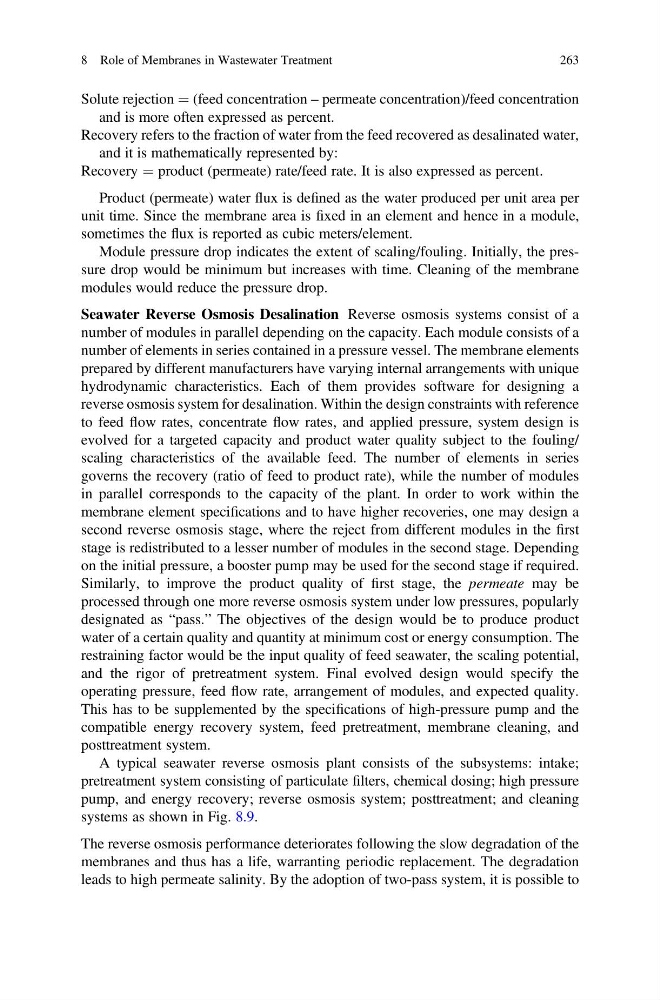
Solute rejection ¼ (feed concentration – permeate concentration)/feed concentration
and is more often expressed as percent.
Recovery refers to the fraction of water from the feed recovered as desalinated water,
and it is mathematically represented by:
Recovery ¼ product (permeate) rate/feed rate. It is also expressed as percent.
Product (permeate) water flux is defined as the water produced per unit area per
unit time. Since the membrane area is fixed in an element and hence in a module,
sometimes the flux is reported as cubic meters/element.
Module pressure drop indicates the extent of scaling/fouling. Initially, the pressure drop would be minimum but increases with time. Cleaning of the membrane
modules would reduce the pressure drop.
Seawater Reverse Osmosis Desalination Reverse osmosis systems consist of a
number of modules in parallel depending on the capacity. Each module consists of a
number of elements in series contained in a pressure vessel. The membrane elements
prepared by different manufacturers have varying internal arrangements with unique
hydrodynamic characteristics. Each of them provides software for designing a
reverse osmosis system for desalination. Within the design constraints with reference
to feed flow rates, concentrate flow rates, and applied pressure, system design is
evolved for a targeted capacity and product water quality subject to the fouling/
scaling characteristics of the available feed. The number of elements in series
governs the recovery (ratio of feed to product rate), while the number of modules
in parallel corresponds to the capacity of the plant. In order to work within the
membrane element specifications and to have higher recoveries, one may design a
second reverse osmosis stage, where the reject from different modules in the first
stage is redistributed to a lesser number of modules in the second stage. Depending
on the initial pressure, a booster pump may be used for the second stage if required.
Similarly, to improve the product quality of first stage, the permeate may be
processed through one more reverse osmosis system under low pressures, popularly
designated as “pass.” The objectives of the design would be to produce product
water of a certain quality and quantity at minimum cost or energy consumption. The
restraining factor would be the input quality of feed seawater, the scaling potential,
and the rigor of pretreatment system. Final evolved design would specify the
operating pressure, feed flow rate, arrangement of modules, and expected quality.
This has to be supplemented by the specifications of high-pressure pump and the
compatible energy recovery system, feed pretreatment, membrane cleaning, and
posttreatment system.
A typical seawater reverse osmosis plant consists of the subsystems: intake;
pretreatment system consisting of particulate filters, chemical dosing; high pressure
pump, and energy recovery; reverse osmosis system; posttreatment; and cleaning
systems as shown in Fig. 8.9.
The reverse osmosis performance deteriorates following the slow degradation of the
membranes and thus has a life, warranting periodic replacement. The degradation
leads to high permeate salinity. By the adoption of two-pass system, it is possible to
8 Role of Membranes in Wastewater Treatment
263
and is more often expressed as percent.
Recovery refers to the fraction of water from the feed recovered as desalinated water,
and it is mathematically represented by:
Recovery ¼ product (permeate) rate/feed rate. It is also expressed as percent.
Product (permeate) water flux is defined as the water produced per unit area per
unit time. Since the membrane area is fixed in an element and hence in a module,
sometimes the flux is reported as cubic meters/element.
Module pressure drop indicates the extent of scaling/fouling. Initially, the pressure drop would be minimum but increases with time. Cleaning of the membrane
modules would reduce the pressure drop.
Seawater Reverse Osmosis Desalination Reverse osmosis systems consist of a
number of modules in parallel depending on the capacity. Each module consists of a
number of elements in series contained in a pressure vessel. The membrane elements
prepared by different manufacturers have varying internal arrangements with unique
hydrodynamic characteristics. Each of them provides software for designing a
reverse osmosis system for desalination. Within the design constraints with reference
to feed flow rates, concentrate flow rates, and applied pressure, system design is
evolved for a targeted capacity and product water quality subject to the fouling/
scaling characteristics of the available feed. The number of elements in series
governs the recovery (ratio of feed to product rate), while the number of modules
in parallel corresponds to the capacity of the plant. In order to work within the
membrane element specifications and to have higher recoveries, one may design a
second reverse osmosis stage, where the reject from different modules in the first
stage is redistributed to a lesser number of modules in the second stage. Depending
on the initial pressure, a booster pump may be used for the second stage if required.
Similarly, to improve the product quality of first stage, the permeate may be
processed through one more reverse osmosis system under low pressures, popularly
designated as “pass.” The objectives of the design would be to produce product
water of a certain quality and quantity at minimum cost or energy consumption. The
restraining factor would be the input quality of feed seawater, the scaling potential,
and the rigor of pretreatment system. Final evolved design would specify the
operating pressure, feed flow rate, arrangement of modules, and expected quality.
This has to be supplemented by the specifications of high-pressure pump and the
compatible energy recovery system, feed pretreatment, membrane cleaning, and
posttreatment system.
A typical seawater reverse osmosis plant consists of the subsystems: intake;
pretreatment system consisting of particulate filters, chemical dosing; high pressure
pump, and energy recovery; reverse osmosis system; posttreatment; and cleaning
systems as shown in Fig. 8.9.
The reverse osmosis performance deteriorates following the slow degradation of the
membranes and thus has a life, warranting periodic replacement. The degradation
leads to high permeate salinity. By the adoption of two-pass system, it is possible to
8 Role of Membranes in Wastewater Treatment
263