

porous and nonporous charged membrane, respectively. Membrane distillation is the
process where the hydrophobic membranes are used for the recovery of water.
Membrane contactors are a class of membrane products, which are used to carry
out conventional separation techniques by providing large interfacial contact area
without the bother of mixing the contacting phases. These are porous inert membrane matrices with potential application in the removal of pollutants from water.
Membrane bioreactor, which is extensively used in the treatment of wastewater, is a
contactor between the microorganisms and waste stream. Further applications
include membrane solvent extraction, gas absorption, etc.
8.2.2 Membrane Configuration
The commercial membranes are prepared as either flat sheets or cylindrical ones with
different diameters. The membranes so prepared are configured in different geometries such as plate and frame, spiral, tubular, and hollow fiber. Each of these
configurations has their unique characteristics and suited for certain environment.
A membrane element describes the membrane housed in a particular configuration
with inlet and outlets as a single unit. These membrane elements can be connected in
series to assemble a membrane module. For large capacity plants, the modules can be
connected in series or in parallel depending on the design objectives. Selection of a
configuration depends on the compactness, hydrodynamic characteristics, ease of
cleaning and maintenance, and economics. Plate and frame and spiral elements are
prepared from flat sheets, while tubular and hollow fiber elements are based on
cylindrical membranes.
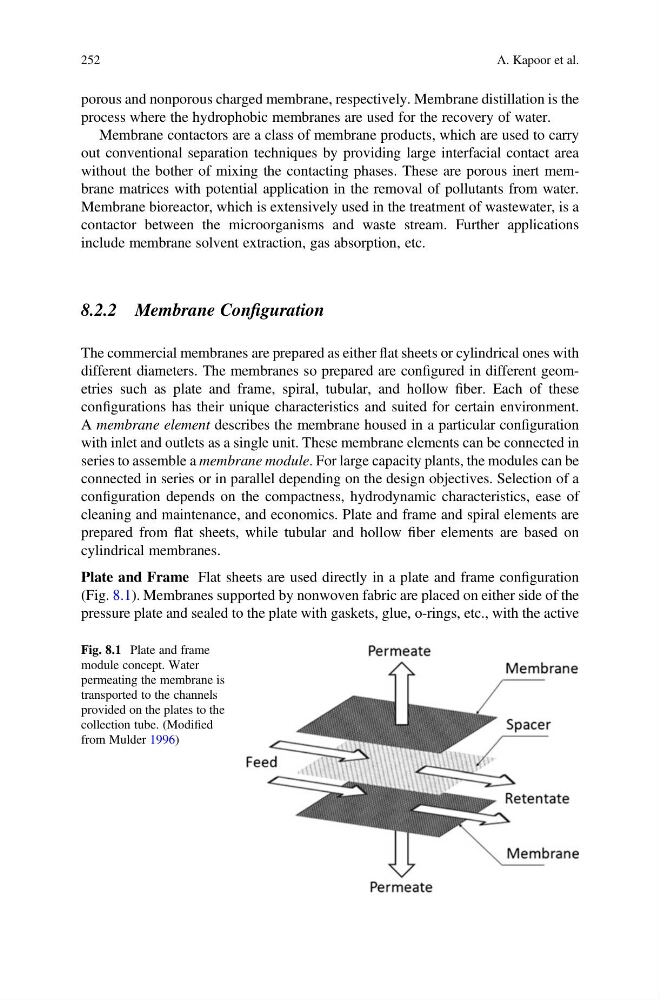
Plate and Frame Flat sheets are used directly in a plate and frame configuration
(Fig. 8.1). Membranes supported by nonwoven fabric are placed on either side of the
pressure plate and sealed to the plate with gaskets, glue, o-rings, etc., with the active
Fig. 8.1 Plate and frame
module concept. Water
permeating the membrane is
transported to the channels
provided on the plates to the
collection tube. (Modified
from Mulder 1996)
252
A. Kapoor et al.
process where the hydrophobic membranes are used for the recovery of water.
Membrane contactors are a class of membrane products, which are used to carry
out conventional separation techniques by providing large interfacial contact area
without the bother of mixing the contacting phases. These are porous inert membrane matrices with potential application in the removal of pollutants from water.
Membrane bioreactor, which is extensively used in the treatment of wastewater, is a
contactor between the microorganisms and waste stream. Further applications
include membrane solvent extraction, gas absorption, etc.
8.2.2 Membrane Configuration
The commercial membranes are prepared as either flat sheets or cylindrical ones with
different diameters. The membranes so prepared are configured in different geometries such as plate and frame, spiral, tubular, and hollow fiber. Each of these
configurations has their unique characteristics and suited for certain environment.
A membrane element describes the membrane housed in a particular configuration
with inlet and outlets as a single unit. These membrane elements can be connected in
series to assemble a membrane module. For large capacity plants, the modules can be
connected in series or in parallel depending on the design objectives. Selection of a
configuration depends on the compactness, hydrodynamic characteristics, ease of
cleaning and maintenance, and economics. Plate and frame and spiral elements are
prepared from flat sheets, while tubular and hollow fiber elements are based on
cylindrical membranes.
Plate and Frame Flat sheets are used directly in a plate and frame configuration
(Fig. 8.1). Membranes supported by nonwoven fabric are placed on either side of the
pressure plate and sealed to the plate with gaskets, glue, o-rings, etc., with the active
Fig. 8.1 Plate and frame
module concept. Water
permeating the membrane is
transported to the channels
provided on the plates to the
collection tube. (Modified
from Mulder 1996)
252
A. Kapoor et al.