

HO 2
•
þ e
À
þ H
þ
! H 2 O 2
ð1:26Þ
H 2 O 2 þ h υ ! HO
•
þ HO
•
ð1:27Þ
1.2.2 Photocatalytic Process
Photocatalytic process is normally described by heterogeneous photocatalysis. The
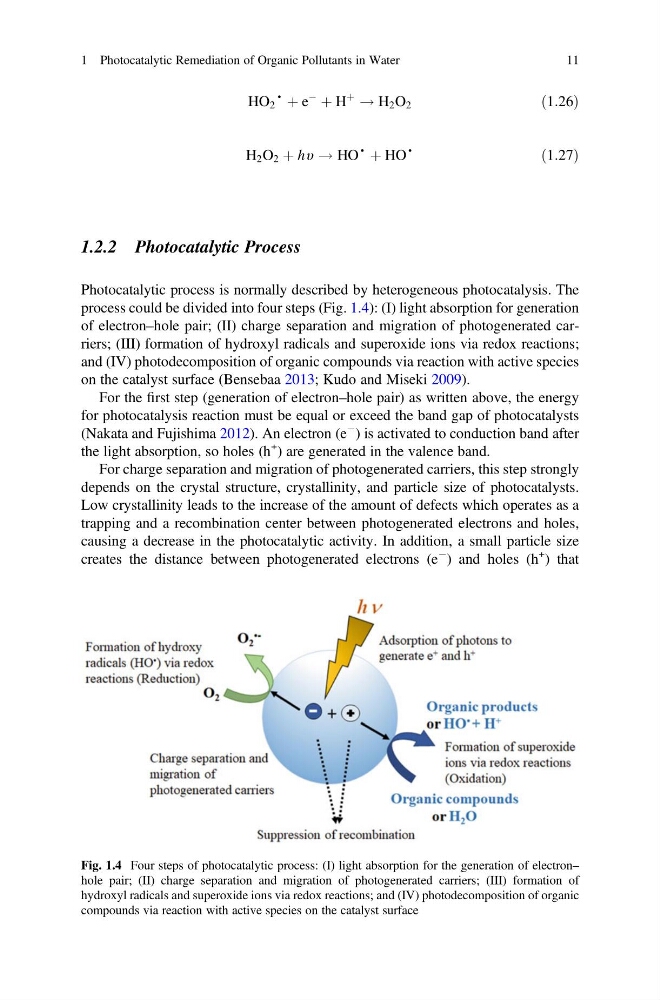
process could be divided into four steps (Fig. 1.4): (I) light absorption for generation
of electron–hole pair; (II) charge separation and migration of photogenerated carriers; (III) formation of hydroxyl radicals and superoxide ions via redox reactions;
and (IV) photodecomposition of organic compounds via reaction with active species
on the catalyst surface (Bensebaa 2013; Kudo and Miseki 2009).
For the first step (generation of electron–hole pair) as written above, the energy
for photocatalysis reaction must be equal or exceed the band gap of photocatalysts
(Nakata and Fujishima 2012). An electron (e
À ) is activated to conduction band after
the light absorption, so holes (h
+
) are generated in the valence band.
For charge separation and migration of photogenerated carriers, this step strongly
depends on the crystal structure, crystallinity, and particle size of photocatalysts.
Low crystallinity leads to the increase of the amount of defects which operates as a
trapping and a recombination center between photogenerated electrons and holes,
causing a decrease in the photocatalytic activity. In addition, a small particle size
creates the distance between photogenerated electrons (e
À ) and holes (h
+
) that
Fig. 1.4 Four steps of photocatalytic process: (I) light absorption for the generation of electron–
hole pair; (II) charge separation and migration of photogenerated carriers; (III) formation of
hydroxyl radicals and superoxide ions via redox reactions; and (IV) photodecomposition of organic
compounds via reaction with active species on the catalyst surface
1 Photocatalytic Remediation of Organic Pollutants in Water
11
•
þ e
À
þ H
þ
! H 2 O 2
ð1:26Þ
H 2 O 2 þ h υ ! HO
•
þ HO
•
ð1:27Þ
1.2.2 Photocatalytic Process
Photocatalytic process is normally described by heterogeneous photocatalysis. The
process could be divided into four steps (Fig. 1.4): (I) light absorption for generation
of electron–hole pair; (II) charge separation and migration of photogenerated carriers; (III) formation of hydroxyl radicals and superoxide ions via redox reactions;
and (IV) photodecomposition of organic compounds via reaction with active species
on the catalyst surface (Bensebaa 2013; Kudo and Miseki 2009).
For the first step (generation of electron–hole pair) as written above, the energy
for photocatalysis reaction must be equal or exceed the band gap of photocatalysts
(Nakata and Fujishima 2012). An electron (e
À ) is activated to conduction band after
the light absorption, so holes (h
+
) are generated in the valence band.
For charge separation and migration of photogenerated carriers, this step strongly
depends on the crystal structure, crystallinity, and particle size of photocatalysts.
Low crystallinity leads to the increase of the amount of defects which operates as a
trapping and a recombination center between photogenerated electrons and holes,
causing a decrease in the photocatalytic activity. In addition, a small particle size
creates the distance between photogenerated electrons (e
À ) and holes (h
+
) that
Fig. 1.4 Four steps of photocatalytic process: (I) light absorption for the generation of electron–
hole pair; (II) charge separation and migration of photogenerated carriers; (III) formation of
hydroxyl radicals and superoxide ions via redox reactions; and (IV) photodecomposition of organic
compounds via reaction with active species on the catalyst surface
1 Photocatalytic Remediation of Organic Pollutants in Water
11