

Ghernaout et al. (2008) explained the principle behind of electrochemical coagulation cell has three stages. That is the first stage there is. forming of coagulants in
the anode due to electrical oxidation secondly mineralization and emulsion of
breaking of pollutants and suspended particles through the mechanism of adsorption,
electrical double-layer compression, enmeshment in a precipitate and inter-particle
bridging and charge neutralization, finally in the last stage the mineralized a particles
and bacteria, fecal coliforms can form floc.
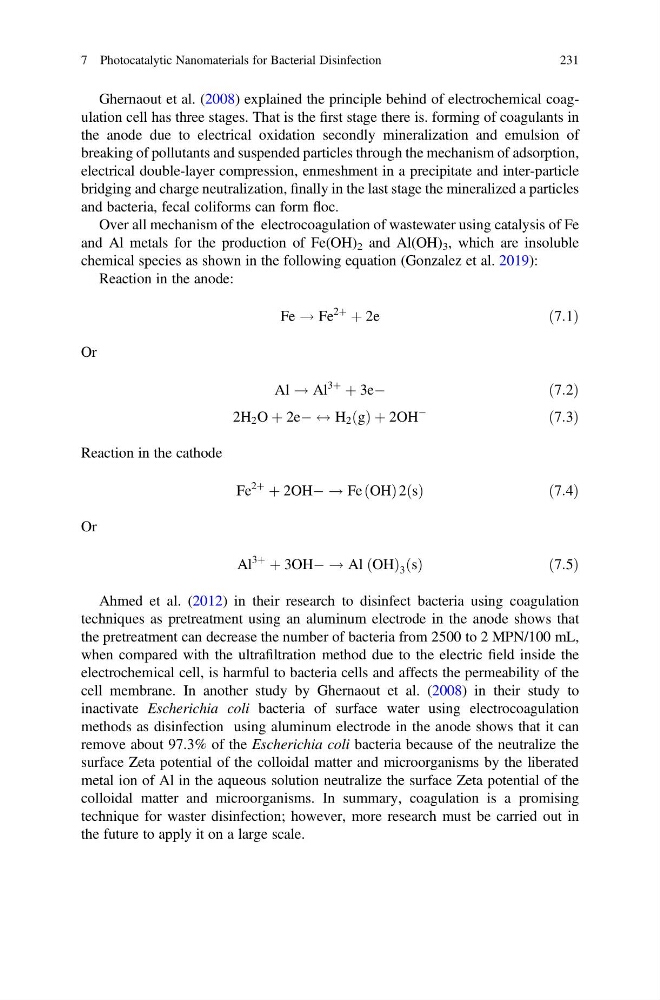
Over all mechanism of the electrocoagulation of wastewater using catalysis of Fe
and Al metals for the production of Fe(OH) 2 and Al(OH) 3 , which are insoluble
chemical species as shown in the following equation (Gonzalez et al. 2019):
Reaction in the anode:
Fe ! Fe
2þ
þ 2e
ð7:1Þ
Or
Al ! Al
3þ
þ 3eÀ
ð 7:2Þ
2H 2 O þ 2eÀ $ H 2 g
ð Þ þ 2OH
À
ð7:3Þ
Reaction in the cathode
Fe
2þ
þ 2OHÀ ! Fe OH
ð Þ2 s
ð Þ
ð7:4Þ
Or
Al
3þ
þ 3OHÀ ! Al OH
ð Þ 3 s
ð Þ
ð7:5Þ
Ahmed et al. (2012) in their research to disinfect bacteria using coagulation
techniques as pretreatment using an aluminum electrode in the anode shows that
the pretreatment can decrease the number of bacteria from 2500 to 2 MPN/100 mL,
when compared with the ultrafiltration method due to the electric field inside the
electrochemical cell, is harmful to bacteria cells and affects the permeability of the
cell membrane. In another study by Ghernaout et al. (2008) in their study to
inactivate Escherichia coli bacteria of surface water using electrocoagulation
methods as disinfection using aluminum electrode in the anode shows that it can
remove about 97.3% of the Escherichia coli bacteria because of the neutralize the
surface Zeta potential of the colloidal matter and microorganisms by the liberated
metal ion of Al in the aqueous solution neutralize the surface Zeta potential of the
colloidal matter and microorganisms. In summary, coagulation is a promising
technique for waster disinfection; however, more research must be carried out in
the future to apply it on a large scale.
7 Photocatalytic Nanomaterials for Bacterial Disinfection
231
the anode due to electrical oxidation secondly mineralization and emulsion of
breaking of pollutants and suspended particles through the mechanism of adsorption,
electrical double-layer compression, enmeshment in a precipitate and inter-particle
bridging and charge neutralization, finally in the last stage the mineralized a particles
and bacteria, fecal coliforms can form floc.
Over all mechanism of the electrocoagulation of wastewater using catalysis of Fe
and Al metals for the production of Fe(OH) 2 and Al(OH) 3 , which are insoluble
chemical species as shown in the following equation (Gonzalez et al. 2019):
Reaction in the anode:
Fe ! Fe
2þ
þ 2e
ð7:1Þ
Or
Al ! Al
3þ
þ 3eÀ
ð 7:2Þ
2H 2 O þ 2eÀ $ H 2 g
ð Þ þ 2OH
À
ð7:3Þ
Reaction in the cathode
Fe
2þ
þ 2OHÀ ! Fe OH
ð Þ2 s
ð Þ
ð7:4Þ
Or
Al
3þ
þ 3OHÀ ! Al OH
ð Þ 3 s
ð Þ
ð7:5Þ
Ahmed et al. (2012) in their research to disinfect bacteria using coagulation
techniques as pretreatment using an aluminum electrode in the anode shows that
the pretreatment can decrease the number of bacteria from 2500 to 2 MPN/100 mL,
when compared with the ultrafiltration method due to the electric field inside the
electrochemical cell, is harmful to bacteria cells and affects the permeability of the
cell membrane. In another study by Ghernaout et al. (2008) in their study to
inactivate Escherichia coli bacteria of surface water using electrocoagulation
methods as disinfection using aluminum electrode in the anode shows that it can
remove about 97.3% of the Escherichia coli bacteria because of the neutralize the
surface Zeta potential of the colloidal matter and microorganisms by the liberated
metal ion of Al in the aqueous solution neutralize the surface Zeta potential of the
colloidal matter and microorganisms. In summary, coagulation is a promising
technique for waster disinfection; however, more research must be carried out in
the future to apply it on a large scale.
7 Photocatalytic Nanomaterials for Bacterial Disinfection
231