

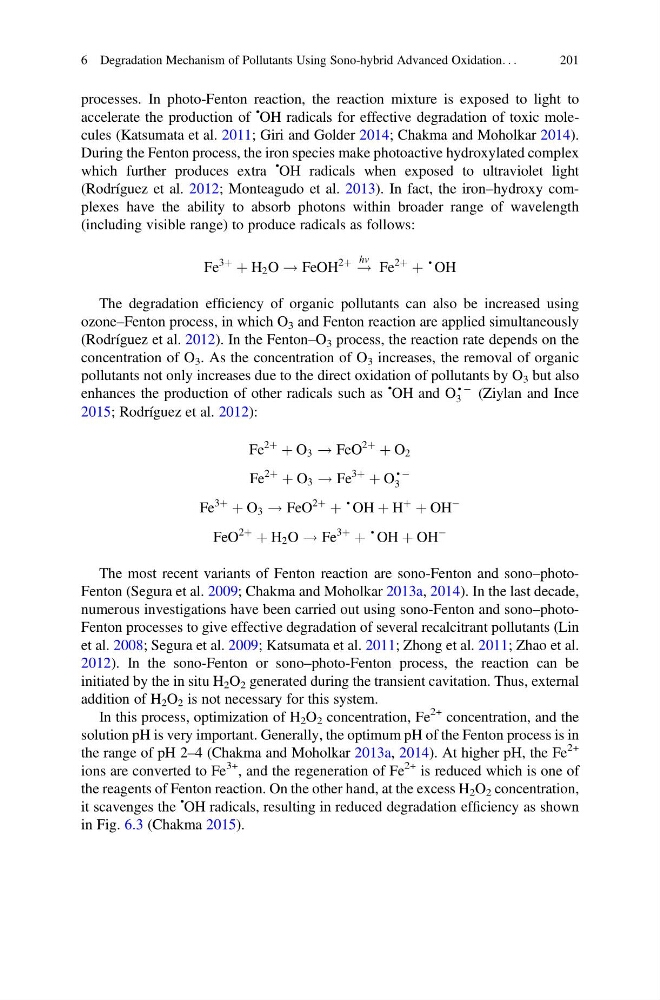
processes. In photo-Fenton reaction, the reaction mixture is exposed to light to
accelerate the production of
•
OH radicals for effective degradation of toxic molecules (Katsumata et al. 2011; Giri and Golder 2014; Chakma and Moholkar 2014).
During the Fenton process, the iron species make photoactive hydroxylated complex
which further produces extra
•
OH radicals when exposed to ultraviolet light
(Rodríguez et al. 2012; Monteagudo et al. 2013). In fact, the iron–hydroxy complexes have the ability to absorb photons within broader range of wavelength
(including visible range) to produce radicals as follows:
Fe
3þ
þ H 2 O ! FeOH
2þ
!
hv Fe
2þ
þ
• OH
The degradation efficiency of organic pollutants can also be increased using
ozone–Fenton process, in which O 3 and Fenton reaction are applied simultaneously
(Rodríguez et al. 2012). In the Fenton–O 3 process, the reaction rate depends on the
concentration of O 3 . As the concentration of O 3 increases, the removal of organic
pollutants not only increases due to the direct oxidation of pollutants by O 3 but also
enhances the production of other radicals such as
• OH and O
• À
3
(Ziylan and Ince
2015; Rodríguez et al. 2012):
Fe
2þ
þ O 3 ! FeO
2þ
þ O 2
Fe
2þ
þ O 3 ! Fe
3þ
þ O
• À
3
Fe
3þ
þ O 3 ! FeO
2þ
þ
• OH þ H
þ
þ OH
À
FeO
2þ
þ H 2 O ! Fe
3þ
þ
• OH þ OH
À
The most recent variants of Fenton reaction are sono-Fenton and sono–photoFenton (Segura et al. 2009; Chakma and Moholkar 2013a, 2014). In the last decade,
numerous investigations have been carried out using sono-Fenton and sono–photoFenton processes to give effective degradation of several recalcitrant pollutants (Lin
et al. 2008; Segura et al. 2009; Katsumata et al. 2011; Zhong et al. 2011; Zhao et al.
2012). In the sono-Fenton or sono–photo-Fenton process, the reaction can be
initiated by the in situ H 2 O 2 generated during the transient cavitation. Thus, external
addition of H 2 O 2 is not necessary for this system.
In this process, optimization of H 2 O 2 concentration, Fe
2+ concentration, and the
solution pH is very important. Generally, the optimum pH of the Fenton process is in
the range of pH 2–4 (Chakma and Moholkar 2013a, 2014). At higher pH, the Fe
2+
ions are converted to Fe
3+ , and the regeneration of Fe
2+ is reduced which is one of
the reagents of Fenton reaction. On the other hand, at the excess H 2 O 2 concentration,
it scavenges the
•
OH radicals, resulting in reduced degradation efficiency as shown
in Fig. 6.3 (Chakma 2015).
6 Degradation Mechanism of Pollutants Using Sono-hybrid Advanced Oxidation. . .
201
accelerate the production of
•
OH radicals for effective degradation of toxic molecules (Katsumata et al. 2011; Giri and Golder 2014; Chakma and Moholkar 2014).
During the Fenton process, the iron species make photoactive hydroxylated complex
which further produces extra
•
OH radicals when exposed to ultraviolet light
(Rodríguez et al. 2012; Monteagudo et al. 2013). In fact, the iron–hydroxy complexes have the ability to absorb photons within broader range of wavelength
(including visible range) to produce radicals as follows:
Fe
3þ
þ H 2 O ! FeOH
2þ
!
hv Fe
2þ
þ
• OH
The degradation efficiency of organic pollutants can also be increased using
ozone–Fenton process, in which O 3 and Fenton reaction are applied simultaneously
(Rodríguez et al. 2012). In the Fenton–O 3 process, the reaction rate depends on the
concentration of O 3 . As the concentration of O 3 increases, the removal of organic
pollutants not only increases due to the direct oxidation of pollutants by O 3 but also
enhances the production of other radicals such as
• OH and O
• À
3
(Ziylan and Ince
2015; Rodríguez et al. 2012):
Fe
2þ
þ O 3 ! FeO
2þ
þ O 2
Fe
2þ
þ O 3 ! Fe
3þ
þ O
• À
3
Fe
3þ
þ O 3 ! FeO
2þ
þ
• OH þ H
þ
þ OH
À
FeO
2þ
þ H 2 O ! Fe
3þ
þ
• OH þ OH
À
The most recent variants of Fenton reaction are sono-Fenton and sono–photoFenton (Segura et al. 2009; Chakma and Moholkar 2013a, 2014). In the last decade,
numerous investigations have been carried out using sono-Fenton and sono–photoFenton processes to give effective degradation of several recalcitrant pollutants (Lin
et al. 2008; Segura et al. 2009; Katsumata et al. 2011; Zhong et al. 2011; Zhao et al.
2012). In the sono-Fenton or sono–photo-Fenton process, the reaction can be
initiated by the in situ H 2 O 2 generated during the transient cavitation. Thus, external
addition of H 2 O 2 is not necessary for this system.
In this process, optimization of H 2 O 2 concentration, Fe
2+ concentration, and the
solution pH is very important. Generally, the optimum pH of the Fenton process is in
the range of pH 2–4 (Chakma and Moholkar 2013a, 2014). At higher pH, the Fe
2+
ions are converted to Fe
3+ , and the regeneration of Fe
2+ is reduced which is one of
the reagents of Fenton reaction. On the other hand, at the excess H 2 O 2 concentration,
it scavenges the
•
OH radicals, resulting in reduced degradation efficiency as shown
in Fig. 6.3 (Chakma 2015).
6 Degradation Mechanism of Pollutants Using Sono-hybrid Advanced Oxidation. . .
201