

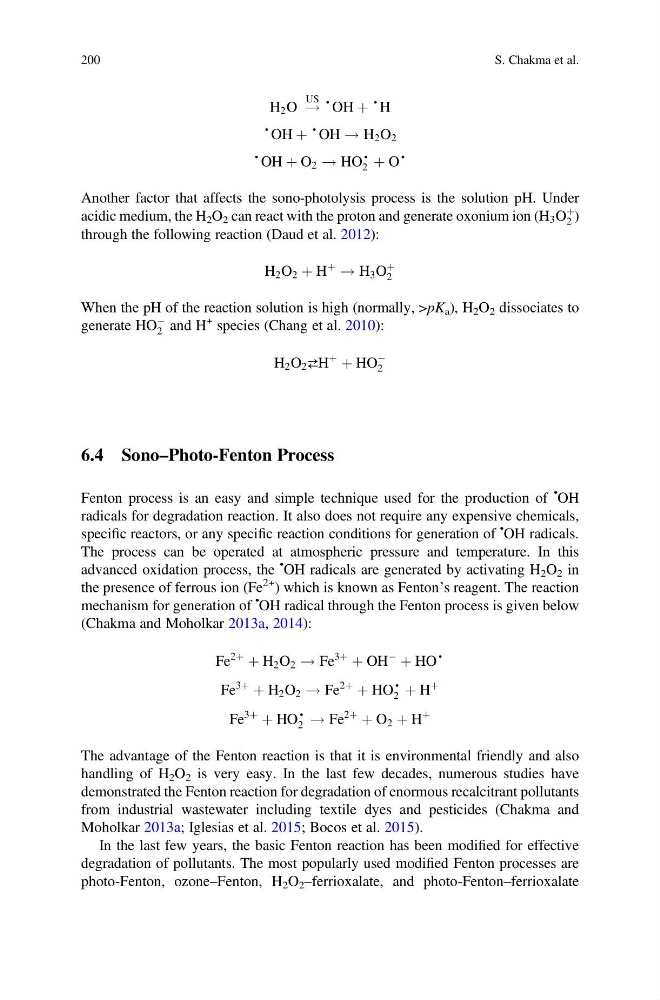
H 2 O !
US • OH þ
• H
• OH þ
• OH ! H 2 O 2
• OH þ O 2 ! HO
•
2 þ O
•
Another factor that affects the sono-photolysis process is the solution pH. Under
acidic medium, the H 2 O 2 can react with the proton and generate oxonium ion (H 3 O
þ
2 )
through the following reaction (Daud et al. 2012):
H 2 O 2 þ H
þ
! H 3 O
þ
2
When the pH of the reaction solution is high (normally, >pK a ), H 2 O 2 dissociates to
generate HO
À
2 and H
+ species (Chang et al. 2010):
H 2 O 2 ⇄H
þ
þ HO
À
2
6.4 Sono–Photo-Fenton Process
Fenton process is an easy and simple technique used for the production of
•
OH
radicals for degradation reaction. It also does not require any expensive chemicals,
specific reactors, or any specific reaction conditions for generation of
•
OH radicals.
The process can be operated at atmospheric pressure and temperature. In this
advanced oxidation process, the
• OH radicals are generated by activating H 2 O 2 in
the presence of ferrous ion (Fe
2+ ) which is known as Fenton’s reagent. The reaction
mechanism for generation of
•
OH radical through the Fenton process is given below
(Chakma and Moholkar 2013a, 2014):
Fe
2þ
þ H 2 O 2 ! Fe
3þ
þ OH
À
þ HO
•
Fe
3þ
þ H 2 O 2 ! Fe
2þ
þ HO
•
2 þ H
þ
Fe
3þ
þ HO
•
2 ! Fe
2þ
þ O 2 þ H
þ
The advantage of the Fenton reaction is that it is environmental friendly and also
handling of H 2 O 2 is very easy. In the last few decades, numerous studies have
demonstrated the Fenton reaction for degradation of enormous recalcitrant pollutants
from industrial wastewater including textile dyes and pesticides (Chakma and
Moholkar 2013a; Iglesias et al. 2015; Bocos et al. 2015).
In the last few years, the basic Fenton reaction has been modified for effective
degradation of pollutants. The most popularly used modified Fenton processes are
photo-Fenton, ozone–Fenton, H 2 O 2 –ferrioxalate, and photo-Fenton–ferrioxalate
200
S. Chakma et al.
US • OH þ
• H
• OH þ
• OH ! H 2 O 2
• OH þ O 2 ! HO
•
2 þ O
•
Another factor that affects the sono-photolysis process is the solution pH. Under
acidic medium, the H 2 O 2 can react with the proton and generate oxonium ion (H 3 O
þ
2 )
through the following reaction (Daud et al. 2012):
H 2 O 2 þ H
þ
! H 3 O
þ
2
When the pH of the reaction solution is high (normally, >pK a ), H 2 O 2 dissociates to
generate HO
À
2 and H
+ species (Chang et al. 2010):
H 2 O 2 ⇄H
þ
þ HO
À
2
6.4 Sono–Photo-Fenton Process
Fenton process is an easy and simple technique used for the production of
•
OH
radicals for degradation reaction. It also does not require any expensive chemicals,
specific reactors, or any specific reaction conditions for generation of
•
OH radicals.
The process can be operated at atmospheric pressure and temperature. In this
advanced oxidation process, the
• OH radicals are generated by activating H 2 O 2 in
the presence of ferrous ion (Fe
2+ ) which is known as Fenton’s reagent. The reaction
mechanism for generation of
•
OH radical through the Fenton process is given below
(Chakma and Moholkar 2013a, 2014):
Fe
2þ
þ H 2 O 2 ! Fe
3þ
þ OH
À
þ HO
•
Fe
3þ
þ H 2 O 2 ! Fe
2þ
þ HO
•
2 þ H
þ
Fe
3þ
þ HO
•
2 ! Fe
2þ
þ O 2 þ H
þ
The advantage of the Fenton reaction is that it is environmental friendly and also
handling of H 2 O 2 is very easy. In the last few decades, numerous studies have
demonstrated the Fenton reaction for degradation of enormous recalcitrant pollutants
from industrial wastewater including textile dyes and pesticides (Chakma and
Moholkar 2013a; Iglesias et al. 2015; Bocos et al. 2015).
In the last few years, the basic Fenton reaction has been modified for effective
degradation of pollutants. The most popularly used modified Fenton processes are
photo-Fenton, ozone–Fenton, H 2 O 2 –ferrioxalate, and photo-Fenton–ferrioxalate
200
S. Chakma et al.