

oxidation depends on pH, concentrations of the pollutants and hydrogen peroxide,
amount of ferrous ions, and temperature (Zheng et al. 2013; Ameta et al. 2018a).
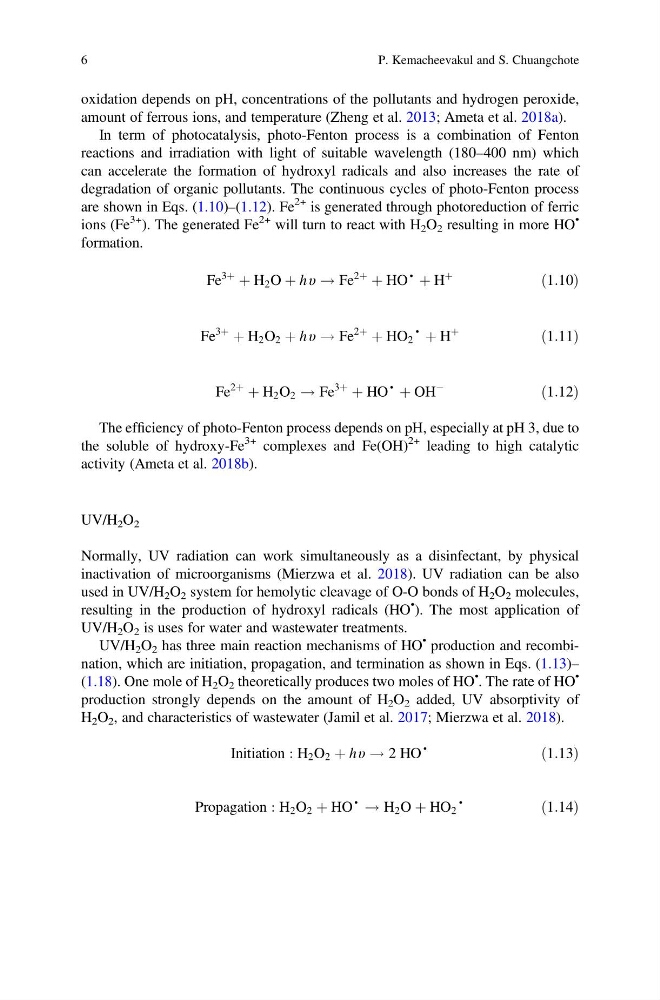
In term of photocatalysis, photo-Fenton process is a combination of Fenton
reactions and irradiation with light of suitable wavelength (180–400 nm) which
can accelerate the formation of hydroxyl radicals and also increases the rate of
degradation of organic pollutants. The continuous cycles of photo-Fenton process
are shown in Eqs. (1.10)–(1.12). Fe
2+ is generated through photoreduction of ferric
ions (Fe
3+ ). The generated Fe
2+ will turn to react with H 2 O 2 resulting in more HO
•
formation.
Fe
3þ
þ H 2 O þ h υ ! Fe
2þ
þ HO
•
þ H
þ
ð1:10Þ
Fe
3þ
þ H 2 O 2 þ h υ ! Fe
2þ
þ HO 2
•
þ H
þ
ð1:11Þ
Fe
2þ
þ H 2 O 2 ! Fe
3þ
þ HO
•
þ OH
À
ð1:12Þ
The efficiency of photo-Fenton process depends on pH, especially at pH 3, due to
the soluble of hydroxy-Fe
3+ complexes and Fe(OH)
2+ leading to high catalytic
activity (Ameta et al. 2018b).
UV/H 2 O 2
Normally, UV radiation can work simultaneously as a disinfectant, by physical
inactivation of microorganisms (Mierzwa et al. 2018). UV radiation can be also
used in UV/H 2 O 2 system for hemolytic cleavage of O-O bonds of H 2 O 2 molecules,
resulting in the production of hydroxyl radicals (HO
• ). The most application of
UV/H 2 O 2 is uses for water and wastewater treatments.
UV/H 2 O 2 has three main reaction mechanisms of HO
• production and recombination, which are initiation, propagation, and termination as shown in Eqs. (1.13)–
(1.18). One mole of H 2 O 2 theoretically produces two moles of HO
•
. The rate of HO
•
production strongly depends on the amount of H 2 O 2 added, UV absorptivity of
H 2 O 2 , and characteristics of wastewater (Jamil et al. 2017; Mierzwa et al. 2018).
Initiation : H 2 O 2 þ h υ ! 2 HO
•
ð1:13Þ
Propagation : H 2 O 2 þ HO
•
! H 2 O þ HO 2
•
ð1:14Þ
6
P. Kemacheevakul and S. Chuangchote
amount of ferrous ions, and temperature (Zheng et al. 2013; Ameta et al. 2018a).
In term of photocatalysis, photo-Fenton process is a combination of Fenton
reactions and irradiation with light of suitable wavelength (180–400 nm) which
can accelerate the formation of hydroxyl radicals and also increases the rate of
degradation of organic pollutants. The continuous cycles of photo-Fenton process
are shown in Eqs. (1.10)–(1.12). Fe
2+ is generated through photoreduction of ferric
ions (Fe
3+ ). The generated Fe
2+ will turn to react with H 2 O 2 resulting in more HO
•
formation.
Fe
3þ
þ H 2 O þ h υ ! Fe
2þ
þ HO
•
þ H
þ
ð1:10Þ
Fe
3þ
þ H 2 O 2 þ h υ ! Fe
2þ
þ HO 2
•
þ H
þ
ð1:11Þ
Fe
2þ
þ H 2 O 2 ! Fe
3þ
þ HO
•
þ OH
À
ð1:12Þ
The efficiency of photo-Fenton process depends on pH, especially at pH 3, due to
the soluble of hydroxy-Fe
3+ complexes and Fe(OH)
2+ leading to high catalytic
activity (Ameta et al. 2018b).
UV/H 2 O 2
Normally, UV radiation can work simultaneously as a disinfectant, by physical
inactivation of microorganisms (Mierzwa et al. 2018). UV radiation can be also
used in UV/H 2 O 2 system for hemolytic cleavage of O-O bonds of H 2 O 2 molecules,
resulting in the production of hydroxyl radicals (HO
• ). The most application of
UV/H 2 O 2 is uses for water and wastewater treatments.
UV/H 2 O 2 has three main reaction mechanisms of HO
• production and recombination, which are initiation, propagation, and termination as shown in Eqs. (1.13)–
(1.18). One mole of H 2 O 2 theoretically produces two moles of HO
•
. The rate of HO
•
production strongly depends on the amount of H 2 O 2 added, UV absorptivity of
H 2 O 2 , and characteristics of wastewater (Jamil et al. 2017; Mierzwa et al. 2018).
Initiation : H 2 O 2 þ h υ ! 2 HO
•
ð1:13Þ
Propagation : H 2 O 2 þ HO
•
! H 2 O þ HO 2
•
ð1:14Þ
6
P. Kemacheevakul and S. Chuangchote