

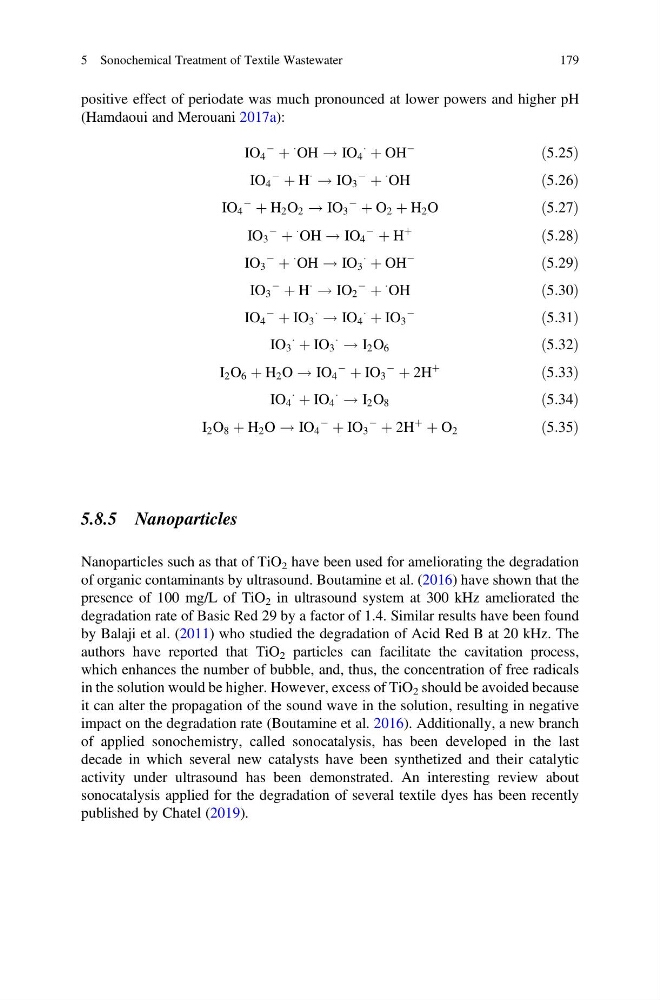
positive effect of periodate was much pronounced at lower powers and higher pH
(Hamdaoui and Merouani 2017a):
IO 4
À
þ
Á OH ! IO 4
Á
þ OH
À
ð5:25Þ
IO 4
À
þ H
Á
! IO 3
À
þ
Á OH
ð5:26Þ
IO 4
À
þ H 2 O 2 ! IO 3
À
þ O 2 þ H 2 O
ð5:27Þ
IO 3
À
þ
Á OH ! IO 4
À
þ H
þ
ð5:28Þ
IO 3
À
þ
Á OH ! IO 3
Á
þ OH
À
ð5:29Þ
IO 3
À
þ H
Á
! IO 2
À
þ
Á OH
ð5:30Þ
IO 4
À
þ IO 3
Á
! IO 4
Á
þ IO 3
À
ð5:31Þ
IO 3
Á
þ IO 3
Á
! I 2 O 6
ð5:32Þ
I 2 O 6 þ H 2 O ! IO 4
À
þ IO 3
À
þ 2H
þ
ð5:33Þ
IO 4
Á
þ IO 4
Á
! I 2 O 8
ð5:34Þ
I 2 O 8 þ H 2 O ! IO 4
À
þ IO 3
À
þ 2H
þ
þ O 2
ð5:35Þ
5.8.5 Nanoparticles
Nanoparticles such as that of TiO 2 have been used for ameliorating the degradation
of organic contaminants by ultrasound. Boutamine et al. (2016) have shown that the
presence of 100 mg/L of TiO 2 in ultrasound system at 300 kHz ameliorated the
degradation rate of Basic Red 29 by a factor of 1.4. Similar results have been found
by Balaji et al. (2011) who studied the degradation of Acid Red B at 20 kHz. The
authors have reported that TiO 2 particles can facilitate the cavitation process,
which enhances the number of bubble, and, thus, the concentration of free radicals
in the solution would be higher. However, excess of TiO 2 should be avoided because
it can alter the propagation of the sound wave in the solution, resulting in negative
impact on the degradation rate (Boutamine et al. 2016). Additionally, a new branch
of applied sonochemistry, called sonocatalysis, has been developed in the last
decade in which several new catalysts have been synthetized and their catalytic
activity under ultrasound has been demonstrated. An interesting review about
sonocatalysis applied for the degradation of several textile dyes has been recently
published by Chatel (2019).
5 Sonochemical Treatment of Textile Wastewater
179
(Hamdaoui and Merouani 2017a):
IO 4
À
þ
Á OH ! IO 4
Á
þ OH
À
ð5:25Þ
IO 4
À
þ H
Á
! IO 3
À
þ
Á OH
ð5:26Þ
IO 4
À
þ H 2 O 2 ! IO 3
À
þ O 2 þ H 2 O
ð5:27Þ
IO 3
À
þ
Á OH ! IO 4
À
þ H
þ
ð5:28Þ
IO 3
À
þ
Á OH ! IO 3
Á
þ OH
À
ð5:29Þ
IO 3
À
þ H
Á
! IO 2
À
þ
Á OH
ð5:30Þ
IO 4
À
þ IO 3
Á
! IO 4
Á
þ IO 3
À
ð5:31Þ
IO 3
Á
þ IO 3
Á
! I 2 O 6
ð5:32Þ
I 2 O 6 þ H 2 O ! IO 4
À
þ IO 3
À
þ 2H
þ
ð5:33Þ
IO 4
Á
þ IO 4
Á
! I 2 O 8
ð5:34Þ
I 2 O 8 þ H 2 O ! IO 4
À
þ IO 3
À
þ 2H
þ
þ O 2
ð5:35Þ
5.8.5 Nanoparticles
Nanoparticles such as that of TiO 2 have been used for ameliorating the degradation
of organic contaminants by ultrasound. Boutamine et al. (2016) have shown that the
presence of 100 mg/L of TiO 2 in ultrasound system at 300 kHz ameliorated the
degradation rate of Basic Red 29 by a factor of 1.4. Similar results have been found
by Balaji et al. (2011) who studied the degradation of Acid Red B at 20 kHz. The
authors have reported that TiO 2 particles can facilitate the cavitation process,
which enhances the number of bubble, and, thus, the concentration of free radicals
in the solution would be higher. However, excess of TiO 2 should be avoided because
it can alter the propagation of the sound wave in the solution, resulting in negative
impact on the degradation rate (Boutamine et al. 2016). Additionally, a new branch
of applied sonochemistry, called sonocatalysis, has been developed in the last
decade in which several new catalysts have been synthetized and their catalytic
activity under ultrasound has been demonstrated. An interesting review about
sonocatalysis applied for the degradation of several textile dyes has been recently
published by Chatel (2019).
5 Sonochemical Treatment of Textile Wastewater
179