

when sonication is assisted with 15 mg/L of Fe
2+ and from 5% to 50% after 1 h with
the same iron dose (Boutamine et al. 2017). Several similar observations have been
reported for different types of dyes at different sonochemical conditions (Sun et al.
2007; Wang et al. 2008; Song et al. 2009; Eren 2012; Basturk and Karatas 2014;
Dükkancı et al. 2014; Verma et al. 2015).
5.8.3 Persulfate (S 2 O 8
22
)
Even though persulfate can act as a direct oxidant (E
¼ 2.07 V), its reaction rates are
limited for more recalcitrant contaminants (Zhang et al. 2015). The combination of
persulfate with ultrasound is new tool for intensifying the sonochemical degradation
of nonvolatile micropollutants in water (Neppolian et al. 2002, 2010). In this case,
ultrasound can activate persulfate into sulfate radical (SO 4
•À ) that have an oxidation
potential (E
0
¼ 2.6 V) comparable to that of hydroxyl radical, i.e., 2.8 V (Latimer
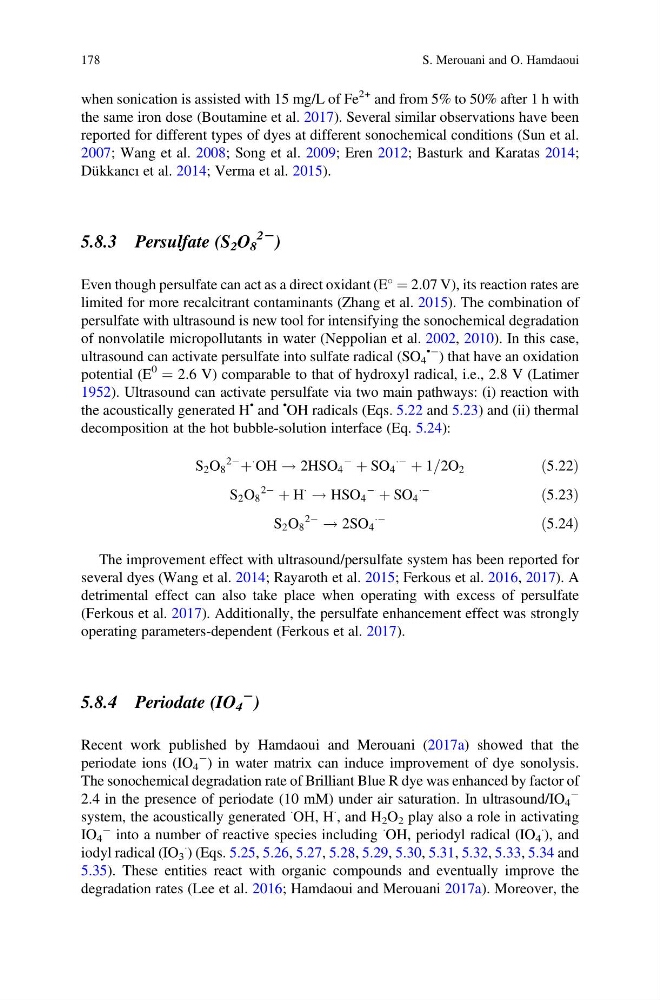
1952). Ultrasound can activate persulfate via two main pathways: (i) reaction with
the acoustically generated H
• and
•
OH radicals (Eqs. 5.22 and 5.23) and (ii) thermal
decomposition at the hot bubble-solution interface (Eq. 5.24):
S 2 O 8
2À
þ
Á OH ! 2HSO 4
À
þ SO 4
ÁÀ
þ 1=2O 2
ð5:22Þ
S 2 O 8
2À
þ H
Á
! HSO 4
À
þ SO 4
ÁÀ
ð5:23Þ
S 2 O 8
2À
! 2SO 4
ÁÀ
ð5:24Þ
The improvement effect with ultrasound/persulfate system has been reported for
several dyes (Wang et al. 2014; Rayaroth et al. 2015; Ferkous et al. 2016, 2017). A
detrimental effect can also take place when operating with excess of persulfate
(Ferkous et al. 2017). Additionally, the persulfate enhancement effect was strongly
operating parameters-dependent (Ferkous et al. 2017).
5.8.4 Periodate (IO 4
2 )
Recent work published by Hamdaoui and Merouani (2017a) showed that the
periodate ions (IO 4
À ) in water matrix can induce improvement of dye sonolysis.
The sonochemical degradation rate of Brilliant Blue R dye was enhanced by factor of
2.4 in the presence of periodate (10 mM) under air saturation. In ultrasound/IO 4
À
system, the acoustically generated
Á OH, H
Á , and H 2 O 2 play also a role in activating
IO 4
À into a number of reactive species including
Á OH, periodyl radical (IO 4
Á
), and
iodyl radical (IO 3
Á ) (Eqs. 5.25, 5.26, 5.27, 5.28, 5.29, 5.30, 5.31, 5.32, 5.33, 5.34 and
5.35). These entities react with organic compounds and eventually improve the
degradation rates (Lee et al. 2016; Hamdaoui and Merouani 2017a). Moreover, the
178
S. Merouani and O. Hamdaoui
2+ and from 5% to 50% after 1 h with
the same iron dose (Boutamine et al. 2017). Several similar observations have been
reported for different types of dyes at different sonochemical conditions (Sun et al.
2007; Wang et al. 2008; Song et al. 2009; Eren 2012; Basturk and Karatas 2014;
Dükkancı et al. 2014; Verma et al. 2015).
5.8.3 Persulfate (S 2 O 8
22
)
Even though persulfate can act as a direct oxidant (E
¼ 2.07 V), its reaction rates are
limited for more recalcitrant contaminants (Zhang et al. 2015). The combination of
persulfate with ultrasound is new tool for intensifying the sonochemical degradation
of nonvolatile micropollutants in water (Neppolian et al. 2002, 2010). In this case,
ultrasound can activate persulfate into sulfate radical (SO 4
•À ) that have an oxidation
potential (E
0
¼ 2.6 V) comparable to that of hydroxyl radical, i.e., 2.8 V (Latimer
1952). Ultrasound can activate persulfate via two main pathways: (i) reaction with
the acoustically generated H
• and
•
OH radicals (Eqs. 5.22 and 5.23) and (ii) thermal
decomposition at the hot bubble-solution interface (Eq. 5.24):
S 2 O 8
2À
þ
Á OH ! 2HSO 4
À
þ SO 4
ÁÀ
þ 1=2O 2
ð5:22Þ
S 2 O 8
2À
þ H
Á
! HSO 4
À
þ SO 4
ÁÀ
ð5:23Þ
S 2 O 8
2À
! 2SO 4
ÁÀ
ð5:24Þ
The improvement effect with ultrasound/persulfate system has been reported for
several dyes (Wang et al. 2014; Rayaroth et al. 2015; Ferkous et al. 2016, 2017). A
detrimental effect can also take place when operating with excess of persulfate
(Ferkous et al. 2017). Additionally, the persulfate enhancement effect was strongly
operating parameters-dependent (Ferkous et al. 2017).
5.8.4 Periodate (IO 4
2 )
Recent work published by Hamdaoui and Merouani (2017a) showed that the
periodate ions (IO 4
À ) in water matrix can induce improvement of dye sonolysis.
The sonochemical degradation rate of Brilliant Blue R dye was enhanced by factor of
2.4 in the presence of periodate (10 mM) under air saturation. In ultrasound/IO 4
À
system, the acoustically generated
Á OH, H
Á , and H 2 O 2 play also a role in activating
IO 4
À into a number of reactive species including
Á OH, periodyl radical (IO 4
Á
), and
iodyl radical (IO 3
Á ) (Eqs. 5.25, 5.26, 5.27, 5.28, 5.29, 5.30, 5.31, 5.32, 5.33, 5.34 and
5.35). These entities react with organic compounds and eventually improve the
degradation rates (Lee et al. 2016; Hamdaoui and Merouani 2017a). Moreover, the
178
S. Merouani and O. Hamdaoui