

seawater induced an enhancement index of 2 for naphthol blue black at 1700 kHz
against 1 for the same pollutant at 585 kHz.
Bicarbonate and carbonate showed dual trends that are related to the relative
concentration of both the dye and anions (Minero et al. 2008; Merouani et al. 2010a;
Guzman-Duque et al. 2011). At low concentration of the dye, the degradation rate
increased with carbonate/bicarbonate concentration rise to higher level. Instead, at
higher concentration of the dye, bicarbonate/carbonate ions have a competitive
effect. These observations were related to the formation of CO 3
Á– radical and its
subsequent reaction with the dye. CO 3
Á– radical is a powerful oxidant (E
¼ 1.78 V)
which may be formed when using ultrasound for water treatment through quenching
of hydroxyl radical by HCO 3
À and CO 3
2À as:
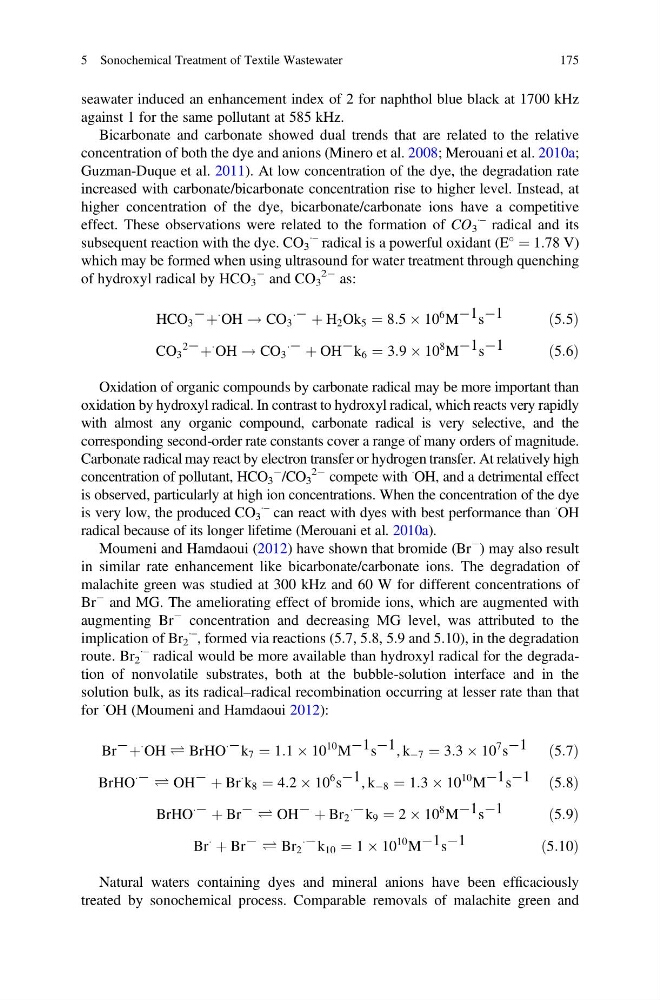
HCO 3
À þ
Á OH ! CO 3
ÁÀ
þ H 2 Ok 5 ¼ 8:5 Â 10
6 M À1 s À1
ð5:5Þ
CO 3
2À
þ
Á OH ! CO 3
ÁÀ
þ OH À k 6 ¼ 3:9 Â 10
8 M À1 s À1
ð5:6Þ
Oxidation of organic compounds by carbonate radical may be more important than
oxidation by hydroxyl radical. In contrast to hydroxyl radical, which reacts very rapidly
with almost any organic compound, carbonate radical is very selective, and the
corresponding second-order rate constants cover a range of many orders of magnitude.
Carbonate radical may react by electron transfer or hydrogen transfer. At relatively high
concentration of pollutant, HCO 3
À
/CO 3
2À compete with
Á
OH, and a detrimental effect
is observed, particularly at high ion concentrations. When the concentration of the dye
is very low, the produced CO 3
Á– can react with dyes with best performance than
Á OH
radical because of its longer lifetime (Merouani et al. 2010a).
Moumeni and Hamdaoui (2012) have shown that bromide (Br
À
) may also result
in similar rate enhancement like bicarbonate/carbonate ions. The degradation of
malachite green was studied at 300 kHz and 60 W for different concentrations of
Br
À and MG. The ameliorating effect of bromide ions, which are augmented with
augmenting Br
À concentration and decreasing MG level, was attributed to the
implication of Br 2
Á– , formed via reactions (5.7, 5.8, 5.9 and 5.10), in the degradation
route. Br 2
Á– radical would be more available than hydroxyl radical for the degradation of nonvolatile substrates, both at the bubble-solution interface and in the
solution bulk, as its radical–radical recombination occurring at lesser rate than that
for
Á OH (Moumeni and Hamdaoui 2012):
Br À þ
Á OH Ð BrHO
ÁÀ k 7 ¼ 1:1 Â 10
10 M À1 s À1 , k À7 ¼ 3:3 Â 10
7 s À1 ð5:7Þ
BrHO
ÁÀ
Ð OH À þ Br
Á k 8 ¼ 4:2 Â 10
6 s À1 , k À8 ¼ 1:3 Â 10
10 M À1 s À1 ð5:8Þ
BrHO
ÁÀ
þ Br À Ð OH À þ Br 2
ÁÀ k 9 ¼ 2 Â 10
8 M À1 s À1
ð5:9Þ
Br
Á
þ Br À Ð Br 2
ÁÀ k 10 ¼ 1 Â 10
10 M À1 s À1
ð5:10Þ
Natural waters containing dyes and mineral anions have been efficaciously
treated by sonochemical process. Comparable removals of malachite green and
5 Sonochemical Treatment of Textile Wastewater
175
against 1 for the same pollutant at 585 kHz.
Bicarbonate and carbonate showed dual trends that are related to the relative
concentration of both the dye and anions (Minero et al. 2008; Merouani et al. 2010a;
Guzman-Duque et al. 2011). At low concentration of the dye, the degradation rate
increased with carbonate/bicarbonate concentration rise to higher level. Instead, at
higher concentration of the dye, bicarbonate/carbonate ions have a competitive
effect. These observations were related to the formation of CO 3
Á– radical and its
subsequent reaction with the dye. CO 3
Á– radical is a powerful oxidant (E
¼ 1.78 V)
which may be formed when using ultrasound for water treatment through quenching
of hydroxyl radical by HCO 3
À and CO 3
2À as:
HCO 3
À þ
Á OH ! CO 3
ÁÀ
þ H 2 Ok 5 ¼ 8:5 Â 10
6 M À1 s À1
ð5:5Þ
CO 3
2À
þ
Á OH ! CO 3
ÁÀ
þ OH À k 6 ¼ 3:9 Â 10
8 M À1 s À1
ð5:6Þ
Oxidation of organic compounds by carbonate radical may be more important than
oxidation by hydroxyl radical. In contrast to hydroxyl radical, which reacts very rapidly
with almost any organic compound, carbonate radical is very selective, and the
corresponding second-order rate constants cover a range of many orders of magnitude.
Carbonate radical may react by electron transfer or hydrogen transfer. At relatively high
concentration of pollutant, HCO 3
À
/CO 3
2À compete with
Á
OH, and a detrimental effect
is observed, particularly at high ion concentrations. When the concentration of the dye
is very low, the produced CO 3
Á– can react with dyes with best performance than
Á OH
radical because of its longer lifetime (Merouani et al. 2010a).
Moumeni and Hamdaoui (2012) have shown that bromide (Br
À
) may also result
in similar rate enhancement like bicarbonate/carbonate ions. The degradation of
malachite green was studied at 300 kHz and 60 W for different concentrations of
Br
À and MG. The ameliorating effect of bromide ions, which are augmented with
augmenting Br
À concentration and decreasing MG level, was attributed to the
implication of Br 2
Á– , formed via reactions (5.7, 5.8, 5.9 and 5.10), in the degradation
route. Br 2
Á– radical would be more available than hydroxyl radical for the degradation of nonvolatile substrates, both at the bubble-solution interface and in the
solution bulk, as its radical–radical recombination occurring at lesser rate than that
for
Á OH (Moumeni and Hamdaoui 2012):
Br À þ
Á OH Ð BrHO
ÁÀ k 7 ¼ 1:1 Â 10
10 M À1 s À1 , k À7 ¼ 3:3 Â 10
7 s À1 ð5:7Þ
BrHO
ÁÀ
Ð OH À þ Br
Á k 8 ¼ 4:2 Â 10
6 s À1 , k À8 ¼ 1:3 Â 10
10 M À1 s À1 ð5:8Þ
BrHO
ÁÀ
þ Br À Ð OH À þ Br 2
ÁÀ k 9 ¼ 2 Â 10
8 M À1 s À1
ð5:9Þ
Br
Á
þ Br À Ð Br 2
ÁÀ k 10 ¼ 1 Â 10
10 M À1 s À1
ð5:10Þ
Natural waters containing dyes and mineral anions have been efficaciously
treated by sonochemical process. Comparable removals of malachite green and
5 Sonochemical Treatment of Textile Wastewater
175