

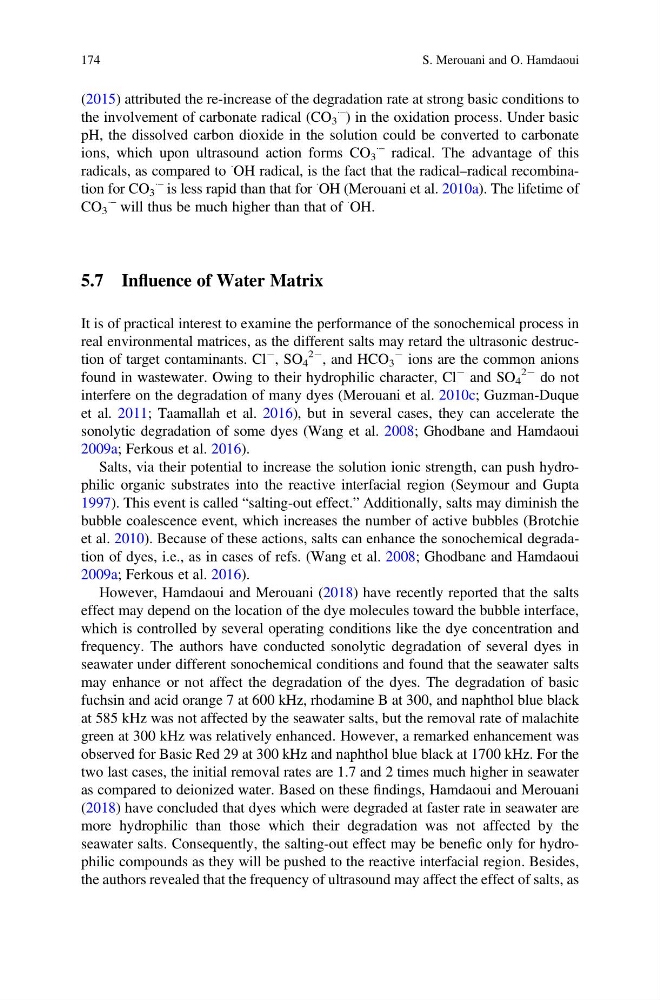
(2015) attributed the re-increase of the degradation rate at strong basic conditions to
the involvement of carbonate radical (CO 3
Á– ) in the oxidation process. Under basic
pH, the dissolved carbon dioxide in the solution could be converted to carbonate
ions, which upon ultrasound action forms CO 3
Á– radical. The advantage of this
radicals, as compared to
Á OH radical, is the fact that the radical–radical recombination for CO 3
Á– is less rapid than that for
Á
OH (Merouani et al. 2010a). The lifetime of
CO 3
Á– will thus be much higher than that of
Á OH.
5.7 Influence of Water Matrix
It is of practical interest to examine the performance of the sonochemical process in
real environmental matrices, as the different salts may retard the ultrasonic destruction of target contaminants. Cl
À , SO 4
2À , and HCO 3
À ions are the common anions
found in wastewater. Owing to their hydrophilic character, Cl
À and SO 4
2À do not
interfere on the degradation of many dyes (Merouani et al. 2010c; Guzman-Duque
et al. 2011; Taamallah et al. 2016), but in several cases, they can accelerate the
sonolytic degradation of some dyes (Wang et al. 2008; Ghodbane and Hamdaoui
2009a; Ferkous et al. 2016).
Salts, via their potential to increase the solution ionic strength, can push hydrophilic organic substrates into the reactive interfacial region (Seymour and Gupta
1997). This event is called “salting-out effect.” Additionally, salts may diminish the
bubble coalescence event, which increases the number of active bubbles (Brotchie
et al. 2010). Because of these actions, salts can enhance the sonochemical degradation of dyes, i.e., as in cases of refs. (Wang et al. 2008; Ghodbane and Hamdaoui
2009a; Ferkous et al. 2016).
However, Hamdaoui and Merouani (2018) have recently reported that the salts
effect may depend on the location of the dye molecules toward the bubble interface,
which is controlled by several operating conditions like the dye concentration and
frequency. The authors have conducted sonolytic degradation of several dyes in
seawater under different sonochemical conditions and found that the seawater salts
may enhance or not affect the degradation of the dyes. The degradation of basic
fuchsin and acid orange 7 at 600 kHz, rhodamine B at 300, and naphthol blue black
at 585 kHz was not affected by the seawater salts, but the removal rate of malachite
green at 300 kHz was relatively enhanced. However, a remarked enhancement was
observed for Basic Red 29 at 300 kHz and naphthol blue black at 1700 kHz. For the
two last cases, the initial removal rates are 1.7 and 2 times much higher in seawater
as compared to deionized water. Based on these findings, Hamdaoui and Merouani
(2018) have concluded that dyes which were degraded at faster rate in seawater are
more hydrophilic than those which their degradation was not affected by the
seawater salts. Consequently, the salting-out effect may be benefic only for hydrophilic compounds as they will be pushed to the reactive interfacial region. Besides,
the authors revealed that the frequency of ultrasound may affect the effect of salts, as
174
S. Merouani and O. Hamdaoui
the involvement of carbonate radical (CO 3
Á– ) in the oxidation process. Under basic
pH, the dissolved carbon dioxide in the solution could be converted to carbonate
ions, which upon ultrasound action forms CO 3
Á– radical. The advantage of this
radicals, as compared to
Á OH radical, is the fact that the radical–radical recombination for CO 3
Á– is less rapid than that for
Á
OH (Merouani et al. 2010a). The lifetime of
CO 3
Á– will thus be much higher than that of
Á OH.
5.7 Influence of Water Matrix
It is of practical interest to examine the performance of the sonochemical process in
real environmental matrices, as the different salts may retard the ultrasonic destruction of target contaminants. Cl
À , SO 4
2À , and HCO 3
À ions are the common anions
found in wastewater. Owing to their hydrophilic character, Cl
À and SO 4
2À do not
interfere on the degradation of many dyes (Merouani et al. 2010c; Guzman-Duque
et al. 2011; Taamallah et al. 2016), but in several cases, they can accelerate the
sonolytic degradation of some dyes (Wang et al. 2008; Ghodbane and Hamdaoui
2009a; Ferkous et al. 2016).
Salts, via their potential to increase the solution ionic strength, can push hydrophilic organic substrates into the reactive interfacial region (Seymour and Gupta
1997). This event is called “salting-out effect.” Additionally, salts may diminish the
bubble coalescence event, which increases the number of active bubbles (Brotchie
et al. 2010). Because of these actions, salts can enhance the sonochemical degradation of dyes, i.e., as in cases of refs. (Wang et al. 2008; Ghodbane and Hamdaoui
2009a; Ferkous et al. 2016).
However, Hamdaoui and Merouani (2018) have recently reported that the salts
effect may depend on the location of the dye molecules toward the bubble interface,
which is controlled by several operating conditions like the dye concentration and
frequency. The authors have conducted sonolytic degradation of several dyes in
seawater under different sonochemical conditions and found that the seawater salts
may enhance or not affect the degradation of the dyes. The degradation of basic
fuchsin and acid orange 7 at 600 kHz, rhodamine B at 300, and naphthol blue black
at 585 kHz was not affected by the seawater salts, but the removal rate of malachite
green at 300 kHz was relatively enhanced. However, a remarked enhancement was
observed for Basic Red 29 at 300 kHz and naphthol blue black at 1700 kHz. For the
two last cases, the initial removal rates are 1.7 and 2 times much higher in seawater
as compared to deionized water. Based on these findings, Hamdaoui and Merouani
(2018) have concluded that dyes which were degraded at faster rate in seawater are
more hydrophilic than those which their degradation was not affected by the
seawater salts. Consequently, the salting-out effect may be benefic only for hydrophilic compounds as they will be pushed to the reactive interfacial region. Besides,
the authors revealed that the frequency of ultrasound may affect the effect of salts, as
174
S. Merouani and O. Hamdaoui