

5.6 Influence of Ultrasonic and Environmental Parameters
As briefly noticed in Sect. 5.4, the efficiency of the sonolytic process is sensitive to the
various environmental and ultrasonic parameters. Ultrasonic parameters include frequency and power (or intensity), whereas the solution characteristics, i.e., pH, temperature, initial dye concentration, and dissolved gases, are the most investigated
environmental factors. Although the impact of these parameters was reported in several
reviews, we provide herein a new analysis approach based on the estimation of the
single bubble yield and the number of collapsing bubbles in the irradiating solution.
5.6.1 Frequency of Ultrasound
Several researchers have assessed the influence of frequency in the range of 20 kHz–
2 MHz on the degradation of various textile dyes. Ghodbane and Hamdaoui (2009a)
have reported that for the sonochemical degradation of Acid Blue 25 at 1700 kHz, the
initial degradation rate was 3.5-fold higher than that of 22.5 kHz. Ferkous et al. (2017)
have tested the degradation of the azo dye naphthol blue black at 20 and 585 kHz and
found that the latter frequency provoked an enhancement of 5.66-fold in the initial
degradation rate. In another paper, the same authors have reported that the order of
initial naphthol blue black degradation rate as well as the H 2 O 2 generation rate
followed the order 585 > 840 > 1140 kHz, revealing that 585 kHz is the optimum
frequency for the effective degradation of the dye (Ferkous et al. 2015a).
Among 20, 577, 861, and 1145 kHz, Eren and Ince (2010) found that 577 kHz
provides the best degradation efficiency of C.I. Direct Yellow 9, whereas for
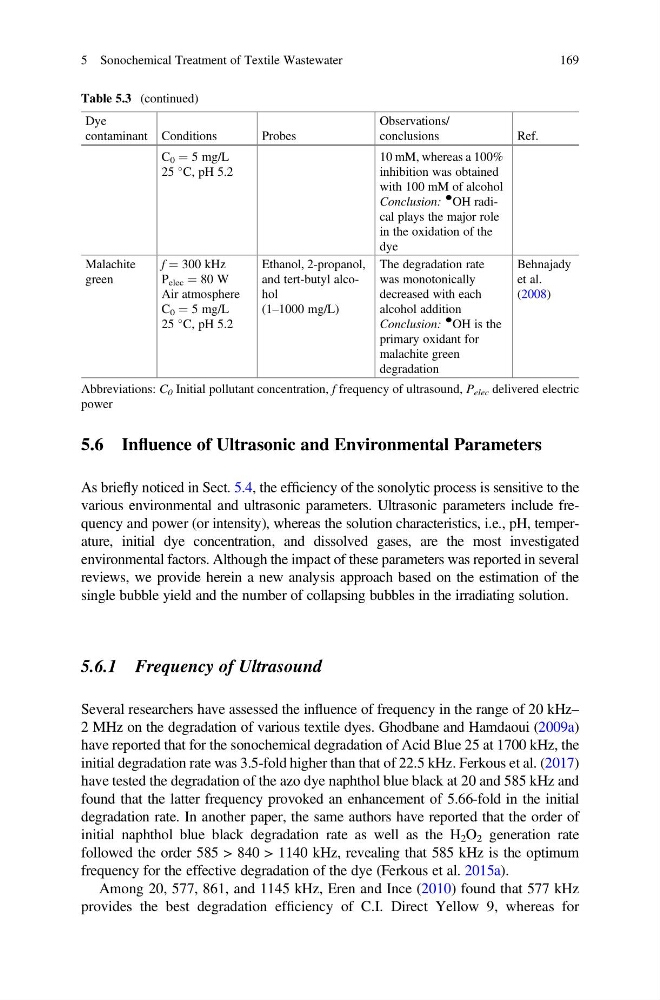
Table 5.3 (continued)
Dye
contaminant Conditions
Probes
Observations/
conclusions
Ref.
C 0 ¼ 5 mg/L
25
C, pH 5.2
10 mM, whereas a 100%
inhibition was obtained
with 100 mM of alcohol
Conclusion:
● OH radical plays the major role
in the oxidation of the
dye
Malachite
green
f ¼ 300 kHz
P elec ¼ 80 W
Air atmosphere
C 0 ¼ 5 mg/L
25
C, pH 5.2
Ethanol, 2-propanol,
and tert-butyl alcohol
(1–1000 mg/L)
The degradation rate
was monotonically
decreased with each
alcohol addition
Conclusion:
● OH is the
primary oxidant for
malachite green
degradation
Behnajady
et al.
(2008)
Abbreviations: C 0 Initial pollutant concentration, f frequency of ultrasound, P elec delivered electric
power
5 Sonochemical Treatment of Textile Wastewater
169
As briefly noticed in Sect. 5.4, the efficiency of the sonolytic process is sensitive to the
various environmental and ultrasonic parameters. Ultrasonic parameters include frequency and power (or intensity), whereas the solution characteristics, i.e., pH, temperature, initial dye concentration, and dissolved gases, are the most investigated
environmental factors. Although the impact of these parameters was reported in several
reviews, we provide herein a new analysis approach based on the estimation of the
single bubble yield and the number of collapsing bubbles in the irradiating solution.
5.6.1 Frequency of Ultrasound
Several researchers have assessed the influence of frequency in the range of 20 kHz–
2 MHz on the degradation of various textile dyes. Ghodbane and Hamdaoui (2009a)
have reported that for the sonochemical degradation of Acid Blue 25 at 1700 kHz, the
initial degradation rate was 3.5-fold higher than that of 22.5 kHz. Ferkous et al. (2017)
have tested the degradation of the azo dye naphthol blue black at 20 and 585 kHz and
found that the latter frequency provoked an enhancement of 5.66-fold in the initial
degradation rate. In another paper, the same authors have reported that the order of
initial naphthol blue black degradation rate as well as the H 2 O 2 generation rate
followed the order 585 > 840 > 1140 kHz, revealing that 585 kHz is the optimum
frequency for the effective degradation of the dye (Ferkous et al. 2015a).
Among 20, 577, 861, and 1145 kHz, Eren and Ince (2010) found that 577 kHz
provides the best degradation efficiency of C.I. Direct Yellow 9, whereas for
Table 5.3 (continued)
Dye
contaminant Conditions
Probes
Observations/
conclusions
Ref.
C 0 ¼ 5 mg/L
25
C, pH 5.2
10 mM, whereas a 100%
inhibition was obtained
with 100 mM of alcohol
Conclusion:
● OH radical plays the major role
in the oxidation of the
dye
Malachite
green
f ¼ 300 kHz
P elec ¼ 80 W
Air atmosphere
C 0 ¼ 5 mg/L
25
C, pH 5.2
Ethanol, 2-propanol,
and tert-butyl alcohol
(1–1000 mg/L)
The degradation rate
was monotonically
decreased with each
alcohol addition
Conclusion:
● OH is the
primary oxidant for
malachite green
degradation
Behnajady
et al.
(2008)
Abbreviations: C 0 Initial pollutant concentration, f frequency of ultrasound, P elec delivered electric
power
5 Sonochemical Treatment of Textile Wastewater
169