

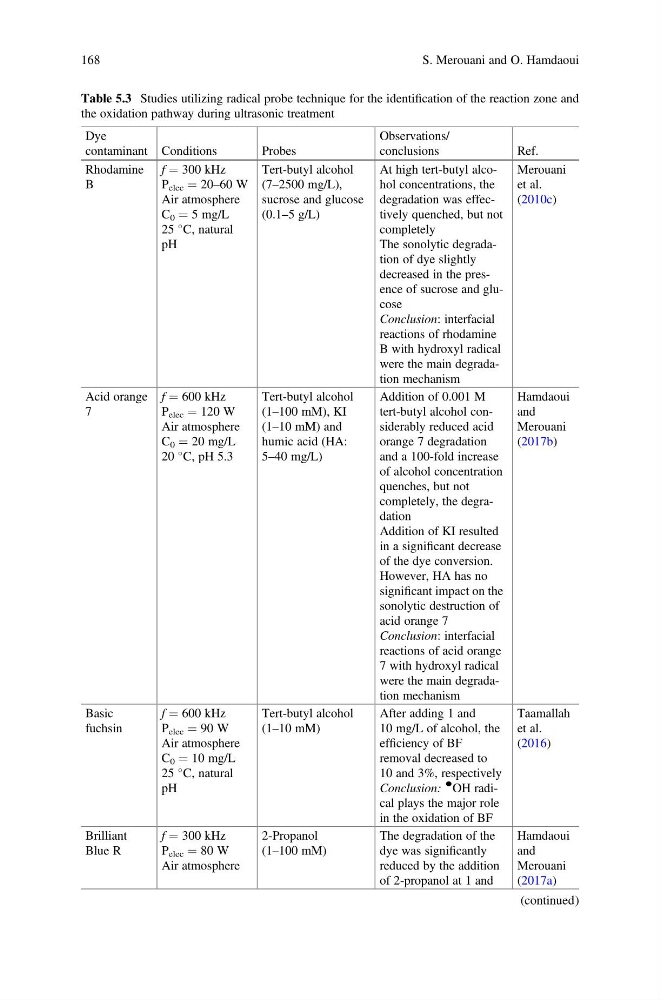
Table 5.3 Studies utilizing radical probe technique for the identification of the reaction zone and
the oxidation pathway during ultrasonic treatment
Dye
contaminant Conditions
Probes
Observations/
conclusions
Ref.
Rhodamine
B
f ¼ 300 kHz
P elec ¼ 20–60 W
Air atmosphere
C 0 ¼ 5 mg/L
25
C, natural
pH
Tert-butyl alcohol
(7–2500 mg/L),
sucrose and glucose
(0.1–5 g/L)
At high tert-butyl alcohol concentrations, the
degradation was effectively quenched, but not
completely
The sonolytic degradation of dye slightly
decreased in the presence of sucrose and glucose
Conclusion: interfacial
reactions of rhodamine
B with hydroxyl radical
were the main degradation mechanism
Merouani
et al.
(2010c)
Acid orange
7
f ¼ 600 kHz
P elec ¼ 120 W
Air atmosphere
C 0 ¼ 20 mg/L
20
C, pH 5.3
Tert-butyl alcohol
(1–100 mM), KI
(1–10 mM) and
humic acid (HA:
5–40 mg/L)
Addition of 0.001 M
tert-butyl alcohol considerably reduced acid
orange 7 degradation
and a 100-fold increase
of alcohol concentration
quenches, but not
completely, the degradation
Addition of KI resulted
in a significant decrease
of the dye conversion.
However, HA has no
significant impact on the
sonolytic destruction of
acid orange 7
Conclusion: interfacial
reactions of acid orange
7 with hydroxyl radical
were the main degradation mechanism
Hamdaoui
and
Merouani
(2017b)
Basic
fuchsin
f ¼ 600 kHz
P elec ¼ 90 W
Air atmosphere
C 0 ¼ 10 mg/L
25
C, natural
pH
Tert-butyl alcohol
(1–10 mM)
After adding 1 and
10 mg/L of alcohol, the
efficiency of BF
removal decreased to
10 and 3%, respectively
Conclusion:
● OH radical plays the major role
in the oxidation of BF
Taamallah
et al.
(2016)
Brilliant
Blue R
f ¼ 300 kHz
P elec ¼ 80 W
Air atmosphere
2-Propanol
(1–100 mM)
The degradation of the
dye was significantly
reduced by the addition
of 2-propanol at 1 and
Hamdaoui
and
Merouani
(2017a)
(continued)
168
S. Merouani and O. Hamdaoui
the oxidation pathway during ultrasonic treatment
Dye
contaminant Conditions
Probes
Observations/
conclusions
Ref.
Rhodamine
B
f ¼ 300 kHz
P elec ¼ 20–60 W
Air atmosphere
C 0 ¼ 5 mg/L
25
C, natural
pH
Tert-butyl alcohol
(7–2500 mg/L),
sucrose and glucose
(0.1–5 g/L)
At high tert-butyl alcohol concentrations, the
degradation was effectively quenched, but not
completely
The sonolytic degradation of dye slightly
decreased in the presence of sucrose and glucose
Conclusion: interfacial
reactions of rhodamine
B with hydroxyl radical
were the main degradation mechanism
Merouani
et al.
(2010c)
Acid orange
7
f ¼ 600 kHz
P elec ¼ 120 W
Air atmosphere
C 0 ¼ 20 mg/L
20
C, pH 5.3
Tert-butyl alcohol
(1–100 mM), KI
(1–10 mM) and
humic acid (HA:
5–40 mg/L)
Addition of 0.001 M
tert-butyl alcohol considerably reduced acid
orange 7 degradation
and a 100-fold increase
of alcohol concentration
quenches, but not
completely, the degradation
Addition of KI resulted
in a significant decrease
of the dye conversion.
However, HA has no
significant impact on the
sonolytic destruction of
acid orange 7
Conclusion: interfacial
reactions of acid orange
7 with hydroxyl radical
were the main degradation mechanism
Hamdaoui
and
Merouani
(2017b)
Basic
fuchsin
f ¼ 600 kHz
P elec ¼ 90 W
Air atmosphere
C 0 ¼ 10 mg/L
25
C, natural
pH
Tert-butyl alcohol
(1–10 mM)
After adding 1 and
10 mg/L of alcohol, the
efficiency of BF
removal decreased to
10 and 3%, respectively
Conclusion:
● OH radical plays the major role
in the oxidation of BF
Taamallah
et al.
(2016)
Brilliant
Blue R
f ¼ 300 kHz
P elec ¼ 80 W
Air atmosphere
2-Propanol
(1–100 mM)
The degradation of the
dye was significantly
reduced by the addition
of 2-propanol at 1 and
Hamdaoui
and
Merouani
(2017a)
(continued)
168
S. Merouani and O. Hamdaoui