

In homogeneous photocatalysis, the free radicals are produced by illumination of
light over the homogeneous molecules of oxidizing agents such as hydrogen peroxide (H 2 O 2 ) and ozone (O 3 ), which are dissolved in water or another medium (Stan
et al. 2012). The commonly known processes are ozonation (UV/O 3 ), photo-Fenton
processes (Fe
2+ and Fe
2+ /H 2 O 2 ), UV/H 2 O 2 , and UV/H 2 O 2 /O 3 .
Ozonation
Ozone, an unstable gas composed of three oxygen atoms (O 3 ) that is a strong
greenhouse gas and variable in the troposphere, becomes one of the most powerful
oxidants with an oxidation potential of 2.07 V (North 2015). Ozone is often used in
water and wastewater treatments, municipal and industrial treatments, agriculture,
chemical synthesis, drinking water disinfection, and food and beverage (Ikehata and
Li 2018; Loeb et al. 2012). Ozone can be generated by promoting potential energy,
e.g., ultraviolet irradiation or electric discharge, to gaseous oxygen molecules. In
terms of the process of ozone, it can react and decompose into various oxidative
species, e.g., hydroxyl radical (HO
•
) and hydrogen peroxide (H 2 O 2 ), leading to
the ozonation process.
Ozonation is the oxidation method which ozone involves in the process. It is
extremely used for water treatment that enormous contaminants (e.g., color substances and heavy metals) contained in the water sources. Furthermore, outgrowths
of ozonation are bacteria disinfection, odorous removal, taste generation, inorganic
component conversions, and cutting of hardly biodegradable organic compounds
(Arvanitoyannis and Kassaveti 2008). Ozonation can be more effective with UV
radiation and oxidizing agents that increase radical formations.
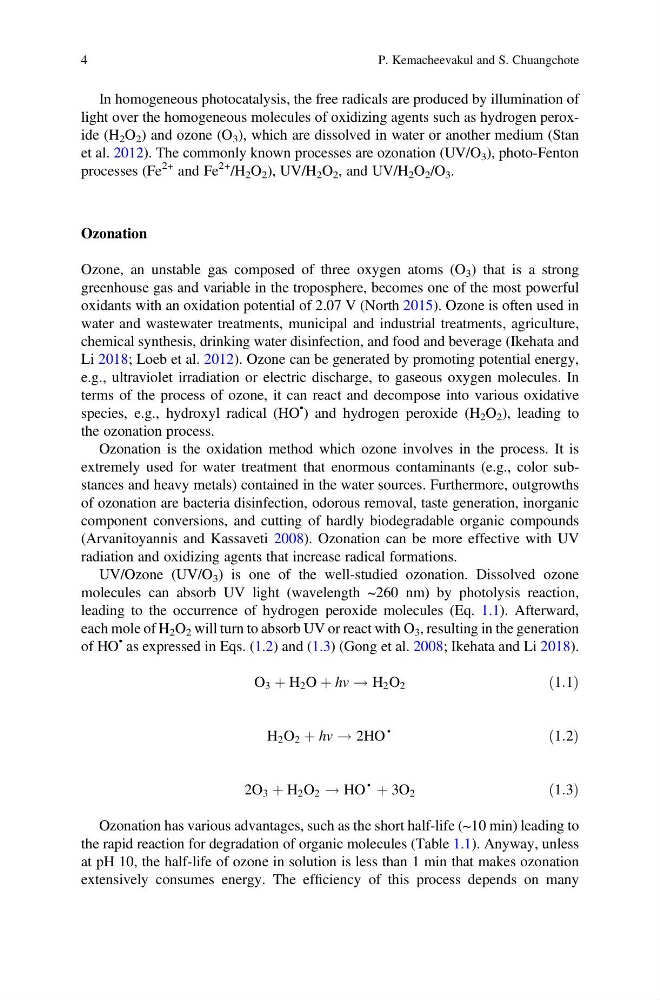
UV/Ozone (UV/O 3 ) is one of the well-studied ozonation. Dissolved ozone
molecules can absorb UV light (wavelength ~260 nm) by photolysis reaction,
leading to the occurrence of hydrogen peroxide molecules (Eq. 1.1). Afterward,
each mole of H 2 O 2 will turn to absorb UV or react with O 3 , resulting in the generation
of HO
• as expressed in Eqs. (1.2) and (1.3) (Gong et al. 2008; Ikehata and Li 2018).
O 3 þ H 2 O þ hv ! H 2 O 2
ð1:1Þ
H 2 O 2 þ hv ! 2HO
•
ð1:2Þ
2O 3 þ H 2 O 2 ! HO
•
þ 3O 2
ð1:3Þ
Ozonation has various advantages, such as the short half-life (~10 min) leading to
the rapid reaction for degradation of organic molecules (Table 1.1). Anyway, unless
at pH 10, the half-life of ozone in solution is less than 1 min that makes ozonation
extensively consumes energy. The efficiency of this process depends on many
4
P. Kemacheevakul and S. Chuangchote
light over the homogeneous molecules of oxidizing agents such as hydrogen peroxide (H 2 O 2 ) and ozone (O 3 ), which are dissolved in water or another medium (Stan
et al. 2012). The commonly known processes are ozonation (UV/O 3 ), photo-Fenton
processes (Fe
2+ and Fe
2+ /H 2 O 2 ), UV/H 2 O 2 , and UV/H 2 O 2 /O 3 .
Ozonation
Ozone, an unstable gas composed of three oxygen atoms (O 3 ) that is a strong
greenhouse gas and variable in the troposphere, becomes one of the most powerful
oxidants with an oxidation potential of 2.07 V (North 2015). Ozone is often used in
water and wastewater treatments, municipal and industrial treatments, agriculture,
chemical synthesis, drinking water disinfection, and food and beverage (Ikehata and
Li 2018; Loeb et al. 2012). Ozone can be generated by promoting potential energy,
e.g., ultraviolet irradiation or electric discharge, to gaseous oxygen molecules. In
terms of the process of ozone, it can react and decompose into various oxidative
species, e.g., hydroxyl radical (HO
•
) and hydrogen peroxide (H 2 O 2 ), leading to
the ozonation process.
Ozonation is the oxidation method which ozone involves in the process. It is
extremely used for water treatment that enormous contaminants (e.g., color substances and heavy metals) contained in the water sources. Furthermore, outgrowths
of ozonation are bacteria disinfection, odorous removal, taste generation, inorganic
component conversions, and cutting of hardly biodegradable organic compounds
(Arvanitoyannis and Kassaveti 2008). Ozonation can be more effective with UV
radiation and oxidizing agents that increase radical formations.
UV/Ozone (UV/O 3 ) is one of the well-studied ozonation. Dissolved ozone
molecules can absorb UV light (wavelength ~260 nm) by photolysis reaction,
leading to the occurrence of hydrogen peroxide molecules (Eq. 1.1). Afterward,
each mole of H 2 O 2 will turn to absorb UV or react with O 3 , resulting in the generation
of HO
• as expressed in Eqs. (1.2) and (1.3) (Gong et al. 2008; Ikehata and Li 2018).
O 3 þ H 2 O þ hv ! H 2 O 2
ð1:1Þ
H 2 O 2 þ hv ! 2HO
•
ð1:2Þ
2O 3 þ H 2 O 2 ! HO
•
þ 3O 2
ð1:3Þ
Ozonation has various advantages, such as the short half-life (~10 min) leading to
the rapid reaction for degradation of organic molecules (Table 1.1). Anyway, unless
at pH 10, the half-life of ozone in solution is less than 1 min that makes ozonation
extensively consumes energy. The efficiency of this process depends on many
4
P. Kemacheevakul and S. Chuangchote