

internal bubble temperature and pressure of ~5000 K and ~1000 atm, respectively
(Merouani et al. 2014d).
Under these circumstances, water vapor molecules are decomposed into H
● and
HO
● radicals, and with O 2 and N 2 presence, various other reactive and non-reactive
entities may form (Merouani et al. 2014c). Radicals can recombine, react with the
gaseous species, or diffuse out of the bubble to serve as aqueous oxidants (Adewuyi
2001). In parallel, volatile compounds, which evaporate into the bubble, can be
decomposed under the high bubble temperature (Pétrier and Francony 1997;
Adewuyi 2001).
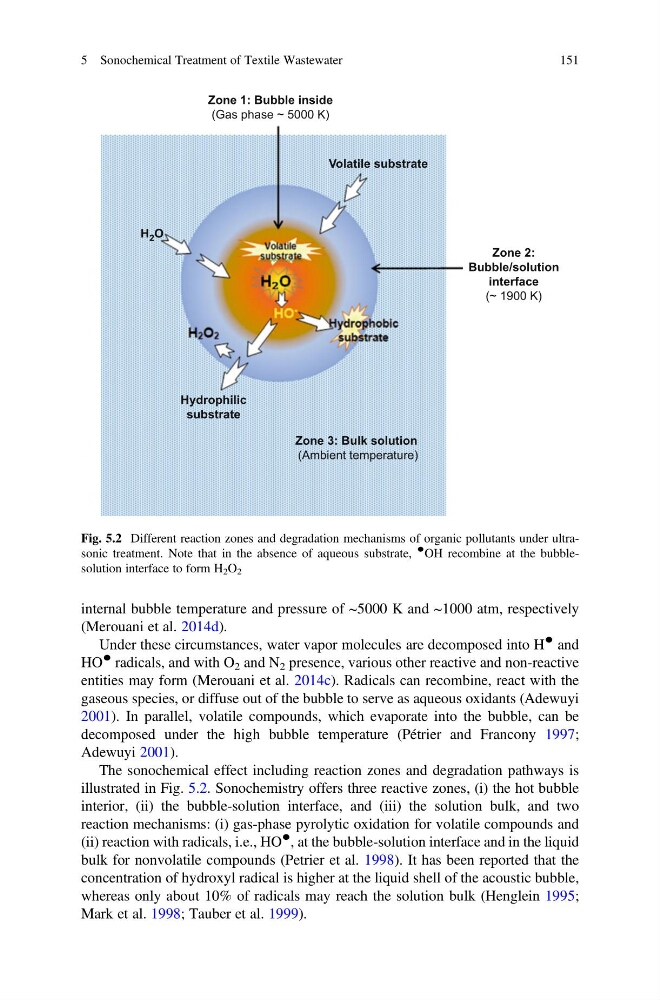
The sonochemical effect including reaction zones and degradation pathways is
illustrated in Fig. 5.2. Sonochemistry offers three reactive zones, (i) the hot bubble
interior, (ii) the bubble-solution interface, and (iii) the solution bulk, and two
reaction mechanisms: (i) gas-phase pyrolytic oxidation for volatile compounds and
(ii) reaction with radicals, i.e., HO
●
, at the bubble-solution interface and in the liquid
bulk for nonvolatile compounds (Petrier et al. 1998). It has been reported that the
concentration of hydroxyl radical is higher at the liquid shell of the acoustic bubble,
whereas only about 10% of radicals may reach the solution bulk (Henglein 1995;
Mark et al. 1998; Tauber et al. 1999).
Zone 2:
Bubble/solution
interface
(~ 1900 K)
Zone 1: Bubble inside
(Gas phase ~ 5000 K)
Volatile substrate
H 2 O
Hydrophilic
substrate
Zone 3: Bulk solution
(Ambient temperature)
Fig. 5.2 Different reaction zones and degradation mechanisms of organic pollutants under ultrasonic treatment. Note that in the absence of aqueous substrate,
● OH recombine at the bubblesolution interface to form H 2 O 2
5 Sonochemical Treatment of Textile Wastewater
151
(Merouani et al. 2014d).
Under these circumstances, water vapor molecules are decomposed into H
● and
HO
● radicals, and with O 2 and N 2 presence, various other reactive and non-reactive
entities may form (Merouani et al. 2014c). Radicals can recombine, react with the
gaseous species, or diffuse out of the bubble to serve as aqueous oxidants (Adewuyi
2001). In parallel, volatile compounds, which evaporate into the bubble, can be
decomposed under the high bubble temperature (Pétrier and Francony 1997;
Adewuyi 2001).
The sonochemical effect including reaction zones and degradation pathways is
illustrated in Fig. 5.2. Sonochemistry offers three reactive zones, (i) the hot bubble
interior, (ii) the bubble-solution interface, and (iii) the solution bulk, and two
reaction mechanisms: (i) gas-phase pyrolytic oxidation for volatile compounds and
(ii) reaction with radicals, i.e., HO
●
, at the bubble-solution interface and in the liquid
bulk for nonvolatile compounds (Petrier et al. 1998). It has been reported that the
concentration of hydroxyl radical is higher at the liquid shell of the acoustic bubble,
whereas only about 10% of radicals may reach the solution bulk (Henglein 1995;
Mark et al. 1998; Tauber et al. 1999).
Zone 2:
Bubble/solution
interface
(~ 1900 K)
Zone 1: Bubble inside
(Gas phase ~ 5000 K)
Volatile substrate
H 2 O
Hydrophilic
substrate
Zone 3: Bulk solution
(Ambient temperature)
Fig. 5.2 Different reaction zones and degradation mechanisms of organic pollutants under ultrasonic treatment. Note that in the absence of aqueous substrate,
● OH recombine at the bubblesolution interface to form H 2 O 2
5 Sonochemical Treatment of Textile Wastewater
151