

pure ZnO and layered platelet-like thinner sheets having smooth morphology of
g-C 3 N 4 analogous to arrangement of graphene sheets (Bian et al. 2013). The
transmission electron microscopy monographs of ZnO/Fe 3 O 4 /g-C 3 N 4 –50% clearly
depict that ZnO and Fe 3 O 4 nanoparticles were dispersed on graphitic carbon nitride
nanosheets, as peak value of Fe is comparatively less which indicates the amount of
ferrites is low in ZnO/Fe 3 O 4 /g-C 3 N 4 nanocomposites.
Balu et al. (2019) synthesized α-Fe 2 O 3 -enriched g-C 3 N 4 /ZnO ternary Z-scheme
nanocomposites for the acid yellow 23 photodegradation in water. The procedure
involves pyrolysis followed by sol–gel synthesis of ternary photocatalyst and for
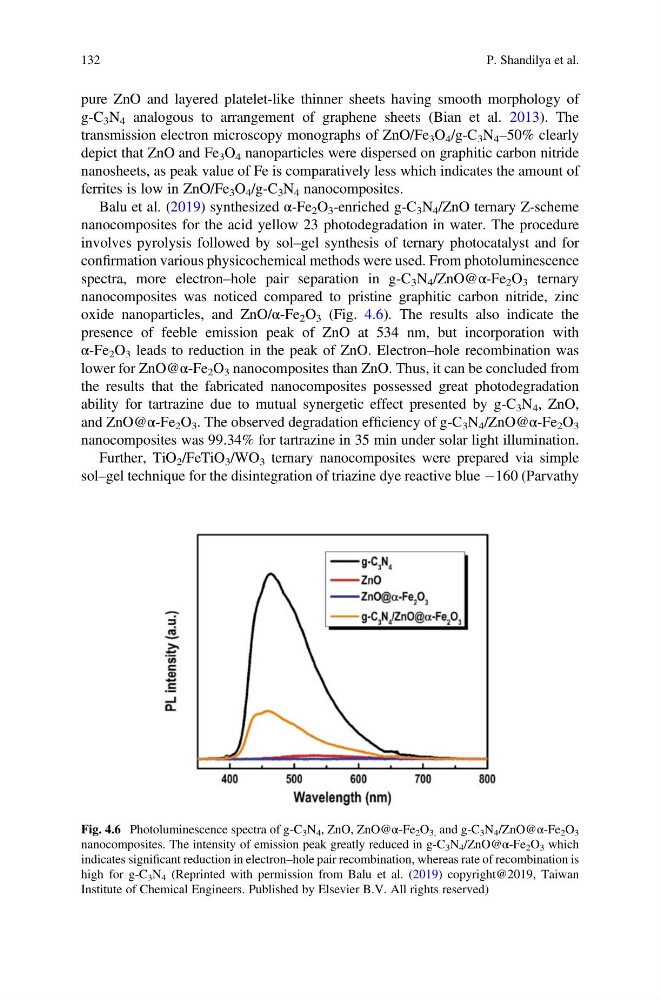
confirmation various physicochemical methods were used. From photoluminescence
spectra, more electron–hole pair separation in g-C 3 N 4 /ZnO@α-Fe 2 O 3 ternary
nanocomposites was noticed compared to pristine graphitic carbon nitride, zinc
oxide nanoparticles, and ZnO/α-Fe 2 O 3 (Fig. 4.6). The results also indicate the
presence of feeble emission peak of ZnO at 534 nm, but incorporation with
α-Fe 2 O 3 leads to reduction in the peak of ZnO. Electron–hole recombination was
lower for ZnO@α-Fe 2 O 3 nanocomposites than ZnO. Thus, it can be concluded from
the results that the fabricated nanocomposites possessed great photodegradation
ability for tartrazine due to mutual synergetic effect presented by g-C 3 N 4 , ZnO,
and ZnO@α-Fe 2 O 3 . The observed degradation efficiency of g-C 3 N 4 /ZnO@α-Fe 2 O 3
nanocomposites was 99.34% for tartrazine in 35 min under solar light illumination.
Further, TiO 2 /FeTiO 3 /WO 3 ternary nanocomposites were prepared via simple
sol–gel technique for the disintegration of triazine dye reactive blue À160 (Parvathy
Fig. 4.6 Photoluminescence spectra of g-C 3 N 4 , ZnO, ZnO@α-Fe 2 O 3, and g-C 3 N 4 /ZnO@α-Fe 2 O 3
nanocomposites. The intensity of emission peak greatly reduced in g-C 3 N 4 /ZnO@α-Fe 2 O 3 which
indicates significant reduction in electron–hole pair recombination, whereas rate of recombination is
high for g-C 3 N 4 (Reprinted with permission from Balu et al. (2019) copyright@2019, Taiwan
Institute of Chemical Engineers. Published by Elsevier B.V. All rights reserved)
132
P. Shandilya et al.
g-C 3 N 4 analogous to arrangement of graphene sheets (Bian et al. 2013). The
transmission electron microscopy monographs of ZnO/Fe 3 O 4 /g-C 3 N 4 –50% clearly
depict that ZnO and Fe 3 O 4 nanoparticles were dispersed on graphitic carbon nitride
nanosheets, as peak value of Fe is comparatively less which indicates the amount of
ferrites is low in ZnO/Fe 3 O 4 /g-C 3 N 4 nanocomposites.
Balu et al. (2019) synthesized α-Fe 2 O 3 -enriched g-C 3 N 4 /ZnO ternary Z-scheme
nanocomposites for the acid yellow 23 photodegradation in water. The procedure
involves pyrolysis followed by sol–gel synthesis of ternary photocatalyst and for
confirmation various physicochemical methods were used. From photoluminescence
spectra, more electron–hole pair separation in g-C 3 N 4 /ZnO@α-Fe 2 O 3 ternary
nanocomposites was noticed compared to pristine graphitic carbon nitride, zinc
oxide nanoparticles, and ZnO/α-Fe 2 O 3 (Fig. 4.6). The results also indicate the
presence of feeble emission peak of ZnO at 534 nm, but incorporation with
α-Fe 2 O 3 leads to reduction in the peak of ZnO. Electron–hole recombination was
lower for ZnO@α-Fe 2 O 3 nanocomposites than ZnO. Thus, it can be concluded from
the results that the fabricated nanocomposites possessed great photodegradation
ability for tartrazine due to mutual synergetic effect presented by g-C 3 N 4 , ZnO,
and ZnO@α-Fe 2 O 3 . The observed degradation efficiency of g-C 3 N 4 /ZnO@α-Fe 2 O 3
nanocomposites was 99.34% for tartrazine in 35 min under solar light illumination.
Further, TiO 2 /FeTiO 3 /WO 3 ternary nanocomposites were prepared via simple
sol–gel technique for the disintegration of triazine dye reactive blue À160 (Parvathy
Fig. 4.6 Photoluminescence spectra of g-C 3 N 4 , ZnO, ZnO@α-Fe 2 O 3, and g-C 3 N 4 /ZnO@α-Fe 2 O 3
nanocomposites. The intensity of emission peak greatly reduced in g-C 3 N 4 /ZnO@α-Fe 2 O 3 which
indicates significant reduction in electron–hole pair recombination, whereas rate of recombination is
high for g-C 3 N 4 (Reprinted with permission from Balu et al. (2019) copyright@2019, Taiwan
Institute of Chemical Engineers. Published by Elsevier B.V. All rights reserved)
132
P. Shandilya et al.