

on the respective bands to generate reactive oxidation species, and
(iv) recombination of electron–hole pair. Further, these generate reactive oxidation
species assist in mineralization of pollutant.
Z-scheme photocatalyst is more advantageous as compared to simple binary
metal oxide photocatalyst as it can efficiently harvest the solar light, separate the
electron–hole pair, and conserve the reductive and oxidative ability of charge carrier
(Xu et al. 2018). In Z-scheme hetrojunction, electrons migrates from higher conduction band to the lower conduction band of another semiconductor. However,
holes follow the reverse movement, and thus, electrons accumulate on one semiconductor for reduction, and holes accumulate on other for oxidation reaction to be
carried out. Another photodegradation mechanism involves transfer of electrons
from conduction band of semiconductor via metal as mediator toward the valence
band of another semiconductor as shown in Fig. 4.3.
4.2 Binary Photocatalyst for Azo Dye Degradation
The photocatalysis catalyzed by metal oxide is extensively explored at laboratory
scale. Some of the metal oxide photocatalyst explored till date are TiO 2 , V 2 O 5 ,
MoO 3 , MnO 2 , Mn 3 O 4 , Fe 3 O 4 , RuO 2 , Co 3 O 4 , Nb 2 O 5 , ZrO 2 , Co 3 O 4 , CuO, CdS, SiO 2 ,
and IrO 2 . Konstantinou and Albanis (2004) discussed effective degradation of azo
dyes having different chemical groups via TiO 2 suspensions under ultraviolet visible
or solar light. The kinetics of photocatalytic oxidation were explored, and
Langmuir–Hinshelwood model has been followed for kinetics study (Konstantinou
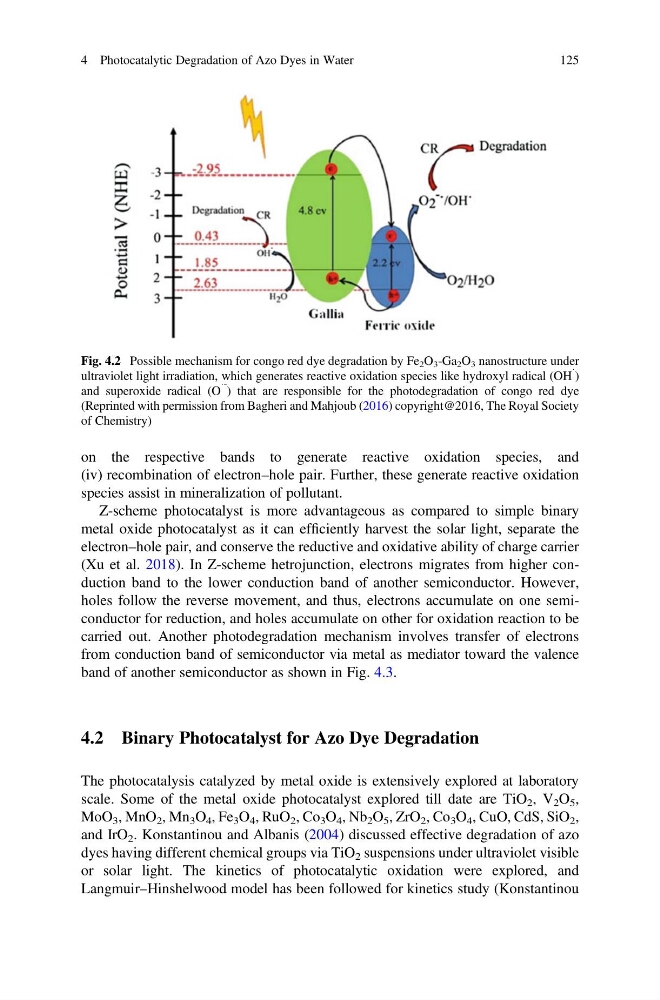
Fig. 4.2 Possible mechanism for congo red dye degradation by Fe 2 O 3 -Ga 2 O 3 nanostructure under
ultraviolet light irradiation, which generates reactive oxidation species like hydroxyl radical (OH
˙
)
and superoxide radical (O
˙¯
) that are responsible for the photodegradation of congo red dye
(Reprinted with permission from Bagheri and Mahjoub (2016) copyright@2016, The Royal Society
of Chemistry)
4 Photocatalytic Degradation of Azo Dyes in Water
125
(iv) recombination of electron–hole pair. Further, these generate reactive oxidation
species assist in mineralization of pollutant.
Z-scheme photocatalyst is more advantageous as compared to simple binary
metal oxide photocatalyst as it can efficiently harvest the solar light, separate the
electron–hole pair, and conserve the reductive and oxidative ability of charge carrier
(Xu et al. 2018). In Z-scheme hetrojunction, electrons migrates from higher conduction band to the lower conduction band of another semiconductor. However,
holes follow the reverse movement, and thus, electrons accumulate on one semiconductor for reduction, and holes accumulate on other for oxidation reaction to be
carried out. Another photodegradation mechanism involves transfer of electrons
from conduction band of semiconductor via metal as mediator toward the valence
band of another semiconductor as shown in Fig. 4.3.
4.2 Binary Photocatalyst for Azo Dye Degradation
The photocatalysis catalyzed by metal oxide is extensively explored at laboratory
scale. Some of the metal oxide photocatalyst explored till date are TiO 2 , V 2 O 5 ,
MoO 3 , MnO 2 , Mn 3 O 4 , Fe 3 O 4 , RuO 2 , Co 3 O 4 , Nb 2 O 5 , ZrO 2 , Co 3 O 4 , CuO, CdS, SiO 2 ,
and IrO 2 . Konstantinou and Albanis (2004) discussed effective degradation of azo
dyes having different chemical groups via TiO 2 suspensions under ultraviolet visible
or solar light. The kinetics of photocatalytic oxidation were explored, and
Langmuir–Hinshelwood model has been followed for kinetics study (Konstantinou
Fig. 4.2 Possible mechanism for congo red dye degradation by Fe 2 O 3 -Ga 2 O 3 nanostructure under
ultraviolet light irradiation, which generates reactive oxidation species like hydroxyl radical (OH
˙
)
and superoxide radical (O
˙¯
) that are responsible for the photodegradation of congo red dye
(Reprinted with permission from Bagheri and Mahjoub (2016) copyright@2016, The Royal Society
of Chemistry)
4 Photocatalytic Degradation of Azo Dyes in Water
125